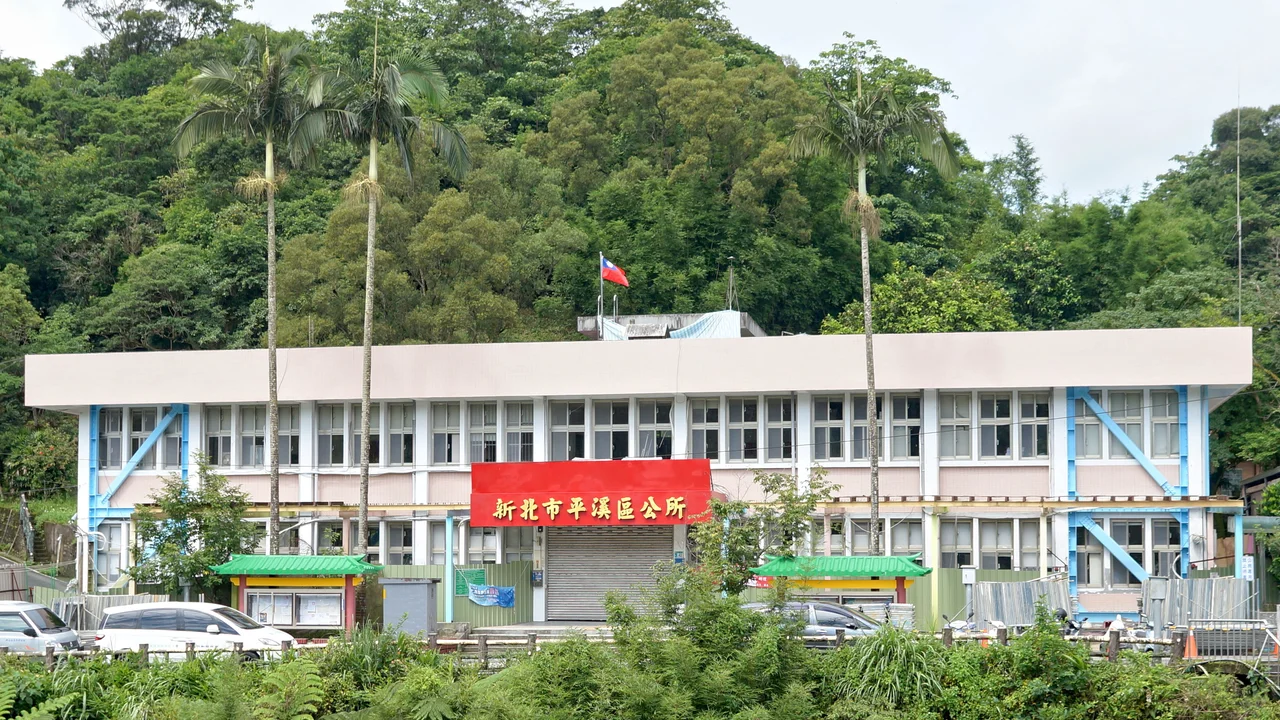

Pingxi District
The wishes go up every year in January and they do not come down for a long time. During the Lantern Festival — held on the fifteenth day of the Lunar New Year, in late January or February — thousands of sky lanterns rise from Pingxi District: paper cylinders swelling with warm air, carrying handwritten hopes above the valley of the upper Keelung River. The sky fills with moving light. It is the most vivid thing the district does, and also the most recent chapter in a much longer story. Pingxi was not built on wishes. It was built on coal.
The Work That Made the Valley
In the early twentieth century, Pingxi District was one of the coal-bearing territories that powered Taiwan's development under Japanese colonial administration. The mountains here, folded and river-cut, held seams of coal that miners followed deep into the hillsides. The Keelung River has its source in Jingtong, the southernmost town on the Pingxi Line — a fact that situates the district at the headwaters of one of northern Taiwan's defining waterways, and also explains why coal extraction here was possible at all: the river provided a corridor for both railway and road access into terrain that would otherwise have been impenetrable. The men who went underground in Jingtong, Shifen, and the smaller mining settlements were doing hard, dangerous work at the edge of a mountain world. Their labor funded the infrastructure — the railway, the old streets — that tourists now come to see.
Remembering the Miners
Pingxi does not let the coal era slip away quietly. The Jingtong Coal Memorial Park and the Jingtong Mining Industry Museum preserve the material history of that period: the equipment, the records, the photographs of men at the pit head. The Taiwan Coal Mine Museum extends that archive further, placing local mining within the broader context of Taiwan's industrial history. Jingtong Old Street, running through the mining settlement at the end of the Pingxi Line, retains the architecture of the early twentieth century — wooden shophouses built for a community that expected its main business to be extracting coal, not receiving tourists. Walking the old streets today, with the museums nearby, is a way of holding both realities at once: the district as it is now, and the district as it was when the work was underground and constant.
Light Rising
The sky lantern tradition in Pingxi has become the district's most internationally recognized feature, drawing visitors from across Taiwan and abroad to the Pingxi International Sky Lantern Festival each Lantern Festival season. The practice involves writing wishes or messages on large paper lanterns, then releasing them from the valley floor to rise above the mountains. The sight — hundreds or thousands of small fires ascending against the dark sky above the river valley — is genuinely striking. Whether the tradition has deep local roots or was adapted and amplified in more recent decades as tourism grew, the wish-writing gives each lantern a personal dimension. The light is not anonymous: someone's words are burning up there, rising above the ridge that once concealed coal seams.
The Valley's Waters
The district's geography anchors its character. Pingxi sits in a valley carved by the upper Keelung River and its tributaries — steep-sided, forested, punctuated by waterfalls that drop from the surrounding ridges. Shifen Waterfall, the widest waterfall in Taiwan, lies within the district, a cascade that spreads across layered rock in a broad curtain. Lingjiao Waterfall offers a different character: narrower, higher, more dramatic in its verticality. These waterfalls are remnants of the same geological energy that folded the mountains here, and they draw hikers and day-trippers along trails that connect the valley towns. With a population of only 4,253 as of February 2023 — the smallest of any New Taipei district — Pingxi is intimate country, where the natural features are never far from the few streets.
Small District, Long Memory
New Taipei City encompasses 29 districts ranging from dense urban centers to remote mountain communities. Pingxi is among the most remote and the least populated. The railway is the lifeline — without the Pingxi Line winding up from Ruifang, the valley communities would be far more isolated than they are. The district's smallness is not a deficit but a character: it enforces a pace that larger places cannot manage, a connection between residents and landscape that density disrupts. The coal is gone, the mines are museums, and the lanterns rise where the pit headframes once stood. What persists is the valley itself, and the Keelung River beginning its long journey to the sea from a source in Jingtong that has been flowing since long before the first miner arrived.
From the Air
Pingxi District lies at approximately 25.026°N, 121.739°E in the mountain interior of northeast Taiwan, roughly 30 kilometers east of Taipei. Flying east from Taipei Songshan Airport (RCSS) at 3,000–4,000 feet, the Keelung River valley is the main corridor into the district — the forested ridges close in on both sides as the valley narrows toward Pingxi and Jingtong. At lower altitudes, the Pingxi Line railway can be traced as it winds along the valley floor. The Shifen waterfall area may be visible as a white cascade on the valley wall. Nearest major airport: Taipei Songshan (RCSS), approximately 30 kilometers west-northwest.
Nearby Stories
- Taoyuan Air Base 4.7 km away
- Min Ping Yu No. 5540 Incident 6.9 km away
- Neiwan 14 km away
- North Jiangsu Main Irrigation Canal 982 km away
- Sinking of MV Sewol 1049 km away
- General Cliff Rock Paintings 1058 km away
- Yellow Sea 1108 km away
- Sibuyan Island 1376 km away