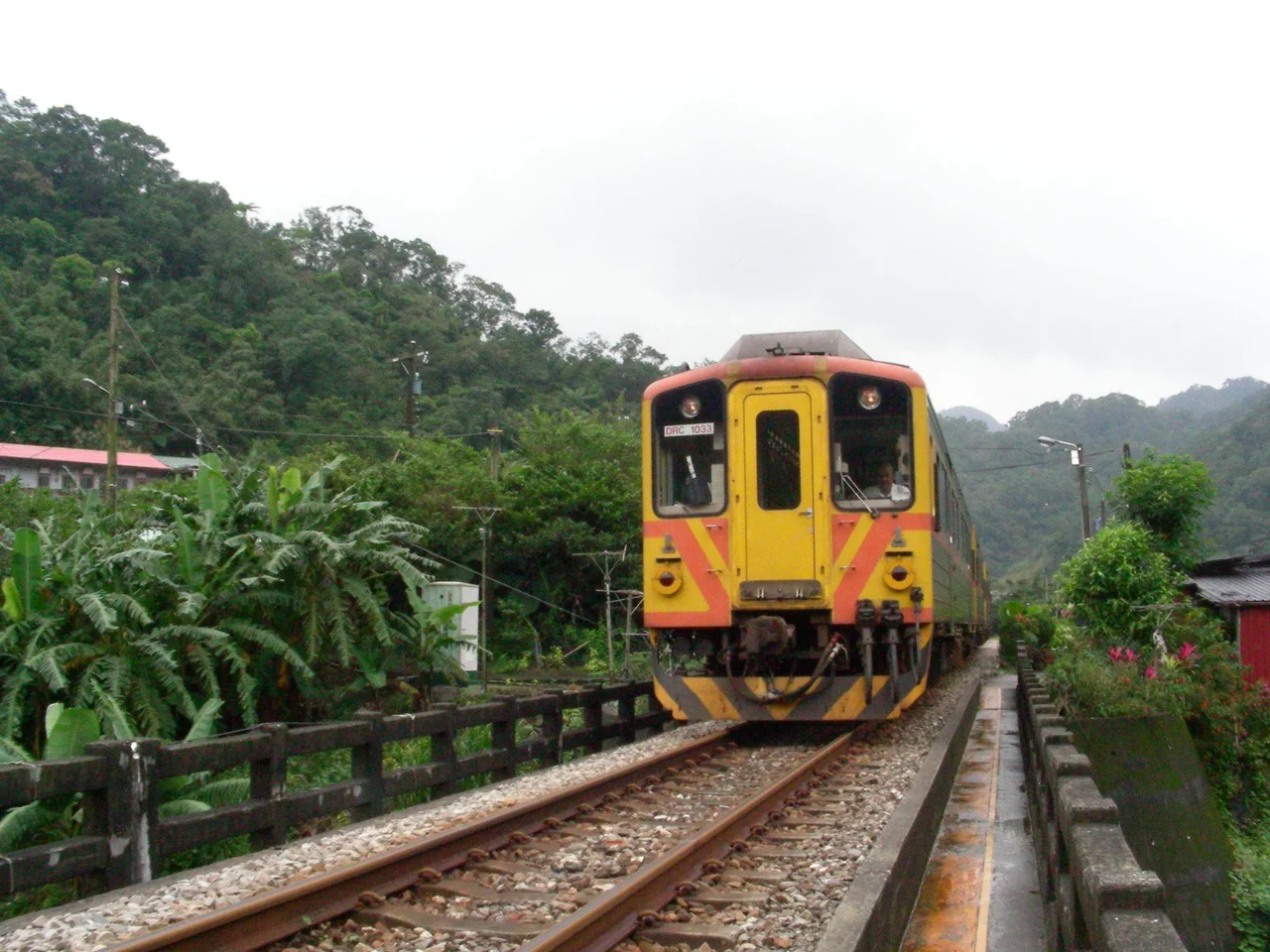

Pingxi Line
The token system still operates. At Sandiaoling, a Taiwan Railways employee physically hands a token — a solid staff of metal — to the train crew before the locomotive is permitted to proceed toward Shifen. It is a nineteenth-century safety method, a physical guarantee that only one train occupies a single-track section at a time. On the Pingxi Line, which was completed in July 1921 during Japanese rule, some things have not needed replacing. The track is narrow gauge. The branch is 12.9 kilometers long. The valley it follows is the same valley. Only the purpose has shifted: the coal is gone, and the passengers now come for scenery.
Rails Built for Black Rock
The railroad was originally constructed to move coal. In the early 1920s, the mountains north of the Yilan plain held producing seams, and the valley of the upper Keelung River was the corridor that made extraction viable. The line was completed in July 1921, threading from Sandiaoling — where it branches from the main Yilan Line — up through the narrowing valley past Shifen, Lingjiao, Pingxi, and Jingtong. The gauge is 1,067 mm (three feet six inches), the same narrow gauge used across Taiwan's rail network, inherited from the Japanese-era engineering that built the island's railways. For decades, the primary freight was coal hauled down from the mining settlements to connect with the broader system at Sandiaoling or Ruifang. When the coal industry declined, the line survived — barely — and eventually found a different economy: tourism.
Twelve-Point-Nine Kilometers of Scenery
The line runs 12.9 kilometers through terrain that would be difficult to traverse any other way. From Sandiaoling, trains climb the valley past forested ridges and creek crossings — including the steel bridge over Sankeng Creek that photographers favor — before reaching the cluster of stations at Shifen, where the valley broadens slightly around the old mining town. The Pingxi Line is a single-track branch, which means trains in both directions must be carefully sequenced. The token method at Sandiaoling is a visible reminder of that constraint. Traveling the full length from Sandiaoling to Jingtong takes around twenty to twenty-five minutes; experienced visitors ride it multiple times in a day, disembarking at different stations to explore on foot before catching the next train.
Stations Along the Valley
Six stations anchor the communities the railway serves: Dahua, Shifen, Wanggu, Lingjiao, Pingxi, and Jingtong. Shifen is the most visited, partly because of its Old Street — where the railway track runs directly down the main shopping lane, close enough that vendors and pedestrians step aside for trains — and partly for its proximity to Shifen Waterfall, a short walk from the station. Jingtong, at the end of the line, is quieter, smaller, its old main street lined with wooden buildings from the mining era. The intermediate stations — Dahua, Wanggu, Lingjiao — see fewer visitors and offer something the more popular stops do not: a sense of the line as a working piece of local geography rather than a tourist circuit.
The Coal That Shaped the Trains
Understanding the Pingxi Line requires understanding what coal mining did to these communities. The railway did not discover the valley; it opened it. Before the branch line, the mining settlements were accessible only by foot or river path. Once the track was laid, the pace of extraction accelerated, and the communities built around that acceleration — the old streets, the mining infrastructure, the temples and opera stages that miners and their families supported with wages earned underground. The labor was relentless and the conditions were hard. What remains are the old streets, the museums at Jingtong, and the railway that was built to serve the miners and now carries their descendants and visitors through the same narrow valley.
A Branch Line That Persisted
Branch lines across Asia that lost their industrial purpose often disappeared. The Pingxi Line survived its coal era and became something unusual: a scenic railway branch that attracts tourists without having been artificially preserved as a heritage line. It is simply still there, still running, still using the token system at Sandiaoling. All trains have through service to the Yilan Line, connecting the mountain valley to Ruifang and beyond. Most services terminate at Houtong or Ruifang, with some extending to Badu on the main line. Day-trippers from Taipei typically board at Taipei Main Station, ride the Yilan Line to Ruifang, then transfer to the branch — a journey of under an hour that deposits them in a valley that moves at a completely different pace than the city they left.
From the Air
The Pingxi Line runs at approximately 25.049°N, 121.787°E, threading through the mountain valley of the upper Keelung River in northeast Taiwan. Flying east from Taipei Songshan Airport (RCSS) at 2,500–3,500 feet, the valley corridor opens between forested ridges — the railway line can be traced along the valley floor where it follows the river from Sandiaoling toward Jingtong. At lower altitudes, steel bridges over creek crossings and the small station buildings at Shifen and Jingtong may be visible. The coastal mountain ridges rise steeply on either side of the valley. Nearest major airport: Taipei Songshan (RCSS), approximately 28 kilometers to the west-northwest.
Nearby Stories
- Taoyuan Air Base 4.7 km away
- Min Ping Yu No. 5540 Incident 6.9 km away
- Neiwan 14 km away
- North Jiangsu Main Irrigation Canal 982 km away
- Sinking of MV Sewol 1049 km away
- General Cliff Rock Paintings 1058 km away
- Yellow Sea 1108 km away
- Sibuyan Island 1376 km away