
Piribebuy
The name itself sounds like the place. Piribebuy — in Guaraní, pirĩ vevuĩ — means something close to "shivers" or "a smooth sensation," the feeling of cool air moving over skin. People say the town earned it from the streams and breezes that cut through these hills of the Cordillera. It is a gentle name. It belongs to a town that was, for five hours on a August morning in 1869, the site of one of the cruelest scenes in South American history.
A Capital of Last Resort
By late 1868, Paraguay was losing. The War of the Triple Alliance had pitted the small nation against Argentina, Brazil, and Uruguay all at once since 1865, and the conflict was grinding the country toward catastrophe. With the capital threatened, the government retreated inland and declared Piribebuy the third provisional capital from December 8, 1868. For eight months this quiet town in the hills held the offices of a nation in collapse — its archives, its leadership, what remained of its hope. The town had begun centuries earlier as little more than a mail-post and a place to rest horses on the road through the cordillera; now it carried a country on its back. Its own founding documents were stored here, which is part of why Piribebuy today marks a symbolic establishment date rather than a real one. The records did not survive what came next.
The Twelfth of August
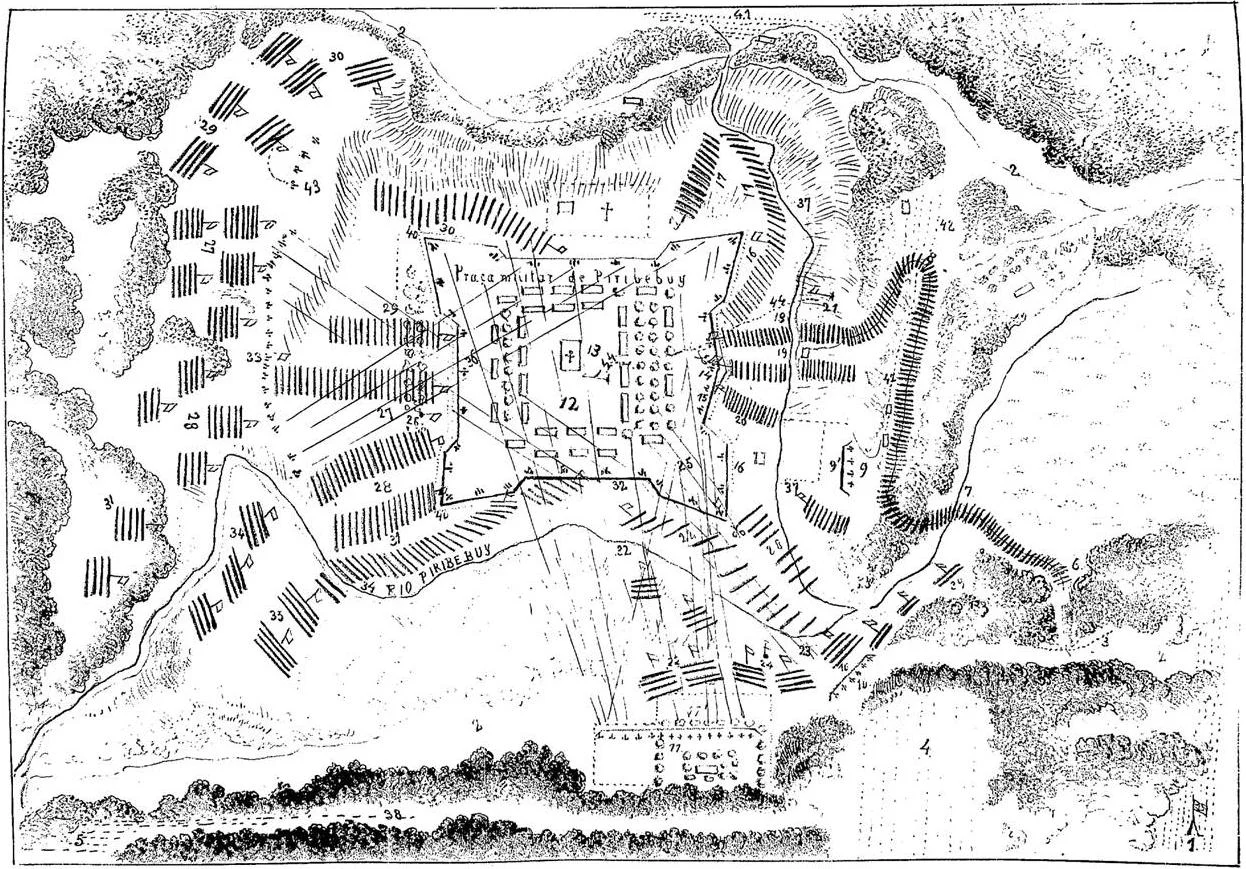
On the morning of August 12, 1869, the allied army arrived under the command of the Count of Eu, son-in-law of Brazil's emperor. The defenders numbered about 1,600. They were not a professional army. They were old men, women, and children — many of them quite literally children — armed with whatever could be found. Facing them stood a force of some 20,000. The bombardment opened at dawn; the infantry charged a few hours later. For roughly five hours the people of Piribebuy held. There was never any real chance. But they held, and the length of that resistance, against those numbers, is why the town is remembered as a martyr capital rather than a footnote.
What Happened to the Wounded
The battle's darkest moment was not the fighting but what followed it. The town's military hospital — the Hospital de Sangre, the "blood hospital" — was set ablaze with the wounded still inside. They burned alive. Among the captured, many were executed, some by decapitation. These were not abstractions or statistics; they were the injured sons and the surrendered defenders of a town that had simply been in the army's path. Paraguay would lose a staggering share of its entire population by the war's end in 1870. The fire at Piribebuy is remembered as one of the moments when that loss stopped being a matter of numbers and became a matter of cruelty.
The Town That Remained
Piribebuy did not vanish. It rebuilt, kept its colonial church of Ñandejará Guasu — the Holy Christ of the Miracles, raised by the Franciscan Gaspar de Medina back in 1744 — and went on living among its streams and breezes. A small history museum now guards relics of the Triple Alliance war and the later Chaco War, holding the memory in a single quiet room. The town is known too for a craft passed down through generations: the Poncho Para'í, the "poncho of 60 stripes," woven with a delicacy that takes years to learn and is taught from one weaver to the next. Today people come for the surrounding nature, the deep history, and that famous weaving, and the district has grown to nearly twenty thousand people across its many small compañías. Visitors leave understanding something true of the whole place: the gentlest name can sit atop the heaviest memory, and a town can hold both at once.
From the Air
Piribebuy lies at 25.48°S, 57.05°W in the Cordillera Department, set among forested hills about 75 km east-southeast of Asunción. The colonial church and the surrounding compact town center sit in a green valley laced with streams — the best visual reference from the air. Recommended viewing altitude is 3,000–5,000 feet AGL. The nearest major airport is Silvio Pettirossi International, Asunción (ICAO: SGAS), roughly 40 nautical miles to the west. Winter (June–August) offers the clearest visibility; summer afternoons turn hazy with convective activity over the cordillera.
Nearby Stories
- Pilcomayo River 5.2 km away
- New Australia 5.2 km away
- Villarrica, Paraguay 19 km away
- La Colmena, Paraguay 38 km away
- Villa Hayes 41 km away
- Río Pilcomayo National Park 49 km away
- Pilar, Paraguay 148 km away
- Laguna Blanca (Paraguay) 150 km away