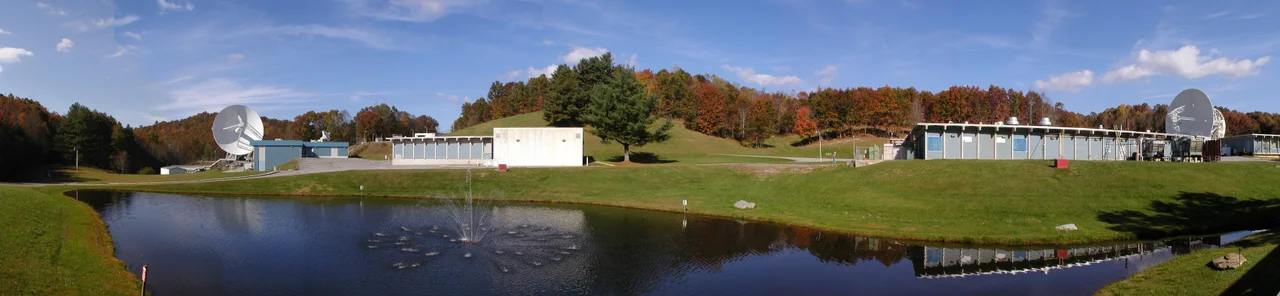

Pisgah Astronomical Research Institute
The two 26-meter dishes still point at the sky, but they listen for different things now. When NASA built this site in 1962, the antennas tracked Project Gemini and Project Apollo spacecraft, bouncing voices between Houston and astronauts in lunar orbit. When the National Security Agency took over in 1981, the same dishes pulled secrets out of geostationary communications satellites - and Transylvania County, North Carolina, was quietly placed off-limits to Soviet visitors. Today the Pisgah Astronomical Research Institute, PARI to anyone who knows it, listens to pulsars and quasars and runs one of the darkest skies certified on the East Coast.
Spacemen
The Rosman Satellite Tracking Station opened in 1962, a Cold War rush job tucked into a hollow of the Pisgah National Forest where surrounding ridges blocked terrestrial radio interference. It joined NASA's Spacecraft Tracking and Data Acquisition Network and became a critical link for the crewed space programs. When Apollo astronauts called home, Rosman was often the station that caught the signal first. Under NASA the gates stayed open. School buses pulled up. Local newspapers covered the antennas as a point of regional pride. Rosman was the friendly face of the Space Race, planted improbably in the Blue Ridge.
Spies
Then the gates closed. In 1981 the National Security Agency took control and renamed the place Rosman Research Station. The agency's mission - intercepting communications relayed by geostationary satellites - made the public tours stop overnight. Local lore says the radio telescope nicknamed Smiley got its painted-on grin around 1982, a cheeky greeting to whichever Soviet reconnaissance satellite happened to be overhead. By 1983 the entire county was off-limits to Soviet visitors, and locals had to guess why. The Transylvania Times asked whether the valley was "in harmony with nature or ground zero for Western North Carolina." The NSA wasn't saying.
Stargazers
When the Cold War ended, so did the NSA's interest in this particular hollow. The government proposed dismantling the dishes. Instead, a small group of scientists and businessmen formed a nonprofit, bought the site in January 1999, and started pointing the antennas at the stars. Today PARI runs research programs with Furman, Clemson, Virginia Tech, South Carolina State, and Duke. The Astronomical Photographic Data Archive, the second-largest plate repository in the world, holds more than 460,000 glass plates from 83 observatories - a salvaged century of sky, digitized for citizen scientists to classify online.
Dark Skies
DarkSky International certified PARI as a Dark Sky Park in 2020, one of only two in North Carolina. The certification matters because the eastern United States has almost none of them - light pollution from Atlanta, Charlotte, and the Eastern Seaboard washes out the Milky Way for tens of millions of people. Here in the Pisgah hollow, surrounded by national forest on every side, the sky still goes properly black. The exhibit galleries display Redstone rocket engines, Apollo-era artifacts, and meteorites from Mars and the Moon - including specimens recovered after a Christmas Eve 2012 burglary saw nearly the entire collection stolen and then quietly returned within a week.
The Untold History
In 2023 a retired CIA senior executive named Craig Gralley published Pisgah Astronomical Research Institute: An Untold History of Spacemen and Spies, finally putting the NASA-to-NSA-to-science arc into print. PARI is open by appointment, and visitors who make the drive find something rare: a place where the same hardware that once carried astronaut voices and Soviet signals now patiently records the radio whispers of objects billions of light-years away. The dishes are old. The mission keeps changing. The sky overhead, mercifully, has not.
From the Air
PARI sits at 35.1996N, 82.8724W, elevation roughly 2,900 feet, deep inside Pisgah National Forest near Balsam Grove. The two 26-meter dish silhouettes are visible from cruising altitude on clear days. Nearest controlled airports: Asheville Regional (KAVL) 28 nm northeast, Greenville-Spartanburg (KGSP) 35 nm southeast. Mountain weather changes quickly; expect orographic cloud over Pisgah Ridge in summer afternoons.
Nearby Stories
- Pickens County, South Carolina 12 km away
- Great Smoky Mountains National Park 15 km away
- Arrowhead Monument 16 km away
- Wilma Dykeman RiverWay Plan 20 km away
- Camp Wadsworth 26 km away
- Green River (North Carolina) 27 km away
- Great Smoky Mountains: The Park That Gets More Visitors Than Anywhere 45 km away
- Dahlonega, Georgia 79 km away