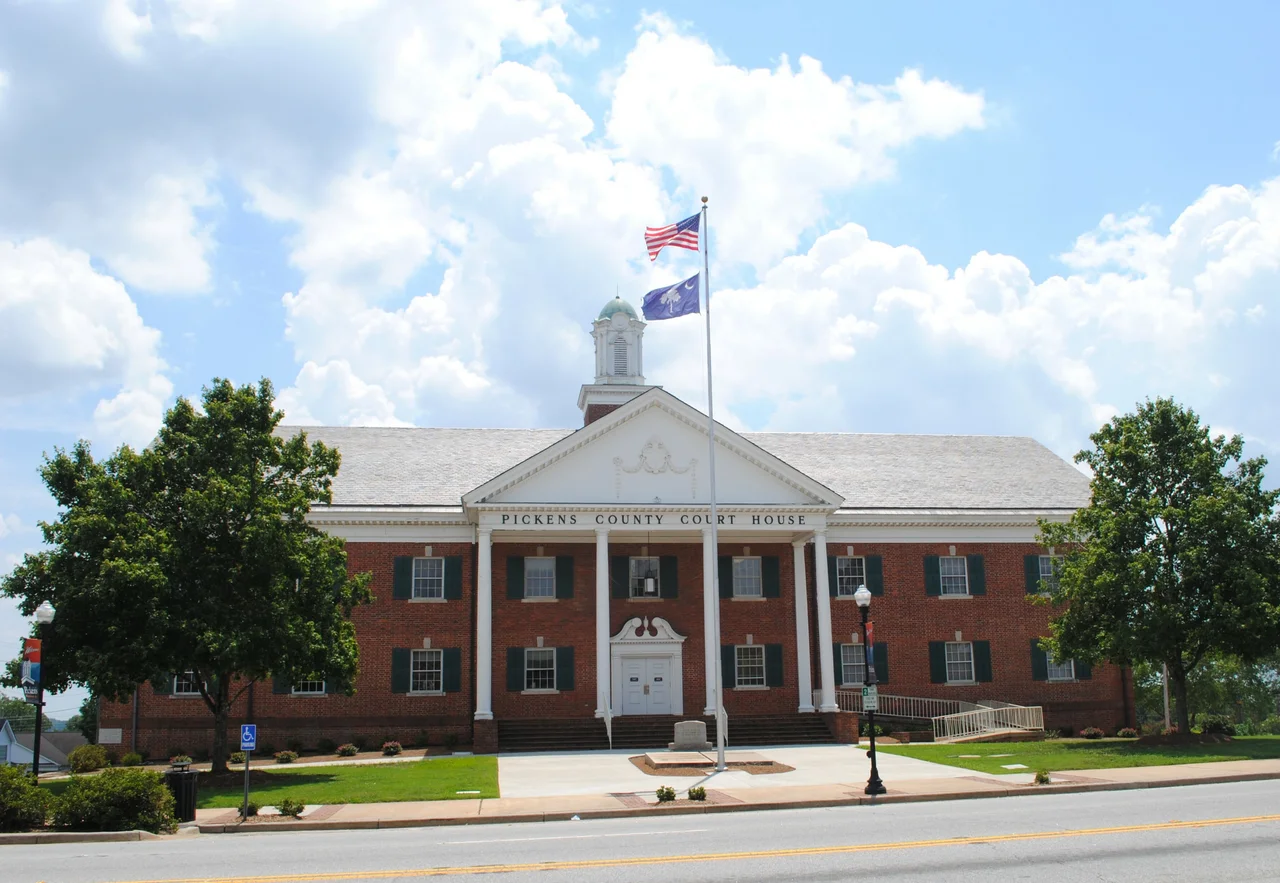

Pickens County, South Carolina
Shoeless Joe Jackson learned to hit a baseball with a stick in the dirt yard of a mill village in Pickens County. He was born July 16, 1887, and by the time he died in 1951 he had been declared one of the greatest natural hitters the game ever produced and then banned from it for the rest of his life. The Black Sox scandal of 1919 cost him his career and his name, but the legend would not stay buried. Generations of South Carolina kids grew up hearing about the boy from the foothills who batted .356 lifetime, swung a bat called Black Betsy, and went to his grave insisting he played the World Series straight. Pickens County is where the story begins.
Where the Mountains Step Down
Pickens County occupies a corner of South Carolina where the Blue Ridge ends abruptly. The northern edge of the county runs up against Sassafras Mountain, the highest point in the state at 3,553 feet. Drive south from there and the land falls fast, through rolling Piedmont farmland, past trout streams and rhododendron tunnels, until you reach the flat working country around Easley, the largest community in the county. The county was carved out of the old Pendleton District in 1826, the same year that John C. Calhoun, the most influential and most divisive South Carolina politician of the early Republic, was Vice President of the United States. Calhoun lived just over the county line in Anderson, but his political shadow fell across all of Upstate South Carolina, and he is still claimed here as a native son.
Orange, Always Orange
Clemson University sits in the southwestern corner of the county and dominates everything around it. The school began in 1889 as an agricultural college on land left by Thomas Green Clemson, John C. Calhoun's son-in-law, and grew into a research university of roughly 28,000 students. On football Saturdays in fall, the population of the small town of Clemson roughly doubles, and orange shirts spill out onto every street and lawn. Memorial Stadium, locally called Death Valley, fits more than 80,000 people inside its concrete bowl, and the hill players run down before kickoff has its own name and its own mythology. Beyond football, the university anchors the county's economy, employs thousands, and gives Pickens an academic identity that the rest of the rural upstate quietly envies.
Mill Town to Suburb
Pickens County's 20th century looked a lot like its neighbors': textile mills opened, workers came down from the mountains and across from Europe, baseball leagues were organized between mill teams, and then in the 1970s the mills started closing as the industry moved overseas. Brandon Mill in nearby Greenville, where Joe Jackson first played, was one of those casualties. What replaced the mills, slowly, was something different. Easley grew into a bedroom community for Greenville commuters. Clemson University expanded. The county developed pockets of high-tech research and pharmaceutical manufacturing, including a Merck plant that turned out to be one of the largest employers in the county. By the 2020 census, 131,404 people lived in Pickens County, with a median age of 36, slightly younger than the state as a whole. The mills are gone, but the names persist on old water towers and renovated factory buildings.
Politics and Quirks
Pickens has been the most Republican county in South Carolina since the year 2000. In 2008 it was the only county in the state to give John McCain over 70 percent of the vote, and Republican margins of 70 percent or more have held steady through every presidential election since. Jimmy Carter's narrow loss in 1980 is still the high-water mark for any Democrat in the county since World War II. Yet the place is full of contradictions. Clemson, with its diverse student body, votes very differently from the surrounding farms. The county produced not just Shoeless Joe but also DeAndre Hopkins, one of the NFL's premier wide receivers, born and raised in Central. Bobby Baker, the wheeler-dealer secretary to the Senate majority leader who fell in a 1963 scandal, came from here too. So did Benjy Bronk of the Howard Stern Show. It is the kind of county that produces both Sunday School teachers and shock-radio writers, and somehow no one finds that strange.
From the Air
Located at 34.89 degrees North, 82.72 degrees West in northwestern South Carolina, west of Greenville. The county stretches from the flat Piedmont in the south up to Sassafras Mountain at 3,553 feet on the North Carolina line. Nearest airports: Oconee County Regional (KCEU) within the county, Pickens County (KLQK) on the western edge, Greenville-Spartanburg International (KGSP) about 30 nm east. Best viewed at 5,500 to 7,500 feet AGL on clear days; the Clemson campus and Lake Hartwell along the southwestern border are prominent visual landmarks.
Nearby Stories
- Pisgah Astronomical Research Institute 8.7 km away
- Anderson Regional Airport 17 km away
- Battle of Lindley's Fort 23 km away
- Camp Wadsworth 26 km away
- Green River (North Carolina) 29 km away
- Great Smoky Mountains National Park 52 km away
- Dahlonega, Georgia 62 km away
- Great Smoky Mountains: The Park That Gets More Visitors Than Anywhere 82 km away