
Point Labatt
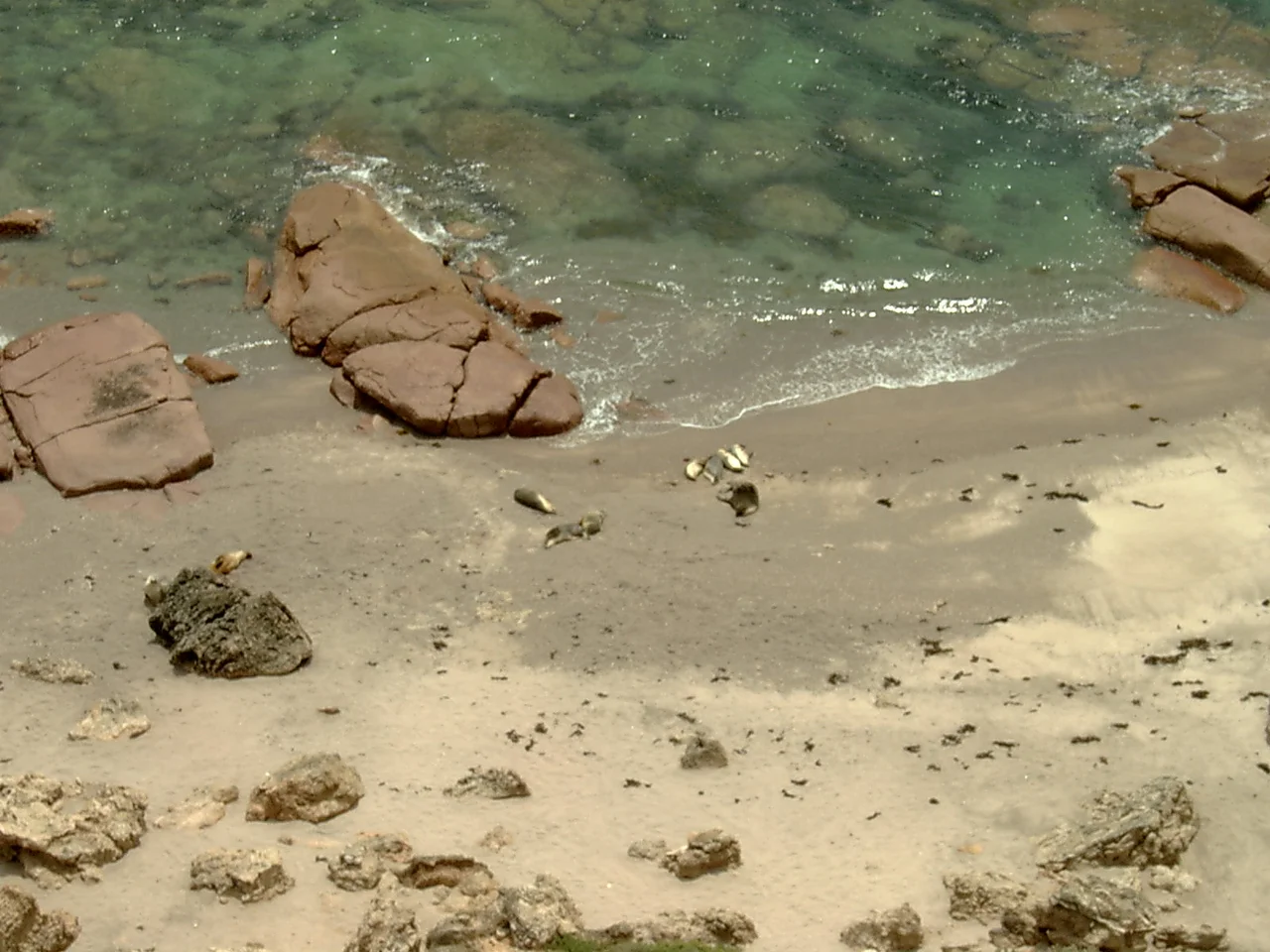
Fifty metres below the viewing platform, scattered across a crescent of beach you can never reach, lie the sea lions. From the clifftop they look almost like driftwood – tan-and-cream bodies sprawled on the sand, the occasional one heaving itself up the beach with surprising effort, or barking a complaint that drifts faintly upward on the wind. This is Point Labatt, a headland on the western coast of the Eyre Peninsula, about forty kilometres south of Streaky Bay, and it holds a distinction shared by nowhere else on the continent: it is the only permanent breeding colony of Australian sea lions on the entire Australian mainland. Every other colony of this species clings to an offshore island, scattered across the southern sea. Here alone, they come ashore on the continent itself.
The Rarest of Seals
The Australian sea lion is found in no other country on Earth, and there are perhaps fewer than twelve thousand of them left – among the rarest seals in the world, and listed as endangered. What makes them so vulnerable is hidden in their biology. Unlike almost every other seal, they breed on a strange seventeen-and-a-half-month cycle, neither yearly nor tied to the seasons, with a pregnancy of around fourteen months – the longest of any seal. Pups arrive slowly and infrequently, and the colonies do not even breed in step with one another. A population that recovers this slowly cannot easily afford a single bad decade. Point Labatt is one of the few mainland windows into a species running quietly out of margin.
A View From the Edge
You watch from above, and that distance is the whole arrangement. The colony sits at the foot of an unbroken wall of cliff that begins here at around sixty metres and climbs to a hundred and thirty-five metres at Cape Radstock to the southeast – the rock a pale calcarenite laid over the deep red granite of the Hiltaba Suite, formed when sea levels settled to their present height some seven and a half thousand years ago. A purpose-built platform, fifty metres up, lets visitors look almost straight down onto the breeding beach without disturbing a single animal. Once, before 1988, people snorkelled with the sea lions in the water below. Now the watching happens from the clifftop, and the beach belongs entirely to the seals.
Life on the Beach
Watch long enough and the scatter of bodies resolves into a society. Bulls – dark, massive, scarred from fighting – patrol stretches of sand and surf, while paler females rest in clusters with their pups. A mother will leave her pup ashore and head out to sea to feed, sometimes for days, diving deep and far along the continental shelf before returning to a beach full of near-identical youngsters and somehow finding her own by its call and its scent. The pups, meanwhile, gather in loose nurseries, sparring and dozing and venturing into tide pools to learn the water. It is a slow, sunlit, faintly chaotic scene, and the sounds of it – the bleating of pups, the bellow of a challenged bull – carry up the cliff to the people leaning on the rail above.
The Gift of the Freemans
The land that makes all this possible was given away. For years the country above the colony was grazed farmland, until in 1972 Ron, Myra and Ellen Freeman donated it specifically so the sea lions could be protected. That single act of generosity became the seed of three overlapping reserves – the Point Labatt Conservation Park on the land, the Aquatic Reserve and the West Coast Bays Marine Park in the water below – and earned the headland a place on the national register of important wetlands. Today only two spots in South Australia let you see Australian sea lions easily in the wild: Seal Bay on Kangaroo Island, and this lonely clifftop on the Eyre Peninsula. Both are accidents of geography made permanent by choice – and here, the choice belonged to one family who looked at a beach full of endangered seals and decided to give it to them.
From the Air
Located at 33.15°S, 134.26°E, on the Calca Peninsula of the western Eyre Peninsula, about 40 km south-by-east of Streaky Bay. The headland marks the start of a long, unbroken line of pale cliffs rising to 135 m at Cape Radstock – a strong visual landmark above otherwise low coast. The sea lion beach sits at the cliff base and is best seen from offshore. Recommended altitude 1,500–2,500 ft; afternoon sea breezes and glare off the water are common. Nearest airstrip is Streaky Bay, roughly 40 km north; Ceduna (YCDU) is the nearest larger regional airport, about 110 km to the northwest.
Nearby Stories
- Port Kenny 4.8 km away
- Streaky Bay 12 km away
- Lake Newland Conservation Park 20 km away
- Poochera, South Australia 24 km away
- Ward Islands 41 km away
- St Francis Island 49 km away
- St Peter Island (South Australia) 95 km away
- Israelite Bay 901 km away