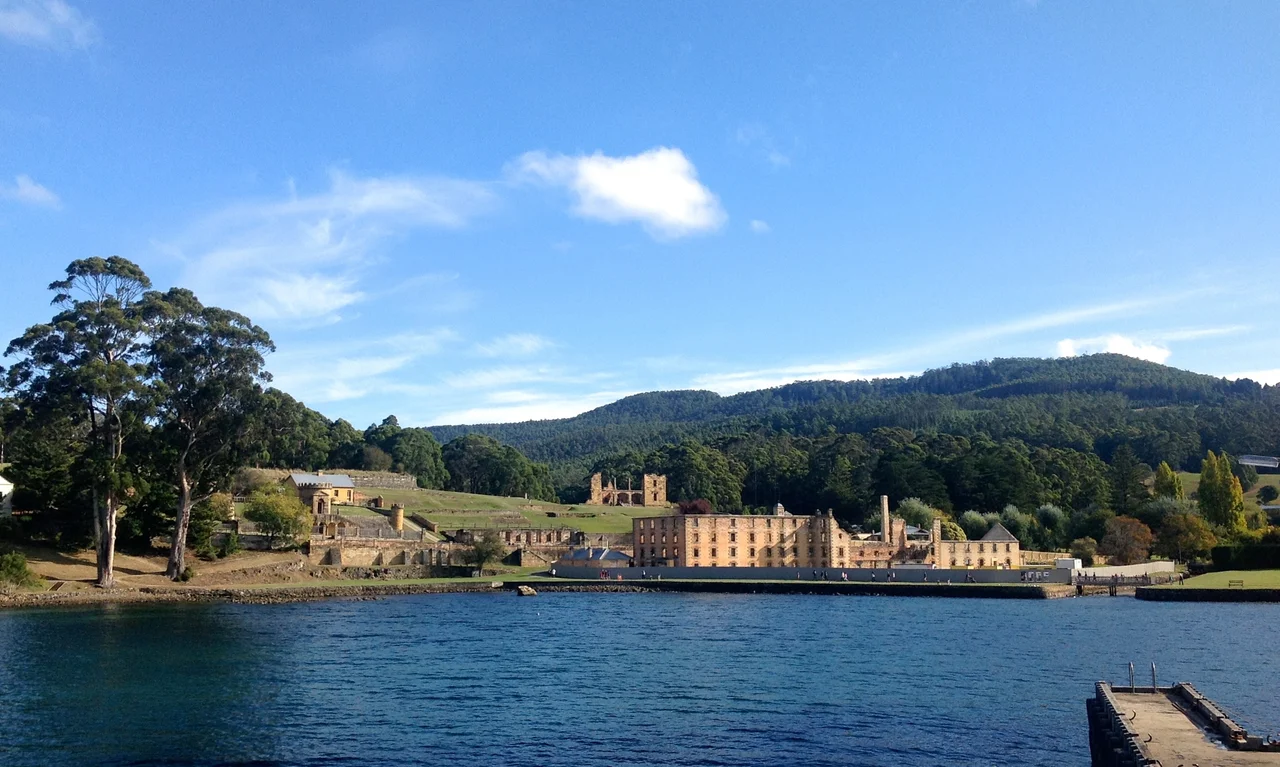

Port Arthur Massacre Memorial
Walter Mikac stood at the funeral for his wife and two small daughters holding three irises. One for Nanette. One for Alannah, who was six. One for Madeline, who was three. They were among thirty-five people killed at Port Arthur on 28 April 1996, the deadliest massacre in modern Australian history. The site where it happened had been chosen for a day out: a famous old convict ruin on Tasmania's coast, the kind of place families go on a Sunday. What unfolded there was so far beyond reckoning that it changed the country. Within weeks, Australia rewrote its gun laws, and a grieving father turned his loss into a foundation to protect other people's children. This is a place now defined as much by what came after as by the day itself.
Who They Were
The thirty-five were not statistics, and the day is best remembered through them. They were tourists and locals, the young and the old. Kate Scott was twenty-one. Anthony Nightingale was forty-four, and his last recorded words, as he understood what was happening, were a cry of "No, not here." Visitors had come from Malaysia and New Zealand; a New Zealand winemaker, Jason Winter, had been pitching in to help the busy cafe staff. Whole families were torn apart, parents and children both. The youngest to die were Alannah and Madeline Mikac, killed with their mother Nanette as they tried to flee. Twenty-three more people were wounded and lived, carrying that day with them. Australia would spend years studying not only how to respond to such an event, but how to care for the survivors, the first responders, and the small community of social workers left to hold a shattered town together.
A Warning Long Ignored
The terrible part is that someone had said it aloud, years before. In 1987, after a series of mass shootings across Sydney, Melbourne and the Northern Territory, the Premier of New South Wales, Barrie Unsworth, walked out of a national gun summit and warned that it would take a massacre in Tasmania before Australia found the will to reform its firearms laws. He was pointing to the state's long resistance to change. Nine years later his grim prediction came true in the worst imaginable way. Across the country, gun ownership had been a patchwork of state rules, with semi-automatic rifles and shotguns far too easy to obtain. The man responsible at Port Arthur held a licence for neither a car nor a gun, yet had armed himself with two semi-automatic rifles. The loophole the warning had named was still wide open on the morning of 28 April 1996.
The Law That Followed
What Australia did next became a model studied around the world. Just six weeks earlier, the Scottish town of Dunblane had lost sixteen children and a teacher in its own school massacre, and the two grieving communities, Port Arthur and Dunblane, formed a lasting kinship across the world. In Australia, the newly elected Prime Minister, John Howard, moved with unusual speed and political courage. Within two weeks of the massacre, his government and every state and territory agreed to the National Firearms Agreement, banning most semi-automatic and pump-action weapons, requiring uniform licensing, a registry, and a waiting period for sales. A national buyback followed, and some 643,000 firearms were handed in and destroyed, funded by a temporary levy. Howard pushed it through over real opposition, including from his own side of politics, and the reform has endured as the defining response to the tragedy: a country deciding, almost overnight, that this would not be allowed to happen again.
A Place of Quiet Reflection
Port Arthur did not become a monument to horror. The community refused to let it. The Broad Arrow Cafe, where so many died, was deliberately left as a ruin and made the centre of a memorial garden, dedicated in April 2000 as a place for quiet reflection rather than spectacle. Out of the loss of the Mikac family came the Alannah and Madeline Foundation, launched in 1997 by Walter Mikac and others to support child victims of violence and to fight bullying, work it still carries on today. The composer Peter Sculthorpe wrote a piece in memoriam for those who died and for those who live with the memory of it, first performed in Hobart that same winter. The convict ruins beyond the garden have stood for nearly two centuries; the memorial among them is much younger, and far more raw. Visitors come now to walk both, and to remember thirty-five people who came here for an ordinary day and never went home.
From the Air
Port Arthur lies on the Tasman Peninsula in southeastern Tasmania at roughly 43.14 degrees south, 147.85 degrees east, about 60 km southeast of Hobart by air on a deeply indented, cliff-lined coast. From altitude the historic site reads as a cluster of sandstone ruins and green lawns around a sheltered bay, with the tiny Isle of the Dead just offshore. Best viewed at 1,500 to 3,000 ft in clear, settled weather; the surrounding Tasman National Park has some of the highest sea cliffs in the Southern Hemisphere, dramatic from the air but a reminder that this coast catches hard Southern Ocean weather. There are no airfields on the peninsula; Hobart International Airport (ICAO: YMHB) is the nearest, roughly 60 km northwest. Approach with respect: this is a place of mourning as much as a landmark.
Nearby Stories
- Hobart 4.6 km away
- Bruny Island 24 km away
- Maria Island 35 km away
- Snowy River 566 km away
- Bundian Way 687 km away
- 2003 Fiordland Earthquake 1487 km away
- Doubtful Sound 1536 km away
- Chatham Islands 2894 km away