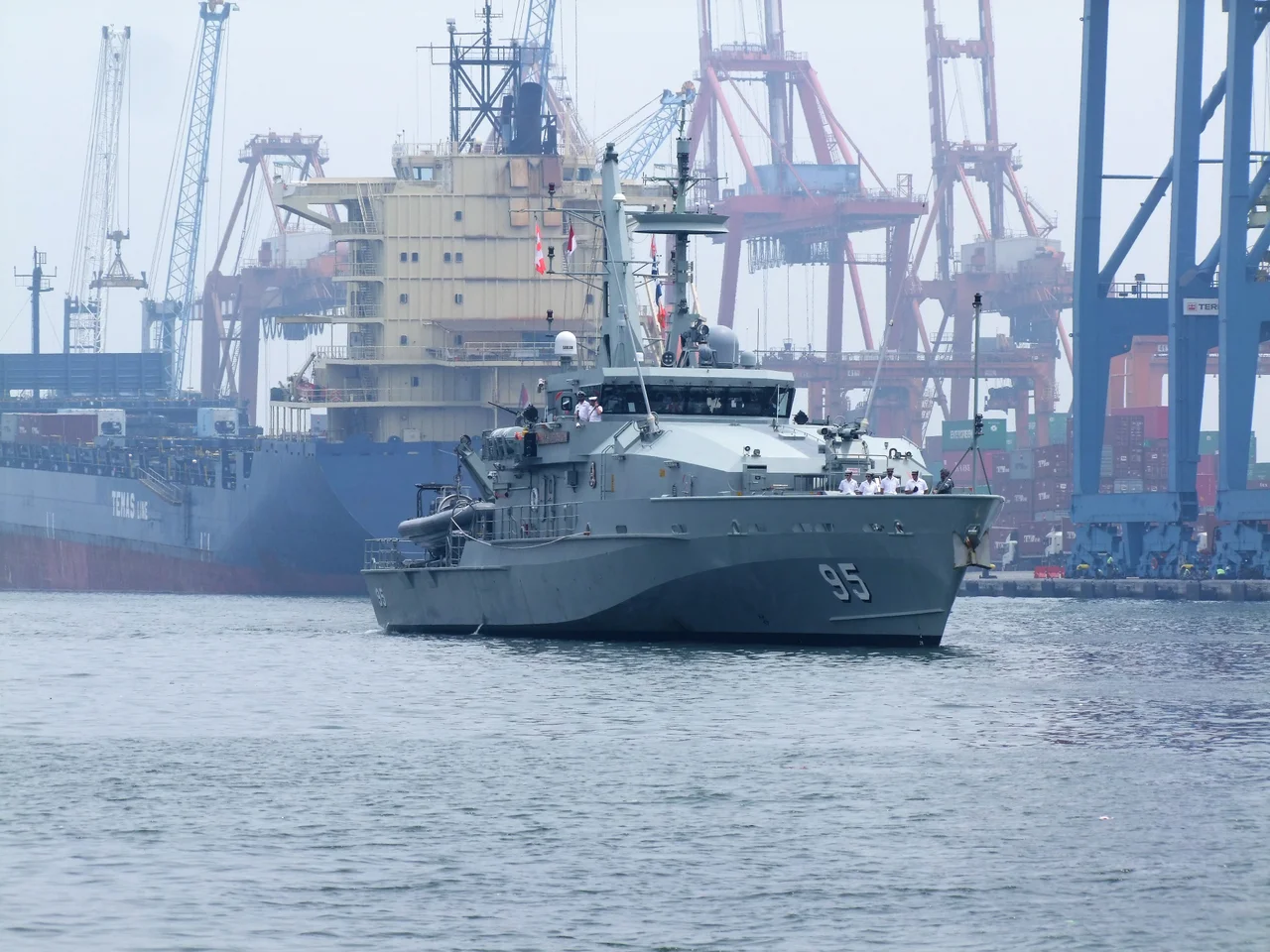

Port of Tanjung Priok
Half of everything Indonesia ships passes through a single bottleneck on Jakarta's northern shore. The Port of Tanjung Priok handles more than 50% of the nation's trans-shipment cargo, and on any given day its 76 berths accommodate everything from chemical tankers to container megaships to ferries carrying passengers between the islands of the archipelago. Lloyd's ranked it the 22nd busiest container port in the world in 2019. Yet the port's story does not begin with containers or cranes. It begins with pepper.
Pepper, Princes, and the Kingdom of Sunda
Long before the first steel crane was erected, this stretch of the Java coast was already a hub of maritime trade. As early as the fourth century, the Indianized kingdom of Tarumanagara established a coastal settlement here. King Purnawarman built a capital he called Sunda Pura on the northern shore and left seven inscribed memorial stones across what is now Banten and West Java. When Tarumanagara declined, the territory passed to the Kingdom of Sunda, and the harbor was renamed Sunda Kelapa. By the 14th century, it had become the kingdom's principal trading port. The first European ships arrived in 1513: four Portuguese vessels out of Malacca, chasing the spice trade and especially black pepper. A Hindu monk's lontar manuscripts documenting this era now sit in the Bodleian Library at Oxford, thousands of miles from the harbor they describe.
When the Suez Canal Changed Everything
For centuries, Sunda Kelapa was sufficient. Then the Suez Canal opened in 1869, and the volume of shipping to the Dutch East Indies surged beyond what the old harbor could absorb. Governor General Johan Wilhelm van Lansberge authorized construction of a new port at Tanjung Priok in 1877, along with a railway station and supporting infrastructure. The new harbor, initially spelled Tandjong Priok in Dutch colonial fashion, would gradually eclipse its predecessor. Tanjung Priuk Station arrived in 1914 to funnel goods inland. Sunda Kelapa still exists today as a harbor for wooden pinisi schooners, a picturesque relic alongside the industrial colossus that replaced it. The shift from pepper port to container megahub took less than two centuries.
A Port That Outgrew Itself
By the 2010s, Tanjung Priok was straining. Turn-around times ran six times longer than Singapore's, and ships sometimes waited a week just for customs clearance. The port had become one of the least efficient in Southeast Asia. The solution was the New Priok extension, a two-phase project also known as Kalibaru Port, designed to more than triple annual capacity from five million TEUs to 18 million. The first phase, completed in 2016, brought immediate relief. Dwelling time dropped from seven days to roughly three. Eight new cranes could move 30 containers per hour, and berths deep enough for ships with a 16-meter draft opened the port to vessels carrying up to 15,000 TEUs. A joint venture between Indonesia's state-run Pelindo II and a Japan-Singapore consortium managed the construction under PT New Priok Container Terminal 1.
A Link in the Maritime Silk Road
Tanjung Priok is not merely an Indonesian asset; it is a node in global commerce. The port sits along the Maritime Silk Road, a trade route stretching from the Chinese coast through the Strait of Malacca, across the Indian Ocean, through the Suez Canal, and into the Mediterranean before terminating at the Adriatic port of Trieste, where rail connections fan out across Central and Eastern Europe. Indonesia has actively courted Belt and Road investment to modernize its port infrastructure, proposing projects worth an estimated $91 billion. The Jakarta International Container Terminal, operated by Hutchison Port Holdings and Pelindo, serves as the country's national hub. Meanwhile, the supplementary Marunda Port was built nearby to handle bulk cargo and relieve pressure on Tanjung Priok's terminals, with a planned capacity of 30 to 35 million tons of bulk per year once its three piers are completed.
Twenty Terminals on the Java Sea
Today the port sprawls across more than 660,000 square meters of storage space behind nearly 17 kilometers of quay. Its 20 terminals serve general cargo, dry and liquid bulk, oil, chemicals, scrap metal, containers, and passengers. The scale is staggering, yet it still bears the imprint of the coast's older identity. Look west and you can find the old Sunda Kelapa harbor, where wooden sailing vessels still dock as they have for centuries. Look east and the New Priok extension rises in concrete and steel, designed for a future of 18,000-TEU triple-E class container ships gliding through 300-meter-wide sea lanes. Between the two, the entire arc of Indonesian maritime history is visible in a single sweep of coastline.
From the Air
Located at 6.10S, 106.89E on Jakarta's northern coast. From the air, the port is unmistakable: a massive complex of container yards, cranes, and berthing areas stretching along the Java Sea coastline. The old Sunda Kelapa harbor lies roughly 5 km to the west, identifiable by its cluster of traditional wooden schooners. Soekarno-Hatta International Airport (WIII) is approximately 20 km to the west. Halim Perdanakusuma Airport (WIIH) lies about 15 km to the southeast. Best viewed at 3,000-5,000 feet for the full scope of port operations and the contrast between old and new harbors.
Nearby Stories
- Lion Air Flight 610 8.5 km away
- Three Days Inside Mako Brimob 23 km away
- Battle of Kalijati 24 km away
- The Crossing at Silebu 34 km away
- Battle of Tjiater Pass 78 km away
- Way Kambas National Park 128 km away
- Ujung Kulon National Park 140 km away
- Battle of the Java Sea 389 km away