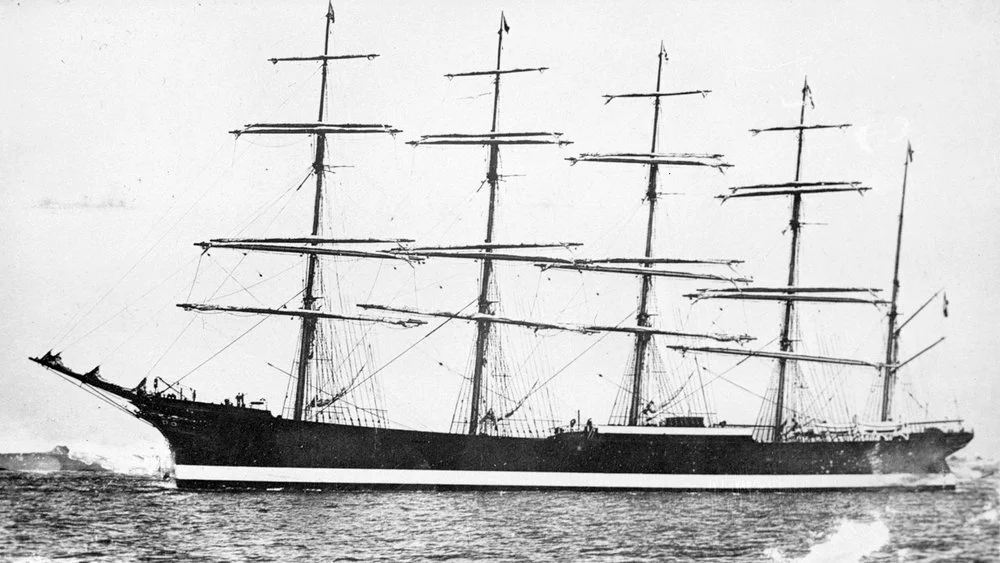

Potosi (barque)
She carried a tower of canvas, forty-three sails spread across five steel masts, and in a fair wind she could outrun a steamship. The Potosi was a windjammer at the very peak of the breed, a 122-metre giant built in 1895 for the German shipping house F. Laeisz, and for nearly two decades she thundered around Cape Horn at speeds that beggared belief for a vessel driven by nothing but wind. Her end, when it came, was strange and slow: not a storm, but fire, and a final volley from a warship's guns off the Patagonian coast.
The Flying P-Liners
The Potosi belonged to a fleet of legends. F. Laeisz gave every ship a name beginning with P, and the firm's fast, immaculately run sailing vessels became famous worldwide as the Flying P-Liners, described by one chronicler as without doubt the most successful fleet of sail ever assembled under a single flag. They ran the nitrate trade, hauling saltpetre from the west coast of South America back to Germany, where it was turned into fertiliser and explosives, and the run demanded ships that could survive Cape Horn again and again. The discipline of the line was such that, across countless voyages, none of the four- or five-masted Laeisz ships was ever lost or dismasted in a Horn storm. Named for the silver-rich Bolivian city of Potosí, then reckoned the highest city in the world, this barque was among the fleet's brightest stars.
A Cathedral of Steel and Canvas
Almost everything about the Potosi was steel: her black hull with its white waterline, her masts, her yards, even much of her rigging drawn into cable. Four of her five masts were square-rigged, each carrying six sails in towering tiers, while the aftermost mast bore fore-and-aft sails. All told she set forty-three sails over a sail area of more than fifty-six thousand square feet. She was a three-island ship, with a raised midship structure the sailors called the Liverpool house, where the captain and crew found dry quarters and the main double wheel stood high above the deck, shielded from the seas that swept her in heavy weather. Only six windjammers of this exact five-masted barque rig were ever built; the Potosi was one of the finest of them.
Faster Than the Wind Had Any Right to Be
The ship was the brainchild of Robert Hilgendorf, the most celebrated of the Laeisz captains, who shaped her design and then sailed her as her first master. Under his hand she set records on the saltpetre run. In good conditions the Potosi could touch nineteen knots, and on her best single day, in 1900 with Hilgendorf commanding, she logged 376 nautical miles in twenty-four hours, an astonishing distance under sail alone. Manned by a crew of around forty, she made twenty-seven round voyages between Hamburg and Chile from 1895 to 1914 under five captains. Of the entire Flying P fleet, only her near-sister Preussen, a true five-masted full-rigged ship, was faster, and the Preussen paid for that speed in handling. The Potosi was the rare combination of enormous and nimble.
Fire Off Patagonia
The war ended her German career. Caught at Valparaíso when the First World War broke out in 1914, she was interned, and afterward handed to France as reparation; sold on, she passed eventually to a Chilean firm in Valparaíso and was renamed Flora. Her end came in 1925. On 15 September, bound for Cape Horn, she caught fire off the Patagonian coast northwest of the Falklands. Her captain set course for the Argentine port of Comodoro Rivadavia and reached the roads on 18 September, anchoring offshore to fight the flames. The fire could not be beaten. On 19 October 1925, the Argentine cruiser Patria put the burning hull down with gunfire, and one of the greatest sailing ships ever built went to the bottom of the South Atlantic, ended not by the Horn she had mastered so often, but by fire and a few rounds of artillery.
From the Air
The Potosi sank off the coast of Chubut Province, Argentina, in the vicinity of 45.25°S, 66.25°W, in the waters off Comodoro Rivadavia where her burning hull was finally scuttled in 1925; sources also place the fire's origin further offshore northwest of the Falklands. There is no surface landmark to see; this is open South Atlantic water along the Patagonian shelf. The nearest major airport is General Enrique Mosconi International Airport at Comodoro Rivadavia (ICAO SAVC), to the south-southwest. For a coastal overview, a recommended altitude of 3,000-6,000 ft AGL takes in the Golfo San Jorge and the Chubut/Santa Cruz coastline. Expect strong, persistent winds and frequently hazy or overcast conditions over the cold offshore waters.
Nearby Stories
- Comodoro Rivadavia 66 km away
- Lake Colhué Huapi 155 km away
- Comodoro Rivadavia Rail Disaster (1953) 160 km away
- Trelew 197 km away
- Museum of Paleontology Egidio Feruglio 209 km away
- Trelew Massacre 231 km away
- Alto Palena–Encuentro River dispute 415 km away
- Disappearance of ARA San Juan 452 km away