
Presencia de América Latina
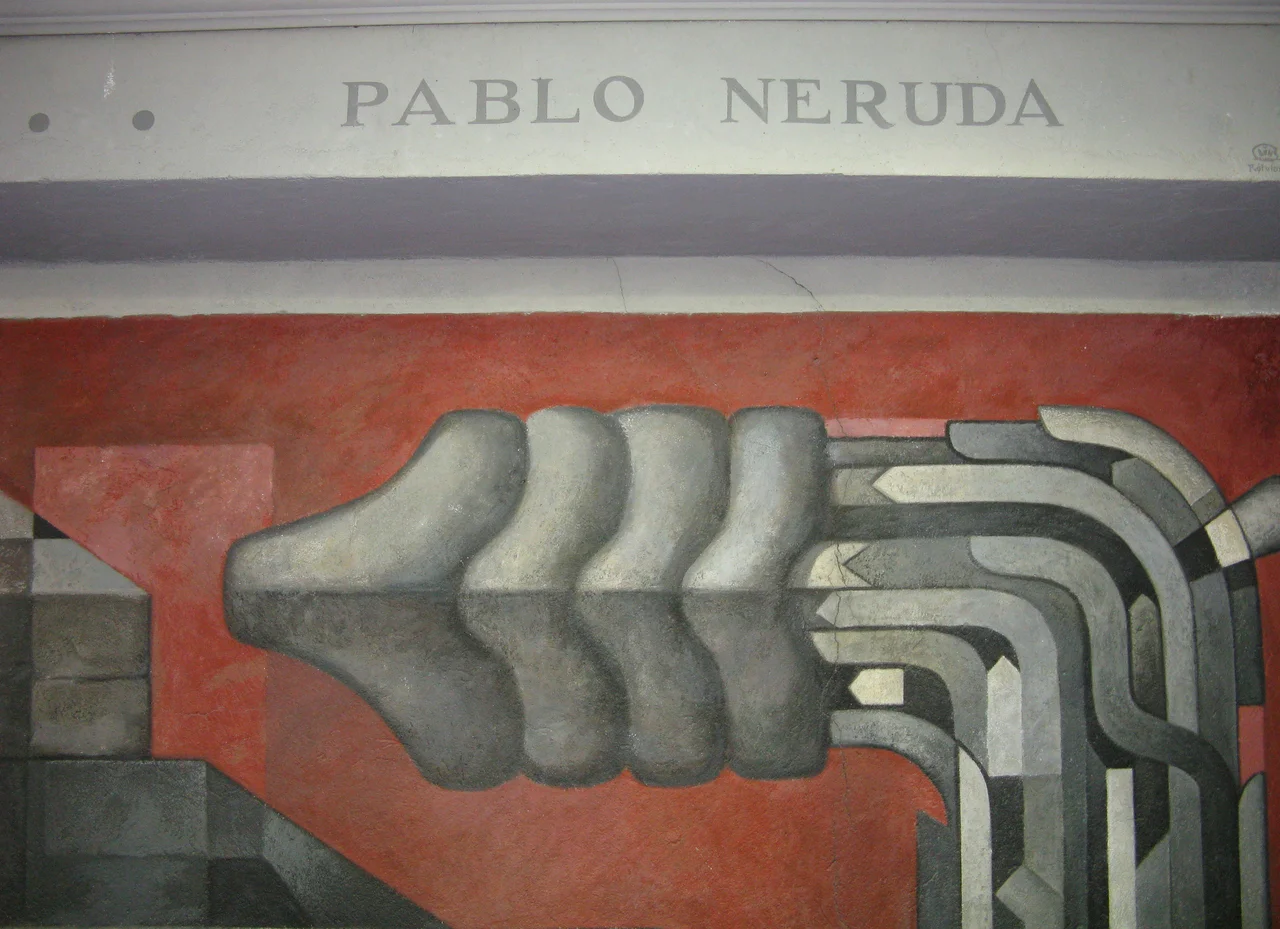
You read it like a book, right to left, beginning with the gods. On the walls of the Casa del Arte in Concepción, the Mexican artist Jorge González Camarena painted the entire saga of Latin America across 300 square meters of acrylic on rough stucco. He worked from November 1964 to April 1965 with a team of Mexican and Chilean painters and a model named Alicia Cuevas, and what they produced is less a picture than a procession. Pre-Columbian deities, the violence of conquest, the birth of a mestizo people, and finally the flags of nearly twenty nations rippling across the top, all crowned by verses from Pablo Neruda. Its subject, stated plainly, is the brotherhood of the peoples of the Americas.
The Gods Come First
The story opens on the right panel, in the world before Europe arrived. From the depths a woman rises with fish in her hands, the riches of the sea made flesh, beside the green mask of Tlaloc, the rain god. Quetzalcoatl, the feathered serpent who stands for culture itself, coils around the actual staircase that climbs to the upper gallery, so the mythology is not just depicted but inhabited by the building. Above, Zontemoc, the Falling Sun, marks the twilight of this ancient world. Then the rupture: a mounted Spanish soldier in armor, dagger drawn, clashes with an eagle-warrior wielding a mace. In a single image González Camarena compresses the collision of two civilizations, the moment one world began to end and another, painfully, to begin.
The Birth of a People
The central panel turns to the creation of a mestizo America, and here the mural grows tender and unflinching at once. The Spanish soldier and a Native woman form what the artist called La pareja original, the Original Couple, the parents of a blended people. They walk across layers of coal in which women lie imprisoned and sleeping, an image of the earth's wealth, its silver and gold and iron and copper, bought at human cost. From this dark seam a pregnant woman sprouts, wrapped in vines, and from her grow American corn and Old World wheat together. At the center, overlapping faces fuse into one, the largest painted red for the Indigenous American. Below them reclines a life-sized woman with a map of Latin America resting on her lap. She is the heart of the entire work, the continent personified, neither conqueror nor conquered but the whole of what they made together.
Wounds and Flowers
The left panel does not pretend the history was painless. A nopal cactus, emblem of Mexico, merges with the climbing vines of the copihue, Chile's national flower, binding the two nations that gave the mural its artists. But the nopal is pierced through with daggers, a frank acknowledgment of the historic mistreatment of Latin America's peoples, and its roots wrap around the bodies of fallen warriors who feed it with their deaths. It is a difficult, honest image: beauty growing directly out of suffering, the present nourished by the wounded past. González Camarena does not look away from cruelty, and he does not let the viewer look away either. The flower and the dagger share the same canvas because, the mural insists, they share the same history.
A Continent's Flags and a Poet's Voice
Across the very top, the flags of the sovereign nations wave in geographic order from south to north, beginning at the right with Chile and the condor and ending with Mexico and its eagle and serpent. The sequence runs through Argentina, Uruguay, Paraguay, Bolivia, Brazil, Peru, Ecuador, Venezuela, Colombia, then Haiti, Cuba, Panama, Costa Rica, Honduras, Nicaragua, and Guatemala. The Andes rise in the far distance. Crowning everything are the words of the Chilean poet Pablo Neruda, drawn from his great epic of the Americas: "There is no beauty like the beauty of America spread out in its hells, in its mountains of rock and power, in its atavistic and eternal rivers." Chile honored the work as a National Historic Landmark by decree on April 30, 2009. Alongside the university's clock tower, it has become a true symbol of Concepción, a gift from Mexico that taught a Chilean city how to see the whole continent at once.
From the Air
The mural lives indoors in the lobby of the Casa del Arte at 36.83°S, 73.04°W, on the campus of the University of Concepción in Concepción, Chile. It cannot be seen from the air, but its home is easy to find from above. The nearest airport is Carriel Sur International (ICAO: SCIE, IATA: CCP) in Talcahuano, about 8 km away and the main air gateway for south-central Chile. From a viewing altitude of 5,000 to 9,000 feet in the region's clear, mild Mediterranean weather, look for the green campus quadrangles near the city center and the landmark campanile (clock tower) of the University of Concepción, which stands as the mural's companion emblem of the city. The Bío Bío River curves to the south and west; Santiago lies roughly 500 km to the north.
Nearby Stories
- Battle of El Roble 7.8 km away
- Chivilingo Hydroelectric Plant 18 km away
- Ninhue 18 km away
- Santa María Island, Chile 25 km away
- Tucapel 47 km away
- 2010 Chile Earthquake 49 km away
- Coal Mining in Chile 51 km away
- 1687 Peru Earthquake 2386 km away