
Pulteney Bridge
Four bridges in the world have shops running along their full span on both sides. The Ponte Vecchio in Florence. The Rialto in Venice. The Krämerbrücke in Erfurt. And Pulteney Bridge in Bath. From the river below it looks like a Palladian palace that has accidentally been built across a river, three perfect segmental arches carrying a single narrow street lined on both sides with little Georgian shops. Robert Adam designed it, the Pulteney family paid for it, and it was finished by 1774 - which makes it the youngest of the four inhabited bridges by several centuries, and the only one Britain ever built.
Why a Bridge with Shops
The Pulteneys owned land in Bathwick, on the far side of the Avon from the old city. They wanted to develop it - houses, streets, a whole new district extending Georgian Bath eastward across the river. But Bathwick was inconvenient. A new bridge was needed, and the Pulteneys decided the bridge itself should pay for the development by carrying rental shops. Thomas Paty drew up the first plans and estimated £4,569 without shops. A second estimate from local builders John Lowther and Richard Reed came in lower, with two shops at each end of the bridge, but winter weather stopped work on the pillars before either design got started. In 1770 the Adam brothers - Robert and James - were already working on the new Bathwick development, and Robert Adam adapted Paty's design into something far grander: a full Palladian palace front, three arches of equal span, shops along the entire length on both sides. The original drawings are preserved at Sir John Soane's Museum in London.
Building It
Local masons Reed and Lowther built the lower part of the bridge - the arches and piers that take the river's weight. Singers and Lankeshere built the upper shops. The whole structure is dressed Bath stone, the same honey-coloured limestone that gives the rest of the city its glow, and from the river the three arches reach across with the kind of measured rhythm Robert Adam was famous for. The shops on the north side have cantilevered rear extensions that hang out over the water - a Georgian engineering trick that lets the bridge's shopkeepers have rooms larger than the bridge itself. As a consequence, the bridge's northern external face is asymmetrical, much altered over the centuries, and frankly nothing to look at. The southern face - the one in every postcard - is the original Adam design. It is Grade I listed.
Damage and Repair
The Avon does not respect Palladian architecture. A flood in 1799 and another in 1800 caused serious damage to the north side of the bridge. The reconstruction by Pinch the Elder did not replicate Adam's original symmetry, and a few decades later the bridge was already losing its clean lines to commercial alterations - shopkeepers cantilevering rooms, glazing in extensions, adding signs. By the early twentieth century the bridge looked nothing like Adam had drawn it. A 1960s programme repaired the underside soffits of all three arches. The northern wing was rebuilt between 1968 and 1972 as part of a flood-prevention scheme, replacing the much-altered nineteenth-century work; nobody pretends the new section has any architectural merit. The southern street facade got another restoration in 1975. The Adam south face is still the masterpiece. The north face is what happens when 250 years of weather, flood and small business have a go.
Daily Life on a Masterpiece
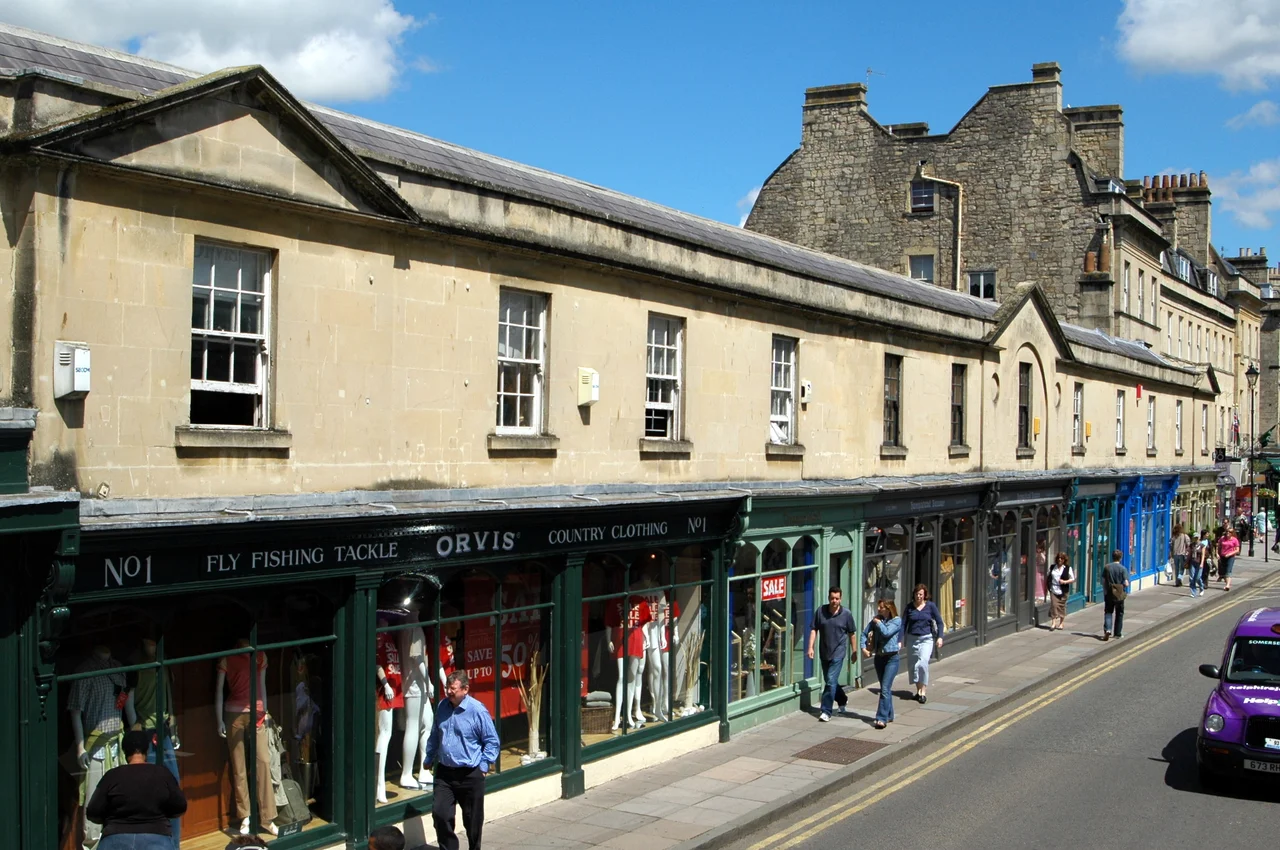
The shops are still in business. A coffee shop, a jeweller, a map seller, a tea room with a view through the back window straight down to the river - the kind of small Georgian frontages whose proprietors quickly stop noticing they are working inside a Grade I listed bridge. Below the bridge, the Pulteney Weir curves in a perfect three-quarter circle, a 1970s engineering work designed to handle flooding and look gracefully Georgian doing it. The combination is one of Bath's signature views: the Palladian bridge above, the curving weir below, narrowboats sliding through, swans drifting in the calm water. Pulteney Bridge has carried buses, the most fined bus lane in Bath, and at one point an abandoned 2011 plan to pedestrianise it entirely. It survives because it works - a bridge that has done two hundred and fifty years of ordinary commercial service inside a piece of museum-grade architecture.
From the Air
Pulteney Bridge spans the River Avon at 51.3831 N, 2.3578 W in the centre of Bath, immediately east of Bath Abbey and the Roman Baths. From the air, look for the curve of the Avon as it bends through Bath, with the three Palladian arches of the bridge and the distinctive horseshoe shape of Pulteney Weir just downstream. Great Pulteney Street runs as a wide axis northeast from the bridge to Sydney Gardens and the Holburne Museum. Bristol Airport (EGGD) is 14 nm west; Kemble (EGBP) 19 nm north-northeast. Recommended viewing altitude 1,500-2,500 feet for the bridge and weir geometry.
Nearby Stories
- Marlborough Castle 1.4 km away
- Clevedon Pier 4.6 km away
- Stourhead 5.6 km away
- Siege of Bridgwater (1645) 8.4 km away
- Raglan Castle 10 km away
- Berkeley Castle 12 km away
- Mottisfont Abbey 20 km away
- Blenheim Palace 33 km away