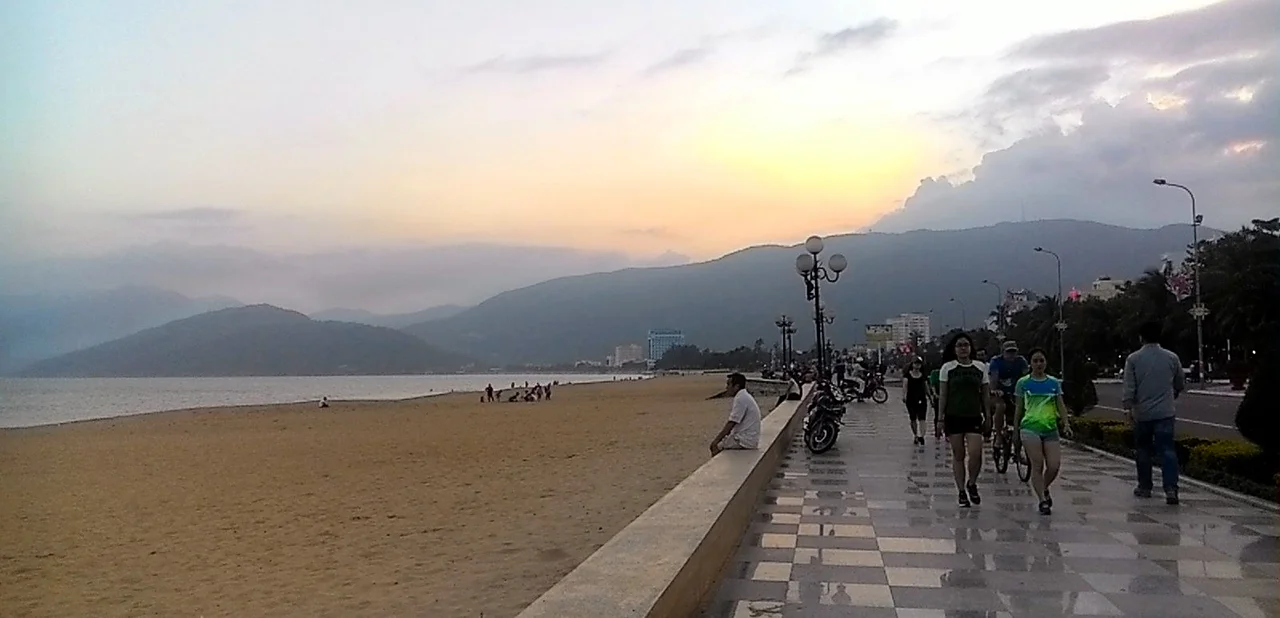

Quy Nhon
Every coastal city in Southeast Asia eventually gets discovered. The formula is familiar: a few guesthouses open, then a few more, then the backpacker trail arrives, then the resort hotels, and within a decade the local seafood restaurants have been replaced by Italian pizza places and the beach is lined with sun loungers from one end to the other. Quy Nhon (Quy Nhơn) has watched this happen to Da Nang to the north and Nha Trang to the south, and remains, somehow, largely untouched. The capital of Bình Định province sits on a small peninsula jutting into the South China Sea with 457,000 people, a five-kilometer beach promenade, and a history so layered — Cham empire, peasant rebellion, Vietnam War — that it would take weeks to begin to absorb it all. Most visitors spend a few days and leave wishing they had planned for longer.
The Cham Towers and the People Who Built Them
A thousand years ago, Quy Nhon was the capital of a civilization. The Cham people — the Chams — built their capital of Vijaya in the plains 50 kilometers from the coast, using the well-protected port at present-day Quy Nhon as their commercial face to the South China Sea. Their Hindu temples, which they called towers, rose across the surrounding countryside in red brick that has proved nearly indestructible over ten centuries of weather and war.
The destruction of the Cham civilization was systematic and devastating. In the 15th century, Vietnamese forces responded to a Cham attempt to enlist Chinese support by invading with a massive fleet. They burned the capital, killed 60,000 Cham men, enslaved 30,000 others, and launched a generations-long campaign of cultural erasure — demolishing Hindu shrines, replacing them with Buddhist temples, and removing the Chams from Vietnamese historical memory as thoroughly as they could manage.
The few thousand Cham people still living in Bình Định today occupy a difficult position: without adequate electricity, running water, or secure land rights in many areas, they carry the weight of a history that the wider country has not fully reckoned with. The Tháp Đôi twin towers in the city are the most accessible of the surviving Cham sites. The countryside holds larger, more complete towers — scattered, understated, and strangely neglected for ruins of such age and quality.
Six Hundred Years of Martial Arts
Bình Định has been the heart of martial arts in Vietnam since the 15th century. According to local accounts, the techniques emerged from necessity — peasants in a remote, lawless region who needed to defend themselves. The skills passed from generation to generation until, three centuries after their origins, Bình Định martial artists became the fighting core of the Tây Sơn rebellion.
Nguyễn Huệ, the most celebrated of the three Tây Sơn brothers from a small village in Bình Định, unified Vietnam and was proclaimed Emperor Quang Trung. In 1789 he led 100,000 volunteer soldiers in a surprise attack against a Chinese Qing force during the Lunar New Year — catching them unprepared and off guard — and crushed the invasion within five days. It is remembered as one of the greatest military victories in Vietnamese history.
His gratitude to the martial arts tradition was practical: he established state-sponsored schools, competitions, and official military roles. His death in 1792, at the age of 40, ended all of that. Successive powers — the imperial Nguyễn dynasty, French colonists, and both sides in the 20th-century civil war — banned the schools and drove the practitioners into hiding in Buddhist temples. The tradition survived underground for two centuries. By 2012, the provincial government was actively funding it again. A biannual martial arts festival brings thousands of fighters from across Vietnam and abroad. Girls have always been important in the Bình Định tradition — a traditional song once advised young men throughout the country to seek out Bình Định women specifically for their martial excellence — and today girls make up nearly half of new students in Quy Nhon's extracurricular programs.
The War Years
In July 1965, U.S. Marines landed at Quy Nhon expecting enemy fire. Instead, they found hundreds of women and children on the beach waving in welcome. The city was nominally under South Vietnamese government control, but the rice fields, jungles, and mountain passes of Bình Định had been Communist strongholds for nearly two decades before the war officially began, and the North Vietnamese 3rd Division — the 'Yellow Stars' — was deeply embedded in the surrounding countryside.
The Americans quickly established barricades, curfews, and garrisons, while locals adapted to the economic reality of hundreds of thousands of soldiers: restaurants opened, bars multiplied, and construction boomed. By the late 1960s, refugee camps in Bình Định held over 130,000 people displaced by fighting in the countryside; the largest camp, in Quy Nhon itself, held an estimated 30,000 people living in makeshift shelters on the beach.
The Phù Cát air base, built 30 kilometers northwest of the city, became one of the major American air installations in the country — hosting Bob Hope, Raquel Welch, and Ann-Margret for troop entertainment while simultaneously running napalm and defoliation bombing missions over the surrounding jungle. More than 3.5 million liters of Agent Orange were stored around Phù Cát and Quy Nhon. A joint U.S.-Vietnamese investigation in 2010 classified the site as one of the most contaminated dioxin hotspots in the country. A 2012 ceremony declared the area clean; independent scientists contest that finding, citing dioxin levels more than 400 times the acceptable standard as recently as 2016.
A Waterfront That Hasn't Been Sold
The reason visitors keep coming to Quy Nhon, and keep being surprised by it, is simpler than its history. The beach promenade stretches for five kilometers along the south and southeastern edge of the peninsula, and across the road from it, dozens of open-air seafood restaurants set plastic tables in the wide median strip between streets, under trees, with 180-degree views of the bay and the mountains receding into the haze behind it.
The seafood is caught the same morning by fishermen from the small villages just outside the city. An entire plate of shellfish — oysters, scallops, clams, mussels — costs a fraction of what it would in Ho Chi Minh City or Da Nang. The restaurants are family operations. Waiters dodge motorcycles crossing the road between kitchen and table. Charcoal grills spill out onto the pavement. The city has not yet decided this needs to be made into something more formal, more presentable, more profitable. This will presumably change. Until it does, Quy Nhon offers something increasingly rare in coastal Southeast Asia: a waterfront that still belongs to the people who live beside it.
Bánh Xèo and the Local Table
The food of Quy Nhon is Bình Định food, which is not quite like Vietnamese food anywhere else. The bánh xèo here — a fried rice-flour crepe — is made without tamarind and served smaller and thinner than the southern Vietnamese version. It comes with fresh cucumber, mint, cilantro, and lettuce for wrapping, all dipped into a brown sauce of roasted peanuts, fermented soy beans, and palm sugar. Neighborhoods specialize in it; regulars argue about which street has the best version with the same intensity that Neapolitan residents argue about pizza.
Beyond bánh xèo: steamed rice-cake cups eaten ten at a time by students at sidewalk tables, pork rolls wrapped in guava leaf for three days until they ferment into something sharp and sour, bánh ít cakes of sticky rice and mung beans darkened by mashed gai leaf, their sweetness cut by a slight bitterness that takes a few bites to appreciate. This is a city where the afternoon siesta still holds — most businesses close for several hours in the middle of the day — and the evenings come alive around tables of food, the mountains visible in the distance, the bay catching the last light.
From the Air
Quy Nhon lies at approximately 13.78°N, 109.22°E on the central Vietnamese coast, with its distinctive peninsula visible from altitude as a tongue of land jutting into the South China Sea. At 8,000–15,000 feet on a clear day, the bay's curve and the surrounding mountain ridges are dramatic: the Phuong Mai peninsula extends to the northeast, and the highlands of the Central Highlands rise to the west. The nearest civil airport is Phu Cat (VVPC), approximately 30km northwest. The urban core sits on the peninsula's narrow neck; the twin Cham towers are visible in the southern part of the city. Monsoon season (mid-September to mid-December) brings reduced visibility and turbulent conditions along this stretch of coast; the summer flying season (April through August) offers the best conditions.
Nearby Stories
- Sông Cầu 11 km away
- Operation Crazy Horse 36 km away
- Kon Ka Kinh National Park 42 km away
- Central Highlands (Vietnam) 42 km away
- Chư Yang Sin National Park 76 km away
- Battle of the Paracel Islands 342 km away
- South-East Asian Theatre of World War II 395 km away
- Kashmir Princess 411 km away