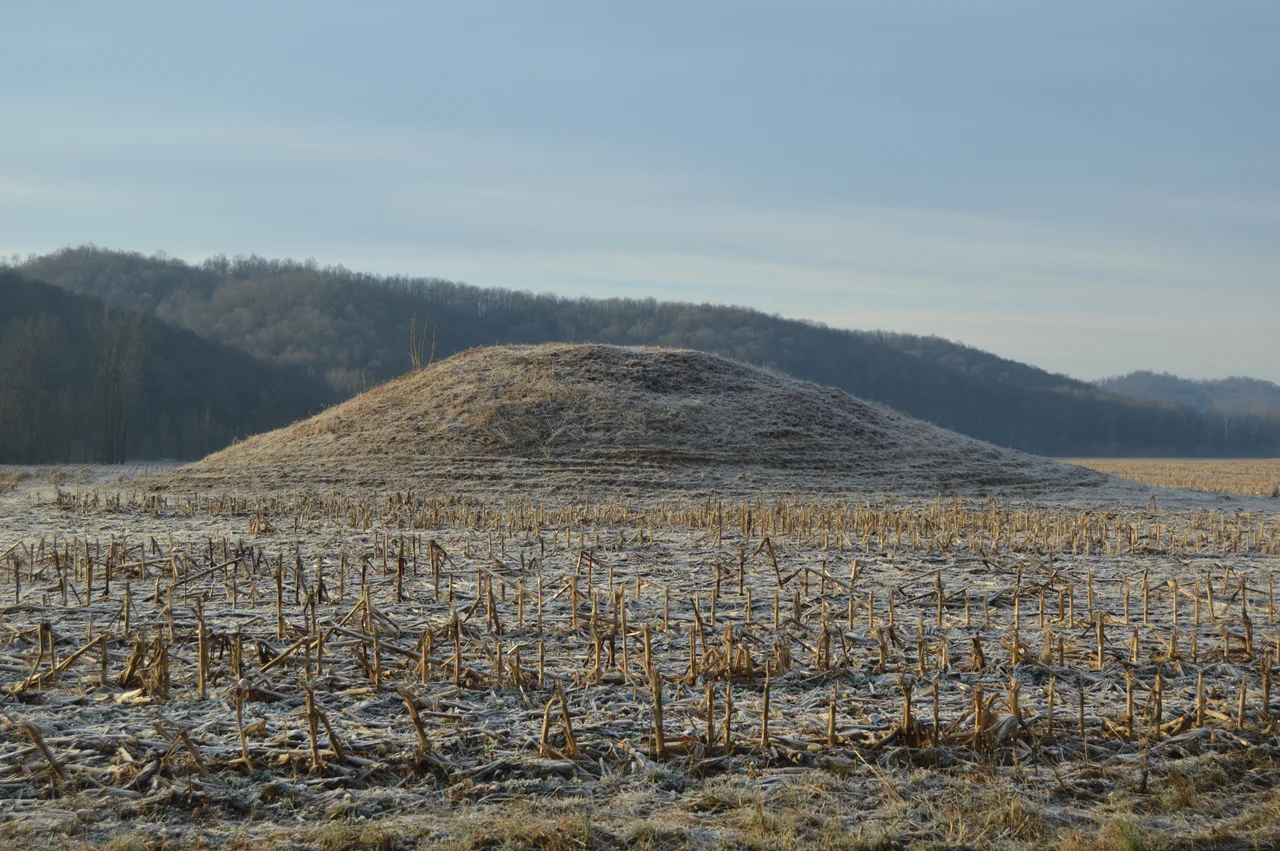

Ratcliffe Mound
The Ratcliffe Mound sits in a farm field at the bottom of a steep-walled Ohio valley, an 86-foot-wide circular cone of earth rising 14 feet above the surrounding cropland. Most surviving Ohio mounds can be confidently attributed to either the Adena or Hopewell cultures based on shape, location, or artifacts found nearby. The Ratcliffe Mound fits neither pattern cleanly. Neither culture typically built mounds at the bottom of narrow valleys. No artifacts have been recovered from the surrounding ground. No archaeologist has ever excavated the mound itself. After almost two thousand years of probable existence, the Ratcliffe Mound is one of the rarest things in archaeology: an unsolved monument hiding in plain sight.
A Mound in the Wrong Place
Adena and Hopewell mound builders, who flourished in southern Ohio between roughly 800 BC and AD 500, had distinctive site preferences. Adena mounds typically crowned ridge tops and hilltops, visible from a distance. Hopewell mounds often grouped near geometric earthworks at major river confluences. The Ratcliffe Mound does neither. It sits at the bottom of a tight valley in western Vinton County, surrounded by open farm fields, with no nearby woodlots or visible companion mounds. The Adena built a group of six mounds about 15 miles east at Zaleski, but they typically chose more elevated ground. The Hopewell rarely built isolated mounds away from larger earthwork complexes. The Ratcliffe Mound resists the standard categories.
What Has Not Been Found
No identifiable artifacts have been recovered from the surface around the mound. No projectile points, no pottery sherds, no stone tools that would key the site to a known culture. The land is private farmland, plowed and replanted across generations, which has likely scattered or buried any surface evidence that once existed. The mound itself has never been excavated by archaeologists. A trench through its interior would almost certainly reveal whether the structure contains burials, hearths, or grave goods diagnostic of a particular tradition. But no such excavation has happened. Whatever lies inside the mound remains inside the mound.
Why Leave It Alone
Modern American archaeology has shifted in recent decades toward leaving ancestral Native American sites undisturbed when possible. The Native American Graves Protection and Repatriation Act of 1990 requires consultation with descendant communities before disturbing burial sites, and most professional archaeologists now treat undisturbed mounds with strong presumptions in favor of preservation. For the Ratcliffe Mound, this means that even though excavation would likely identify the builders, the archaeological community has not pressed the case. The mound has been listed on the National Register of Historic Places since 1975, which protects it from federal funding for disturbance. Its mystery is now part of its protection.
An Unanswered Question
Standing at the edge of the field looking at the cone of earth, you have to fill in the meaning yourself. Perhaps an Adena lineage chose a valley location for reasons we cannot reconstruct - water, kinship, a vision quest, a remembered ancestor. Perhaps a less-documented Woodland-period group, smaller than Adena or Hopewell and largely absent from the archaeological record, built it as the only monument they ever left. Perhaps it served some practical function we have not imagined. The mound sits patiently in the valley while these guesses revolve around it. A thousand years from now, if it is still standing and the cultures of southern Ohio's prehistoric past have been more fully reconstructed, someone may finally be able to name its builders. Until then, the Ratcliffe Mound remains a beautifully framed question.
From the Air
Located at 39.31 N, 82.73 W in western Vinton County, southeast Ohio. The mound sits at the bottom of a steep valley in farm country. John Glenn Columbus International (KCMH) is about 65 miles north. Best viewed at 3,500-5,000 feet on clear days, when the rolling valleys and farmland of the Western Allegheny Plateau are clearly visible.
Nearby Stories
- Athens Lunatic Asylum 14 km away
- Gavin Power Plant 16 km away
- Hardin Village Site 33 km away
- The Y-Bridge of Zanesville 49 km away
- Columbus: The Test Market Where America Tries Things First 49 km away
- Ripley and the Underground Railroad 55 km away
- Wright-Patterson Air Force Base 69 km away