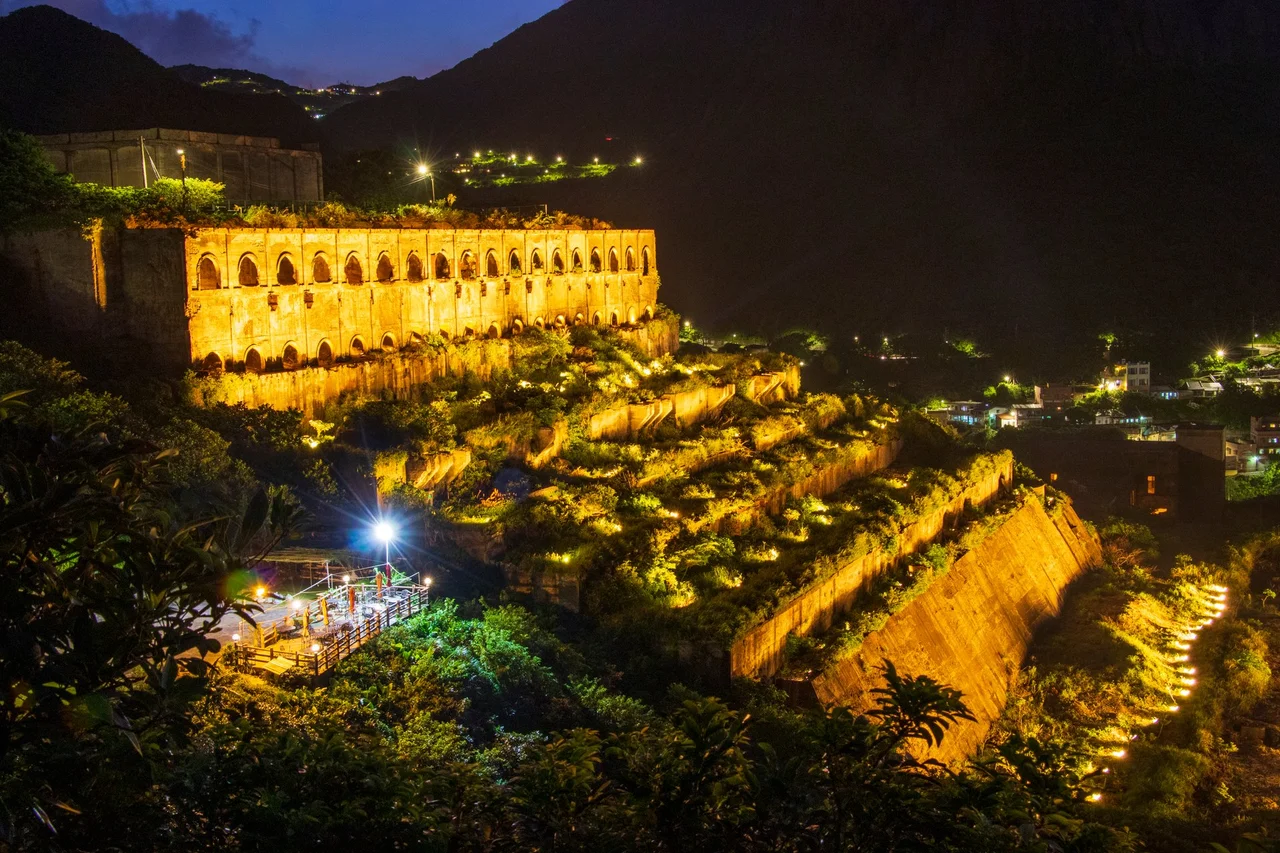

Remains of the 13 Levels
Drive the coastal highway east of Keelung and the ruin appears before the road explains it - a massive stepped structure climbing the hillside above the Pacific, its concrete tiers half-swallowed by vegetation, looking less like a factory and more like a fortress that lost a long war against the jungle. Locals call it the Potala Palace of Mountain Mines, a name that captures both the scale and the improbability: a thirteen-tiered industrial complex built into a slope so steep that each level sits on the roof of the one below.
The Remains of the 13 Levels is the Shuinandong Smelter, built in 1933 during the Japanese occupation of Taiwan. For forty years it processed copper and gold ore hauled from the mines at Jinguashi and Jiufen, refining raw rock into metal through a process that descended through the building's terraces like ore through a funnel. The smelter closed in 1973 when the minerals ran out. The building has been slowly disintegrating ever since, but slowly is the operative word. Concrete endures.
Thirteen Tiers of Fire and Metal
The smelter's design followed the logic of gravity. Ore entered at the top and progressed downhill through successive stages of crushing, roasting, smelting, and refining, each step occupying its own level of the terraced structure. The building was not thirteen discrete stories in the conventional sense but thirteen operational platforms built into the hillside's natural gradient, connected by chutes and conveyors that let gravity do the work of moving heavy material between stages. At peak production, the Shuinandong Smelter processed ore from the entire mining district - gold, copper, silver, and sulfur extracted from the mountains above and refined into exportable metals at the coast below. The facility was massive enough to be visible from passing ships, a landmark of Japanese industrial ambition stamped onto the Taiwanese landscape.
The Prisoners Below
Between 1942 and 1945, the Japanese military sent approximately one thousand prisoners of war to the gold mines surrounding the smelting plant. These were Allied soldiers - British, Canadian, Dutch, Australian, New Zealanders, South Africans, and Americans - captured during Japan's Pacific campaigns and transported to Taiwan for forced labor. The conditions in the mines were harsh: dark, dangerous, and maintained with little regard for the health or survival of the workers. The POWs extracted the ore that fed the smelter above them, their labor invisible from the surface but essential to the facility's output. Today the Taiwan POW Memorial Park stands near the site, dedicated to the memory of those who died in the tunnels. The memorial is modest in scale, a quiet counterpoint to the dramatic ruin on the hillside, but its presence ensures that the smelter's story includes the people who suffered inside the mountain as well as the building that processed what they brought out.
Rust and Recognition
After the Republic of China assumed administration of Taiwan in 1945, the smelter was taken over by a state-run mining corporation. Operations continued for nearly three more decades, but by the early 1970s the ore deposits that had sustained the district since the late nineteenth century were effectively exhausted. The company shut down in 1973, and the Shuinandong Smelter began its long transition from factory to ruin. The concrete frame has proven remarkably durable - the terraced structure remains standing, its silhouette largely intact against the hillside, though vegetation has colonized every horizontal surface and weather has stripped the interiors. The site and its surrounding mining infrastructure have been listed as potential world heritage sites by Taiwan's Ministry of Culture, recognizing the district's significance as one of Asia's most important historical mining landscapes.
Light on the Bones
In 2019, the ruins were illuminated for the Moon Festival in an art installation that gave the decaying structure a second life, at least for a night. Two artists - Chou Lien and Joyce Ho - collaborated with Taiwan Power Company, the current site owner, to project light across the smelter's thirteen tiers, transforming the dark silhouette into a glowing cascade of color visible from the coastal highway and the surrounding hills. The installation drew thousands of visitors and reframed the ruin not as a monument to industrial decline but as a canvas for contemporary art. The building that once glowed from the heat of its furnaces now glows from the light of projectors, and the transformation captures something essential about how Taiwan relates to its Japanese-era industrial heritage: not demolishing it, not restoring it, but finding new uses for the bones that remain.
From the Air
Located at 25.12°N, 121.86°E on the coast of northeastern Taiwan in Ruifang District, New Taipei City. The Remains of the 13 Levels is one of the most visually striking structures on Taiwan's northeast coast - a massive terraced concrete ruin climbing a steep hillside directly above the coastal highway and the Pacific Ocean. From altitude, look for the stepped structure between the shoreline and the ridgeline, near the point where the Yin-yang Sea (split yellow and blue water) meets the coast. The nearby town of Jinguashi sits uphill. Taiwan Taoyuan International Airport (RCTP/TPE) is approximately 80km southwest. Songshan Airport (RCSS/TSA) is about 40km west. Frequent fog and rain along this coast.
Nearby Stories
- Taoyuan Air Base 4.7 km away
- Min Ping Yu No. 5540 Incident 6.9 km away
- Neiwan 14 km away
- North Jiangsu Main Irrigation Canal 982 km away
- Sinking of MV Sewol 1049 km away
- General Cliff Rock Paintings 1058 km away
- Yellow Sea 1108 km away
- Sibuyan Island 1376 km away