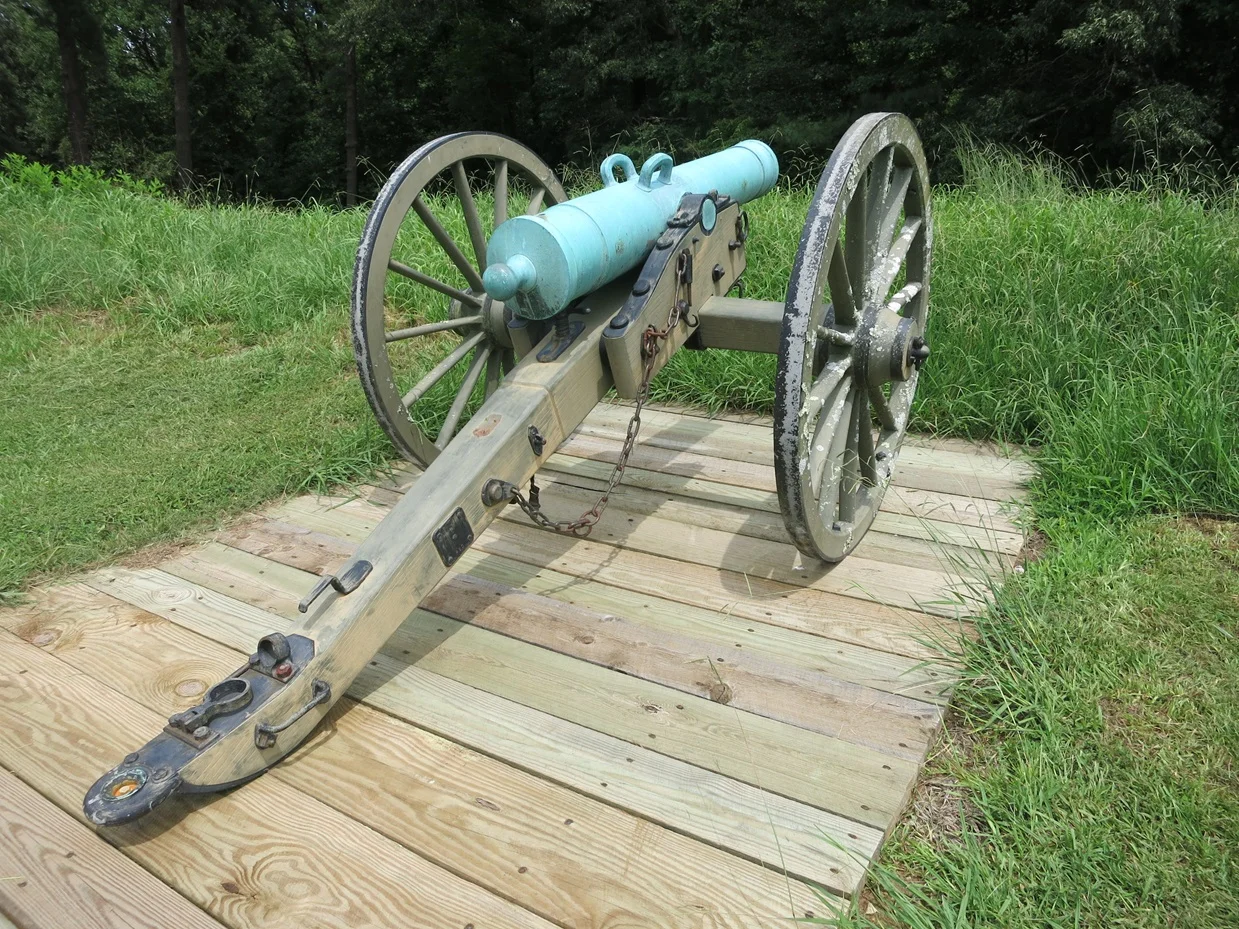

Richmond National Battlefield Park
There is no single Richmond battlefield. The fighting that swirled around the Confederate capital for four years happened across so much ground - so many creeks, hills, river bends, and small farms - that the National Park Service eventually had to gather it all into one park made of thirteen separate pieces. Together they cover more than 3,600 acres in the coastal plain of Virginia, bounded roughly by the watersheds of the James and the Chickahominy. Some of it preserves the Confederate manufacturing heart at Tredegar Iron Works. Some of it preserves the largest military hospital site of the war at Chimborazo. The rest is battlefields, where green meadows and old-growth forest hide entrenchments, redoubts, and the still-shapeless ground where tens of thousands of men were killed or maimed in the long, grinding effort to take Richmond - or to keep it.
Why Richmond Was Worth Four Years
Virginia voted to secede in May 1861. Richmond was chosen as the Confederate capital almost immediately - partly for symbolic reasons, partly because the city was already the South's most important manufacturing center. The Tredegar Iron Works, founded in 1837 on the north bank of the James, was the largest ironworks in the South. It supplied roughly half the artillery used by the Confederate Army during the war and made the iron plating for the ironclad CSS Virginia (originally USS Merrimack). Today the Tredegar site holds the park's main visitor center, with a Civil War museum, interactive theaters, and Park Service rangers. The decision to capitalize Richmond made the city strategically essential to both sides. It is hard to overstate how much war was fought, and how many men died, because of that single choice.
Chimborazo Hospital and the Care of the Wounded
Chimborazo Hospital sat on a hill east of downtown Richmond - one of the city's "seven hills," named for a volcano in Ecuador. At its peak, the hospital cared for up to 4,000 patients at a time and treated more than 76,000 wounded Confederate soldiers over the course of the war. Most of the patients were convalescents, the seriously wounded who had survived initial treatment and needed time to recover. The hospital's surprisingly low 9 percent mortality rate spoke to the work of staff like chief matron Phoebe Yates Pember, who would later write a memoir of those years that remained in print for over a century. The Chimborazo Medical Museum, housed in a former weather station, now displays surgical kits, medical equipment, and accounts of hospital life. It is among the few places visitors can confront, viscerally, what military medicine actually looked like before antibiotics and reliable anesthesia.
The Peninsula Campaign and the Seven Days
George McClellan's first attempt on Richmond came in spring 1862 - the Peninsula Campaign, an amphibious approach up the James and York rivers. He got within four miles of the city before being checked. At Drewry's Bluff, Confederate gunners on a high river bend hammered Union gunboats trying to steam upstream; the fleet had to withdraw. Then Robert E. Lee took command of the Confederate Army of Northern Virginia, and the Seven Days Battles began on June 25, 1862. Beaver Dam Creek (Mechanicsville), Gaines's Mill, Glendale, Malvern Hill: a week of brutal fighting that ultimately drove McClellan back to the James. Lee failed to destroy the Union army outright, but he saved Richmond - and made his reputation. The park preserves walking trails at Beaver Dam Creek, interpretive signs at Gaines's Mill where Lee mounted his largest attack of the war with 57,000 men, and a visitor center at Malvern Hill where Union artillery had its devastating final word.
The Overland Campaign and the Siege
Two years later, in 1864, Ulysses S. Grant made the second great attempt. The Overland Campaign opened in the Wilderness and ground south through Spotsylvania Court House. At Totopotomoy Creek - protected today as a park unit including the Shelton House at Rural Plains - Grant tried and failed to lure Lee into open ground. At Cold Harbor in early June, Grant ordered a massive frontal assault against Lee's prepared positions and lost thousands of men in less than an hour. He later said it was his biggest regret of the war. But Cold Harbor would also be Lee's last clear victory. From there Grant settled into the long siege of Petersburg, where superior Union numbers could be brought to bear against Lee's starving, over-stretched Confederates. Fort Harrison fell to Benjamin Butler in September 1864, forcing Lee to shift his entire line west. The Howlett Line, a Confederate earthworks across the Bermuda Hundred peninsula, kept Butler's army bottled up - in Grant's phrase, "like a cork in a bottle."
What You Can Still See
Richmond National Battlefield Park is unusual among Civil War parks for how scattered it is. There is no single grand vista like Gettysburg's Little Round Top or Vicksburg's hilltop. Instead the park is a network: the Tredegar Iron Works downtown, Chimborazo Hospital on its hill, Drewry's Bluff above the James, Fort Harrison in the eastern suburbs, the quiet creeks at Beaver Dam and Totopotomoy, the old-growth forest at Cold Harbor where the trees themselves are silent witnesses. About 3,600 acres in all. The park headquarters at Chimborazo Medical Museum coordinates visits to all of them. Driving the full circuit takes a day or more; the seasoned approach is to pick a campaign and follow it. The Seven Days drive runs Mechanicsville to Malvern Hill. The Overland route runs Totopotomoy to Cold Harbor. Together they trace, on the ground, why Richmond was held - and finally why it fell.
From the Air
The park's units are scattered across roughly 3,000 acres around Richmond, centered on the city itself at about 37.43°N, 77.37°W. From the air the geography is the story: the James River winds south through the metro area, the Chickahominy River runs to the east, and the battlefields are scattered across the watersheds between them. Recommended viewing altitude 3,000-6,000 feet AGL to take in multiple units. Nearest airports: Richmond International (KRIC) is in the middle of the park network, Chesterfield County (KFCI) is convenient for the Drewry's Bluff and Fort Harrison units. Look for the distinctive bend in the James at Drewry's Bluff and the open meadows at Malvern Hill.
Nearby Stories
- Piney Grove at Southall's Plantation 2.5 km away
- Battle of Amelia Springs 3.5 km away
- Lewis Ginter Botanical Garden 4.3 km away
- Cactus Hill 21 km away
- Fork Union Military Academy 25 km away
- Christopher Newport University 44 km away
- Menokin 47 km away
- Long Grass Plantation 65 km away