
Robertsport
On the hills above the beach stand houses that look as if they wandered in from the American South - tall, plantation-style homes with wide porches, lining broad avenues that lean against the slope. They are decrepit now, paint peeling, roofs sagging, survivors of two civil wars. They were built by people whose grandparents had been enslaved in the United States and who crossed an ocean to build a republic in their ancestral continent. This is Robertsport, capital of Grand Cape Mount County, and its weathered grandeur tells a story far stranger and more layered than its present life as a sleepy fishing town would suggest.
Cape of the Mountain
The Portuguese saw it first from the sea. In the mid-fifteenth century the navigator Pedro de Sintra rounded a thousand-foot granite headland rising green from the Atlantic and named it Cabo do Monte - Cape Mount. The cape became a landmark for centuries of sailors, and not all of them came in peace: in 1840 the writer and slave trader Théodore Canot established a settlement nearby, part of a coast then notorious for the human cargo shipped from its rivers. The town that exists today came later and from a different impulse. In 1849 the young government of Liberia signed a treaty with the Vai people for the territory of Cape Mount, and in 1856 Robertsport was founded as a settlement for recently arrived African American immigrants - free people and former slaves who had emigrated to Liberia to govern themselves.
Roberts's Port
The name honors Joseph Jenkins Roberts, born in Norfolk, Virginia, in 1809, who emigrated to Liberia as a young man and rose to become the country's first president when it declared independence in 1847. Robertsport - Roberts's port - was meant to be his namesake harbor, a town for the Americo-Liberian settler class who modeled their churches, their politics, and their architecture on the country they had left behind. Mount Zion Baptist Church still stands on the hillside. The wide avenues still climb between the trees. The settlers' descendants and the indigenous Vai, Gola, Mende, Kru, Bassa, and others have shared this peninsula for generations, a meeting of peoples that is the deep texture of Liberia itself.
The Waves Nobody Was Watching
For most of its history, Robertsport's curving shoreline was simply where the fishermen launched their canoes. Then, after the Second Liberian Civil War ended in 2003, American visitors arrived and noticed what generations of fishermen had taken for granted: a series of long, peeling, left-hand point breaks among the finest in West Africa. They taught a local man, Alfred Lomax, to surf. Lomax taught others, including Philip Banini, who became an instructor and opened a guesthouse for the surfers who began to trickle in. The breaks earned names - Fisherman's Point, Cotton Trees, Cassava Point - and a small surf culture took root. A 2025 documentary, We The Surfers, followed competitors in the African National Surfing Titles held here, among them local women surfers known as Faith and Butterfly.
A Town That Endured
Liberia's civil wars gutted the country, and Robertsport was not spared the looting. Yet the town remained structurally intact - those old settler houses still standing, battered but unbowed, on their wide avenues above the sea. Life here is hard and unhurried. St. Timothy Government Hospital, the only hospital in a county of some 135,000 people, makes do with around forty beds and a single operating room. The roads are rough, the services few. But the surfers keep coming, the fishermen keep launching their canoes off Fisherman's Point, and the nearby Lake Piso lagoon draws birdwatchers and ecotourists. Travel writers reach for the same phrase: a hidden gem. Robertsport, faded and resilient, is a place where Liberia's whole improbable history - of return, of independence, of war and recovery - washes up with every tide.
From the Air
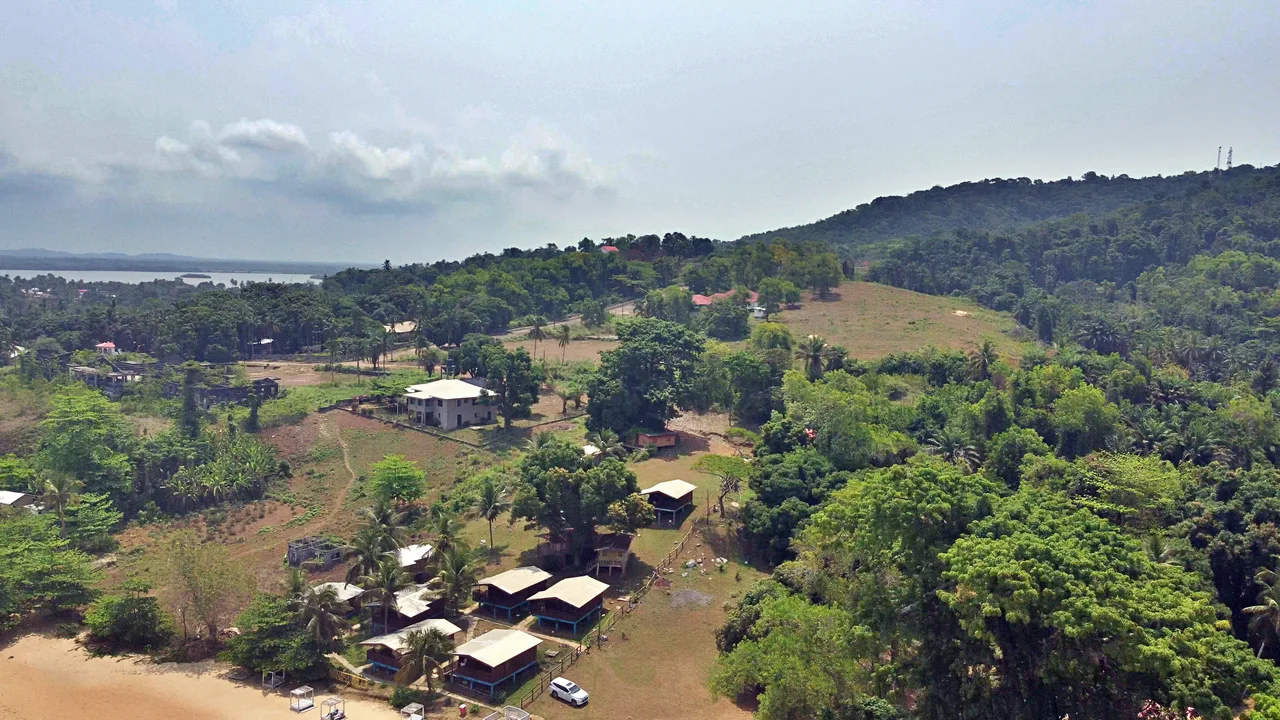
Robertsport sits at roughly 6.75 degrees north, 11.37 degrees west, on the Cape Mount peninsula in western Liberia, about 10 miles from the Sierra Leone border. From the air, look for the distinctive granite promontory of Cape Mount rising about 1,000 feet, the long curve of beach with its point breaks, and Lake Piso lagoon spreading inland behind the town. The nearest major airport is Roberts International (GLRB) near Monrovia, about 70 km southeast. The climate is tropical monsoon: a short dry season from January to March with hazier skies, and a long, very wet season the rest of the year - July to September can bring extreme rainfall and low ceilings.
Nearby Stories
- Hotel Africa 15 km away
- Mount Coffee Hydropower Project 40 km away
- Tiwai Island 58 km away
- Mattru Jong 68 km away
- Ducor Hotel: Africa's Five-Star Ruin 71 km away
- Bonthe District 101 km away
- The Niger River: The Boomerang That Built Empires 231 km away
- Rocas Atoll 2686 km away