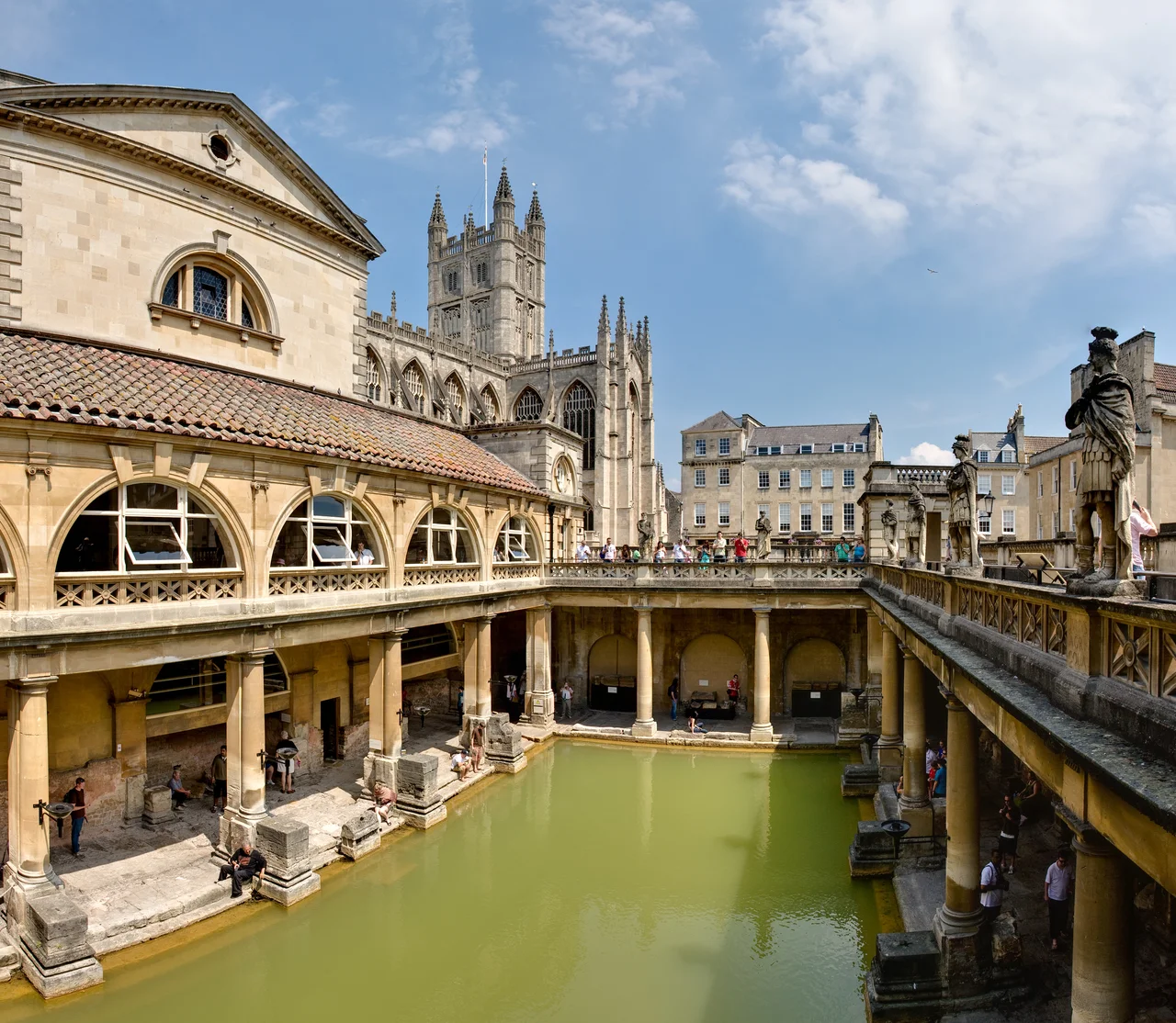

Roman Baths (Bath)
Rain falls on the Mendip Hills, soaks through limestone, and drops between 2,700 and 4,300 metres down into the heat of the earth. The water warms to as much as ninety-six degrees Celsius. Under pressure, it rises along fissures and faults until, at the very point where the Pennyquick fault breaks surface in the middle of Bath, it bubbles up at forty-six degrees and 1.17 million litres a day. That spring has been doing this for thousands of years. The Celts worshipped it. The Romans built their temple over it in the 60s AD. Anglo-Saxons saw the ruined baths and called the place a wonder. The water you can see today - greenish, faintly steaming on a cold morning - fell as rain ten thousand years ago.
Sulis, Then Minerva
Before the Romans arrived, the Britons of this area had already made the spring sacred. They dedicated it to a goddess named Sulis, locally associated with hot water, healing and wisdom. When the Romans conquered Britain in the first century AD, they did what Romans usually did - they kept the local goddess and equated her with one of their own. Sulis became Sulis Minerva, and the town that grew up around the temple they built between 60 and 70 AD was named Aquae Sulis - "the waters of Sulis." The site stayed dedicated to the same goddess under two names for three centuries. About 130 curse tablets - thin lead sheets inscribed with petitions and grievances - have been recovered from the spring, where bathers threw them as offerings. Many of the curses concern stolen clothes, lifted while the victim was bathing. Roman Bath was just civilised enough to have a thieving problem.
Engineering the Sacred
Roman engineers, possibly working under Emperor Claudius's direct instructions, drove oak piles into the wet ground to provide a foundation, then enclosed the spring in an irregular stone chamber lined with lead. The Great Bath was lined with lead from the Mendip mines and is still lined with it today, the original sheets visible at the base. Over the next three hundred years the complex was extended into a full thermae - hot rooms with hypocaust under-floor heating, a frigidarium for cold plunging, a caldarium for the hottest soaking, and a tepidarium for the gradient between them. The temple of Sulis Minerva stood on a podium above the courtyard, approached by steps, fronted by four large fluted Corinthian columns. Above the columns was a triangular pediment 26 feet wide and 8 feet from base to apex, and at its centre was the strange masterpiece that still gives Bath one of its most arresting images.
The Bath Gorgon
Most Gorgons in Roman art are female. The face glowering down from the pediment of the temple of Sulis Minerva is not. It has snakes entwined in its beard, wings above its ears, beetling brows and a heavy moustache - and most scholars now read it as a syncretism, Minerva's traditional Gorgon attribute fused with the face of a local Celtic god who presided over the waters. Others have read the face as Oceanus, or as a sun-god. Whatever its identity, it stared down at worshippers from a height of fifteen metres for centuries, and the surviving fragments of the pediment, now in the museum, are among the most striking pieces of Romano-British sculpture anywhere. A gilt bronze head of Sulis Minerva, found nearby in 1727, is also on display - one of only a handful of gilded bronze cult statues to survive from Roman Britain, and the gilding is still visible on her hair. The Sacred Spring, when excavated, yielded more than 12,000 Roman denarii thrown in as offerings. It is the largest votive coin deposit known from Britain.
Long Decline, Slow Return
After Roman rule ended in the early fifth century, the baths fell apart. Silt filled them. Floods carried away the roofs. The Anglo-Saxon Chronicle suggests they were destroyed by the sixth century, but an Old English poem called The Ruin survives that describes the wreckage in language full of awe, calling them the work of giants. The site never quite stopped being a spa. The Norman king John of Tours built a curative bath over the King's Spring reservoir in the twelfth century. In 1613 Anne of Denmark, wife of James I, was bathed there by the court physician Theodore de Mayerne - and was startled by a flame caused by natural gas leaking from the spring, after which she preferred the Queen's Bath. The eighteenth-century Pump Room above the spring, designed by John Wood the Elder and his son, is a Neoclassical salon still in use for taking the waters and for social functions. The whole site receives more than 1.3 million visitors a year. Modern bathing happens next door, at Thermae Bath Spa, where new boreholes deliver clean water - because in October 1978 a young girl swimming in the connected Beau Street baths contracted naegleriasis from Naegleria fowleri and died, and Bath has not allowed direct bathing in the Roman pools since.
What the Water Knows
The water that comes up in Bath today fell as rain when the last Ice Age was lifting. It has been moving slowly underground all that time - heated by the rocks, pressurised by depth, finally finding its way to the Pennyquick fault and rising into a temple that has been continuously sacred for two thousand years. The Romans built well. Their lead is still in place. Their gorgon still glowers. The 12,000 coins in the spring were thrown with prayers that have not been recoverable for sixteen centuries, but the prayers and the curses and the thefts of bath-clothes all happened, and the water that washed it all is still rising. There is nothing else quite like it in Britain, which is why so many people come.
From the Air
The Roman Baths sit at 51.381 N, 2.35949 W in the centre of Bath, immediately adjacent to Bath Abbey. From the air, look for the dense Georgian core of the World Heritage city, with the abbey's square tower as the anchor and the Roman Baths complex tucked beside it. Pulteney Bridge crosses the Avon a quarter-mile east, and the Royal Crescent sweeps in a half-moon to the north-northwest. The wider Avon valley spreads out to the south. Bristol Airport (EGGD) is 14 nm to the west; Kemble (EGBP) 19 nm to the north-northeast. Recommended viewing altitude 2,000-3,000 feet.
Nearby Stories
- Marlborough Castle 1.4 km away
- Clevedon Pier 4.6 km away
- Stourhead 5.6 km away
- Siege of Bridgwater (1645) 8.4 km away
- Raglan Castle 10 km away
- Berkeley Castle 12 km away
- Mottisfont Abbey 20 km away
- Blenheim Palace 33 km away