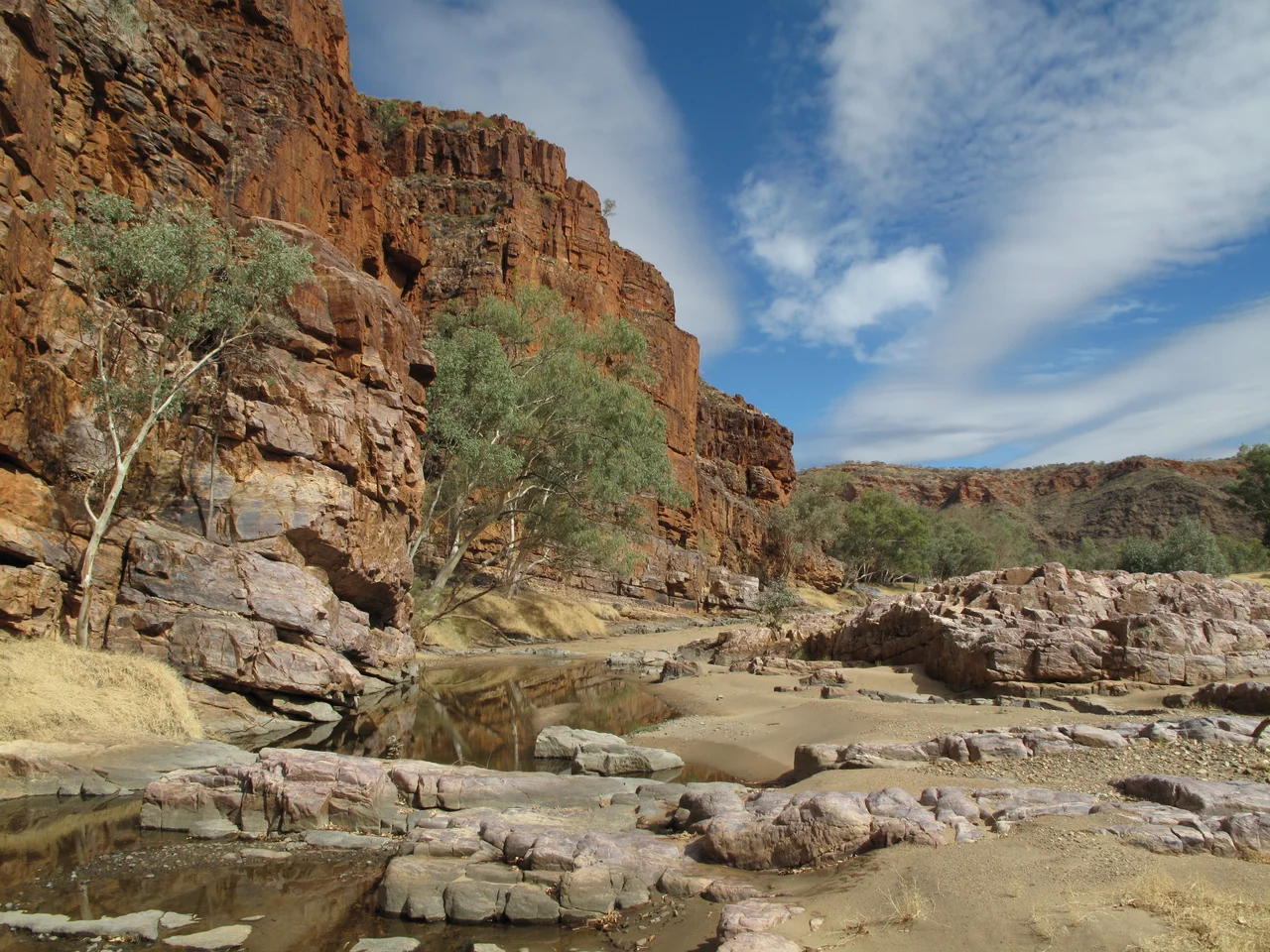

Ruby Gap Nature Park
The red stones were lying right there in the sand of the Hale River, glittering like a promise. In March 1886, the surveyor David Lindsay picked some up, decided he was looking at rubies, and set off a stampede. Within two years more than two hundred and sixty fortune-hunters had hauled themselves a hundred and fifty kilometres east of Alice Springs into one of the harshest corners of the country, certain they had found a fortune in the dirt. They were half right. The stones were real, beautiful, and abundant. They just weren't rubies. To the Eastern Arrernte, whose country this is, the gorge is Tyweltherreme - a place that long predates anyone's idea of treasure.
The Rush That Wasn't
Word travelled fast in the colonial frontier, and a ruby field promised the kind of wealth that made men abandon everything. By May 1888, prospectors swarmed the dry riverbed, chipping at the cliffs and sieving the sand of what they had named Ruby Gap. It was Central Australia's very first mining rush, narrowly preceding Lindsay's own discovery of gold at Arltunga, forty-five kilometres to the west. For a brief, dizzy moment the future looked written in crimson. So many stones came out of the ground that they flooded the market - and that flood, ironically, was the beginning of the end. When a commodity that should be rare suddenly isn't, buyers start asking why.
Garnets, Not Rubies
The questions reached the experts, and the experts reached a verdict. After extended debate, the gemmologists ruled in June 1888 that the glittering red stones were garnets - high-quality garnets, certainly, but garnets all the same, worth a fraction of the rubies everyone had imagined. The market did not gently correct; it crashed. News rippled across the field on 24 May 1888, and the dream that had pulled hundreds into the desert evaporated almost overnight. The rocks in the riverbed had not changed at all. Only the word attached to them had, and the word was everything. Today the park still draws visitors who scratch through the sand at Glen Annie Gorge - the gorge Lindsay named for his wife, Annie - hoping to spot the deep red garnets that fooled an entire colony.
A Grave by the River
One man did not leave. Within the park lies the grave of F. H. Fox, a miner who managed the MacDonnell Ranges Ruby Mining Company, and the timing of his death reads almost like a parable. Fox died on 25 May 1888 - the day after the announcement that turned everyone's rubies into garnets, that collapsed the company he ran, that ended the rush. Whether the news and the death are connected, no record says. The grave is known simply as Fox's Grave, and it sits at the end of a popular walking track, one of the very few visible relics the ruby rush left behind. The headstone that stands there now may not even mark the original spot. It is a fittingly uncertain monument to a boom built on a beautiful mistake.
Older Than the Rush
Strip away the brief human frenzy of the 1880s and what remains is a place of quiet, ancient drama. The Hale River has carved Ruby Gap into towering cliff lines, walls of folded rock glowing in the low light of morning and evening, water lingering in shaded pools long after the surrounding land has dried. Reaching it is still genuinely remote - the approach runs through the Arltunga Historical Reserve and demands a capable four-wheel drive - which is exactly why the gorge feels untouched. The garnets that bankrupted a mining company are still scattered through the sand, free for anyone patient enough to look. The rush lasted barely two years. The gorge has been here, and held by the Arrernte, for a very long time before that, and will outlast every prospector by an immeasurable margin.
From the Air
Ruby Gap Nature Park sits at about 23.50 degrees south, 135.02 degrees east, roughly 150 kilometres east of Alice Springs in the East MacDonnell Ranges of the Northern Territory. The park covers about 9,257 hectares along the Hale River, whose course cuts a dramatic gorge through ridgelines visible from altitude in clear conditions. The nearest major airport is Alice Springs Airport (YBAS) to the west, the transport hub for all of Central Australia. There are no sealed roads to the park; ground access is by four-wheel drive only, via the Arltunga Historical Reserve. The arid interior offers excellent visibility for most of the year, with the best light at dawn and dusk when the river's cliff lines glow red and the surrounding mulga plains throw long shadows.
Nearby Stories
- Hart, Northern Territory 20 km away
- Colson Track 40 km away
- Connellan Air Disaster 77 km away
- Alice Springs Telegraph Station 81 km away
- Stuart Highway 148 km away
- Simpson, Northern Territory 168 km away
- Marqua Station 168 km away
- Simpson Desert Bike Challenge 205 km away