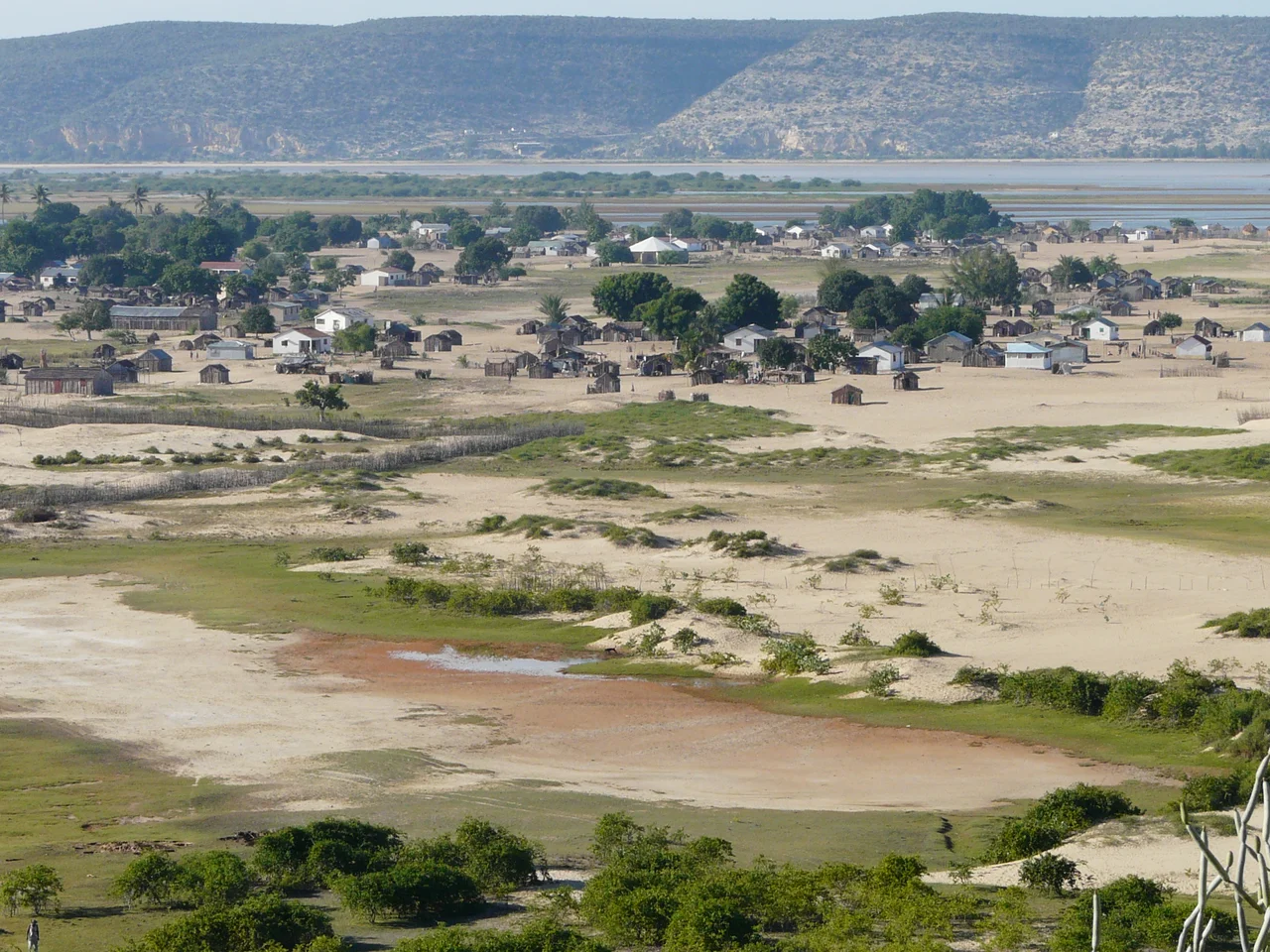

Saint Augustin, Madagascar
Eighty English settlers died here in less than a year. In 1645, a syndicate of London merchants led by William Courteen and Thomas Kynnaston landed a colonizing party on the southern shore of this bay, certain that the warm latitudes near the Onilahy River's mouth would yield easy fortune. They arrived in the dry season, when nothing would grow. The crops failed, the wells turned brackish, and disease moved through the camp. When Malagasy herders drove off the settlers' cattle and then attacked, the survivors had had enough. The roughly sixty who remained abandoned the bay and sailed for India, leaving Saint Augustin to the people who had always known how to live here.
The Bay That Beckoned
Saint Augustin's appeal was never imaginary. The bay sits where the Onilahy River empties into the Mozambique Channel, roughly thirty-five kilometers south of present-day Toliara, sheltered enough to anchor a wooden ship and rinse the salt of a long Indian Ocean crossing from a crew's throats. European captains had marked it on their charts for generations. Fresh water, a defensible shoreline, and a position astride the trade route between the Atlantic and the riches of India made it look, on paper, like the perfect waystation. The Courteen merchants were not foolish to want it. They simply did not understand it. What the charts could not show was that a southwest-Madagascar shore which looks lush from the deck of a ship can offer almost nothing to people who do not know its rhythms - and the dry season here is merciless to the unprepared.
The Pirates Who Stayed
Where settlers failed, opportunists thrived. By the early 1700s, Saint Augustin had become a fixture on the pirate circuit that prowled the Indian Ocean, a coast where men like John Pro, Thomas White, Samuel Burgess, and John Halsey were known to put in. One former pirate, John Rivers, built something more permanent. From 1686 until his death in 1719, Rivers ran a trading post at the bay, reprovisioning passing ships for a fee and dealing in enslaved people - a grim commerce that ran through these waters and reduced human lives to cargo on a ledger. His settlement outlasted the Courteen colony many times over, not because the place had grown gentler, but because a trading post asks far less of a coast than a colony does. It needs only a steady stream of ships and something to sell them.
Life on the Onilahy
Strip away the centuries of European ambition and what endures at Saint Augustin is the ocean and the people who work it. Roughly six in ten residents fish these waters, paddling slender outrigger canoes out past the bar much as their ancestors did. Another quarter farm the surrounding land, coaxing sweet potatoes, rice, and lima beans from soil that demands patience. A smaller share keep livestock. It is a community shaped by the river's mouth and the channel's tides rather than by any harbor master's plan. The town's relationship with the wider world remains stubbornly physical: since 2021, reaching it has meant either a small outrigger across the water or a road journey of some two hundred and fifty kilometers around the bay, a detour that keeps Saint Augustin close to the sea and far from everything else.
What the Water Remembers
There is a quiet symmetry to Saint Augustin's history. The bay that promised easy wealth to outsiders gave none of it freely. The English came for fortune and found graves. The pirates came for profit and built it on the suffering of others. And through all of it, the fishing families remained, neither conquering the place nor conquered by it, simply living at the rhythm the Onilahy and the channel allow. Today the wide estuary still opens to the Mozambique Channel, the canoes still go out at dawn, and the dry season still comes when it comes. The names on the old charts have faded, but the bay keeps doing what it has always done: rewarding those who learn it and turning away those who assume.
From the Air
Saint Augustin lies at 23.55 degrees S, 43.77 degrees E on the southwest coast of Madagascar, at the wide mouth of the Onilahy River where it meets the Mozambique Channel. From the air, look for the pale estuary cutting through arid coastal terrain and the sheltered curve of the bay opening westward to the sea. Best viewed at lower altitudes in clear conditions; the contrast between the green river corridor and the surrounding dry peneplain makes the river mouth a reliable visual landmark. The nearest airport is Toliara Airport (ICAO: FMST), roughly thirty-five kilometers north. The wider region is served by Antananarivo's Ivato International Airport (ICAO: FMMI) for connecting flights. Visibility is best in the May-to-November dry season.
Nearby Stories
- Ifaty 17 km away
- Aloalo 28 km away
- Tsimanampetsotsa National Park 43 km away
- Zombitse-Vohibasia National Park 80 km away
- Velondriake 126 km away
- Androy 157 km away
- Europa Island 319 km away
- SS Lourenco Marques 767 km away