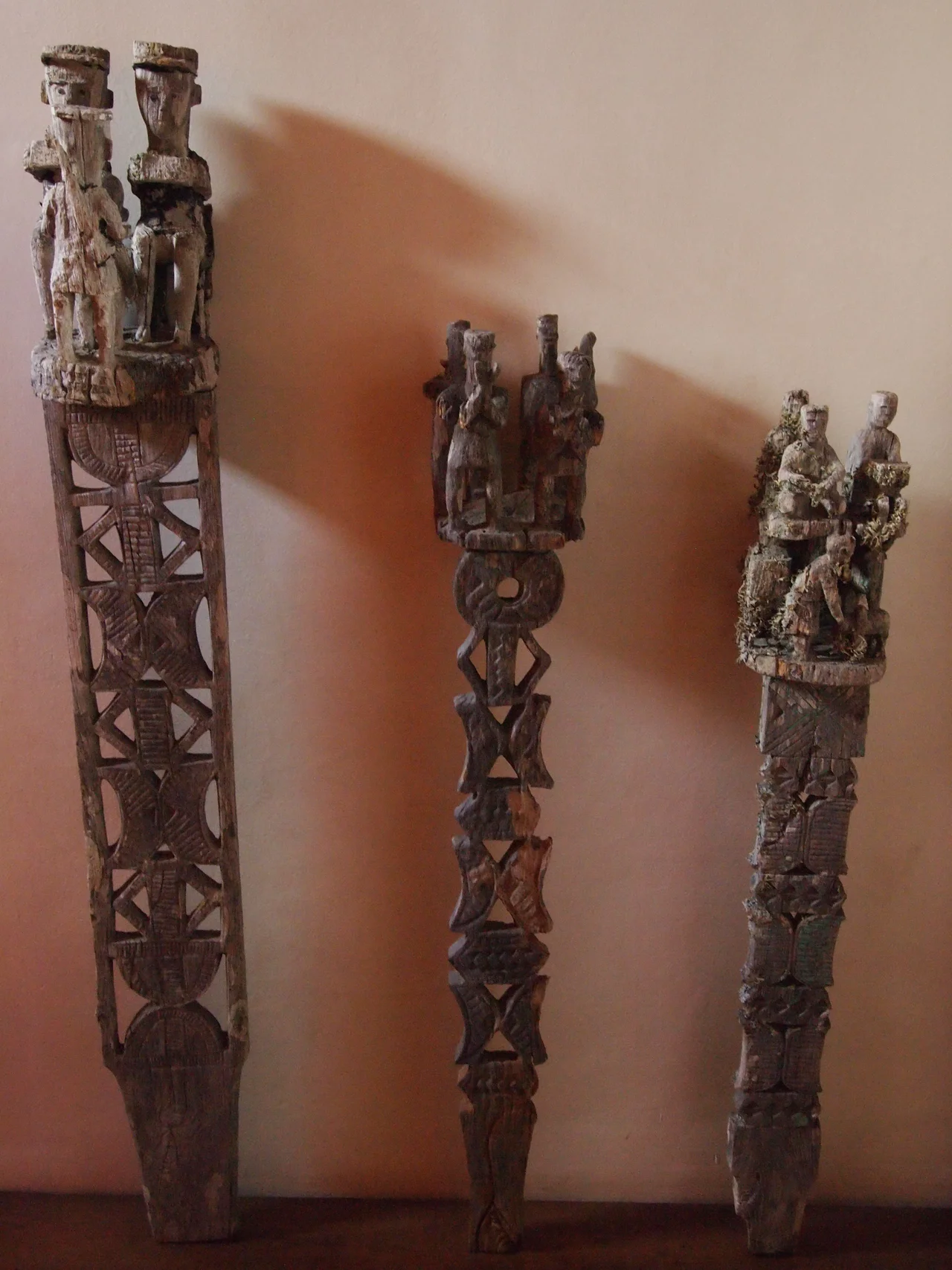

Aloalo
The word itself explains the work. In Malagasy, alo means 'intermediary' or 'messenger,' and the aloalo is exactly that: a carved wooden post raised above a tomb to help the person buried beneath it cross over into the community of ancestors. These are not headstones in any Western sense. Among the Mahafaly people of southwestern Madagascar, death is understood not as an ending but as a passage - a transformation in which the deceased becomes a razana, an ancestor, one of the intermediaries between the living and the divine. The aloalo stands at the threshold of that passage, a sculpture whose purpose is to speak on behalf of someone who can no longer speak for themselves.
A Life Carved in Wood
An aloalo tells a story, and the story is a person. Each post takes the form of a tall wooden stele, its lower length worked into stacked geometric forms - crescents, open circles, interlocking shapes - rising toward a crown of figures at the top. Those upper carvings are the biography. They might depict scenes from the dead person's life, the things they did or owned, the achievements that defined them, often gathered around the figure of a zebu, the humped, crescent-horned cattle that stand at the center of wealth and well-being across the Malagasy plains. A combination of human figures and birds is typical. To read an aloalo is to read a life: this is who they were, this is what they valued, this is what they leave behind.
The Weight of the Zebu
Nothing on an aloalo carries more meaning than the zebu. In Mahafaly life, these cattle are far more than livestock - they are prosperity made flesh, the measure of a family's standing and the currency of its most important obligations. At the funeral of a person of stature, zebu are slaughtered, and their skulls and horns are arranged across the tomb alongside the carved post, a visible record of the honor paid to the dead and the wealth their family commanded. The zebu rendered atop the aloalo echoes those skulls below: prosperity in life, prosperity offered in death. The number of posts a tomb carries speaks plainly of status - the more aloalo, the greater the person they commemorate.
Who the Posts Were For
The aloalo was not, at first, for everyone. In earlier times these monuments were the prerogative of kings and queens, emblems of nobility reserved for those born to rank. Over generations the tradition opened: the wealthy could commission them, and eventually anyone able to honor their dead in this way might raise a post. The art is most closely bound to the Mahafaly, but it is not theirs alone. Aloalo also stand on some tombs of the Antandroy, and on those of the Sakalava, whose carvers became known for figures rendered with frank, sometimes erotic candor. Across all of these peoples, the underlying conviction holds: the tomb is the ancestor's new home, and the carved post is the messenger that helps them arrive.
From the Tomb to the World
These were sacred objects, raised in places set deliberately apart. Traditionally, burial grounds and their aloalo stood outside the villages of the living, in landscapes reserved for the dead and the ancestors they were becoming. That separation was the point - a boundary between the everyday and the eternal. The arrival of French colonial rule in 1896 began to dissolve it. As Madagascar opened to the outside world, the aloalo were noticed, admired, and removed; today these funerary sculptures, made to stand over a specific person's grave and to carry that person's spirit onward, often surface instead on the international art market, far from the tombs they were carved to serve. The skill in them is undeniable. So is the loss, when a messenger meant for one family's dead ends up speaking to strangers in a gallery.
From the Air
The aloalo tradition is centered in the Mahafaly homeland of southwestern Madagascar; the reference coordinates here are 23.17 degrees S, 44.56 degrees E, inland from the Toliara coast in the Atsimo-Andrefana region. This is a cultural tradition rather than a single structure, so there is no one landmark to sight from altitude - but the surrounding country is the spiny-forest and dry-plain landscape of the deep southwest, where Mahafaly tombs and their carved posts stand apart from villages, sometimes visible as small clusters in otherwise open terrain. The nearest airport is Toliara Airport (ICAO: FMST) on the coast to the west, with national connections through Antananarivo's Ivato International Airport (ICAO: FMMI). Best appreciated on the ground and up close; from the air, the dry southwestern interior is most clearly seen in the May-to-November dry season.
Nearby Stories
- Arboretum d'Antsokay 20 km away
- Zombitse-Vohibasia National Park 21 km away
- Ilakaka 29 km away
- Ifaty 34 km away
- Mikea Forest 63 km away
- Saint Augustin, Madagascar 75 km away
- Isalo National Park 81 km away
- Anosy 155 km away