
Salisbury University
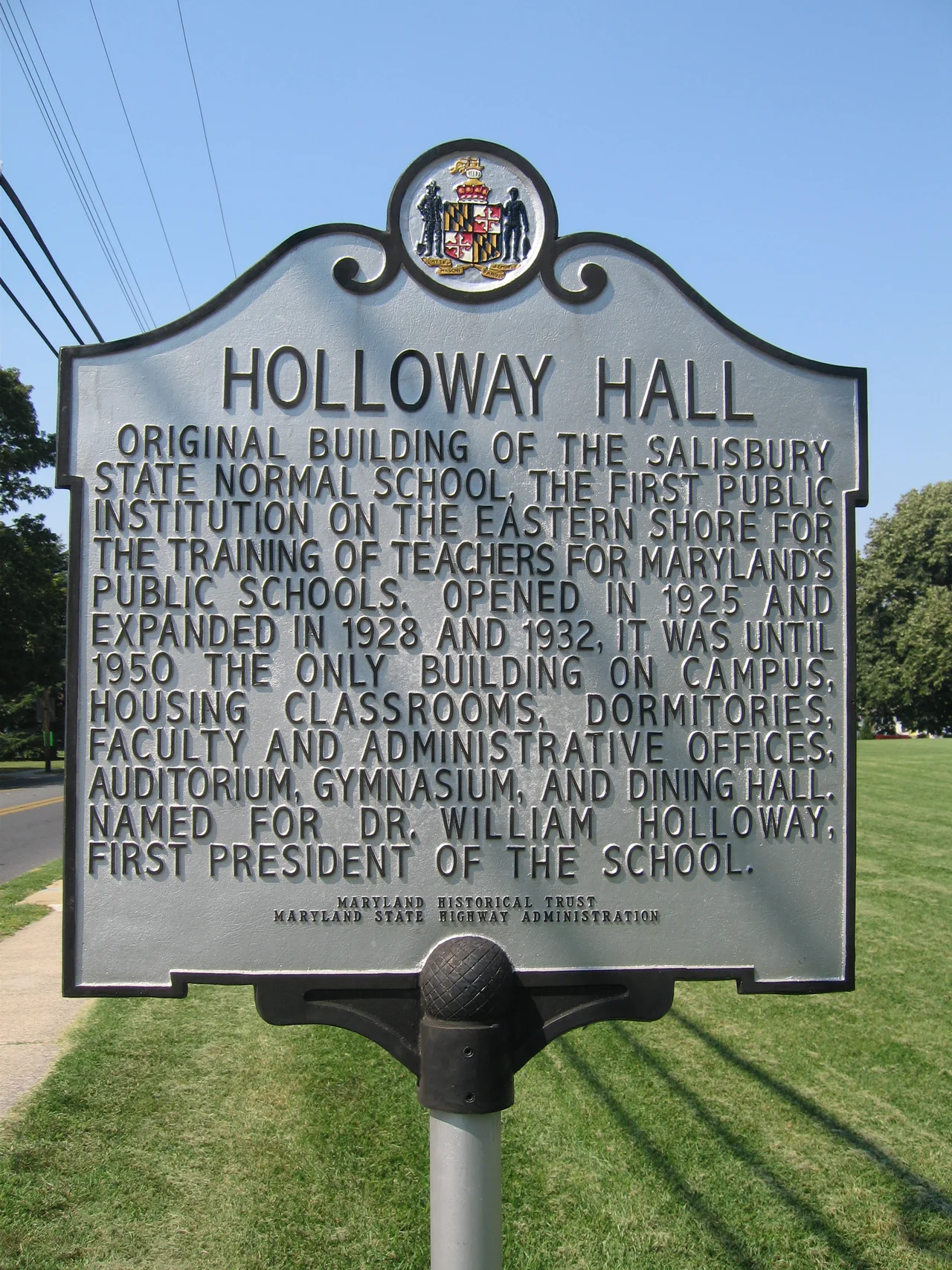
On September 25, 1925, William J. Holloway opened the Maryland State Normal School with 105 students. Six of his eight original faculty members held degrees from Columbia's Teachers College, and the curriculum reflected that pedigree - even in a small Eastern Shore town, the new school began as an outpost of Progressive-era teacher training. Maryland was short on elementary school teachers, and the lower shore was the part of the state most short of all. Holloway's school took the unglamorous assignment and ran with it. A century later, the institution is Salisbury University, the largest employer on the lower shore after Perdue Farms, and the lacrosse field next to Holloway Hall has hosted more national championships than the football field at most flagship universities.
Five Names in a Century
The school has worn a name for each phase of its mission. It opened as the Maryland State Normal School in 1925, a two-year teacher-training program. During the Depression the state extended the course of study to three years, then four, and in 1935 the institution rebranded as the Maryland State Teachers College. In 1963 it became Salisbury State College, signaling expansion beyond teacher training. By 1988 it was Salisbury State University, and in 2001 it dropped 'State' to become simply Salisbury University. Each renaming followed an expansion of mission - graduate degrees, professional schools, research programs, doctoral offerings. The school now organizes 8,000 students across six academic units: the Fulton School of Liberal Arts, Perdue School of Business, Henson School of Science and Technology, Seidel School of Education, the College of Health and Human Services, and the Clarke Honors College. Two of those names belong to Eastern Shore families that gave the buildings: the Perdues of poultry, the Hensons of aviation.
An Arboretum With Buildings In It
Salisbury University's 183-acre campus was designated an arboretum in 1988 by the American Association of Botanical Gardens and Arboreta. More than 2,000 species of plant life grow here - magnolia, rhododendron, viburnum, Japanese maple, bald cypress, crape myrtle. A goldfish pond and Japanese garden sit beside the Honors House. The Pergola near the Commons, the Holloway Hall Courtyard Garden, the Bellavance Honors Center Japanese Garden, and the Miller Alumni Garden all anchor the landscape. The campus also holds an unexpected collection of figurative sculpture, including casts of works by Auguste Rodin (Coquelin Cadet), Daniel Chester French (Ralph Waldo Emerson), Augustus Saint-Gaudens (Diana), and Carl Akeley (Wounded Comrade). A student walking from the academic commons to the dining hall passes a Rodin, a French, and a saint-Gaudens. Few state universities have arranged their campuses this carefully.
Thirteen National Lacrosse Titles
Salisbury University men's lacrosse has won thirteen NCAA Division III national championships, more than any other program in the division. Between 2003 and 2008 the Sea Gulls won five titles in six years, including three consecutive championships. During one stretch the team won 114 of 115 games and recorded a 69-game winning streak. The lacrosse program is the engine of Salisbury athletics, but the overall Sea Gulls record stretches well beyond it: 22 team national championships in total and 24 individual titles in track and field and wrestling. The university competes mostly in the Coast to Coast Athletic Conference, with football in the New Jersey Athletic Conference. For a Division III school in a town of 33,000 people, the trophy case is improbable - the kind of athletic culture more often associated with Division I universities five times the size.
The Sarbanes Lecture and the Bosserman Center
Salisbury is not just a sports school. The Paul S. Sarbanes Lecture Series, named for Maryland's second-longest-serving U.S. Senator, has brought John Lewis and Nancy Pelosi to campus. The Fulton School's Bosserman Center for Conflict Resolution has hosted Nobel laureates Lech Walesa, the former president of Poland and co-founder of Solidarity, and F.W. de Klerk, the South African president who began the negotiations that ended apartheid. In 2020 the United Nations designated the Bosserman Center as a Regional Centre for Expertise - a hub for conflict prevention and creative problem solving - and the university became a designated United Nations Millennium Campus. Twenty-nine Salisbury students have been named UN Millennium Fellows since 2020. The Patricia R. Guerrieri Academic Commons, opened in 2016 at a cost of $117 million, is the largest building on campus; the Princeton Review named its library one of the top 20 in the United States in 2021, alongside Columbia and Williams.
The Sea Gull Century and the Hundred-Mile Ride to Assateague
Each October, Salisbury University hosts the Sea Gull Century - a 100-mile (and 62-mile) cycling event that draws nearly 8,000 riders to the flat back roads of the Eastern Shore. The ride begins and ends at the university and includes a scenic halfway point at Assateague Island, where the wild ponies graze on the dune grass. For one Saturday, the Eastern Shore has more spandex than seafood. The university is also home to the American Cancer Society's largest on-campus Relay for Life event in the country - a per-capita fundraising leader that has raised more than $1.5 million since it started. The Eastern Shore Regional GIS Cooperative, founded in 2004, works with municipal, county, regional, state, and federal partners across Delmarva to build data tools for everything from emergency response to land conservation. In May 2024, the university announced a $100 million performing arts complex to be built in downtown Salisbury - a thousand-seat theater and a smaller 450-seat space - in partnership with the city. The school that opened in 1925 to train elementary teachers now anchors the cultural life of the region it was founded to serve.
From the Air
Salisbury University sits at 38.34 degrees north, 75.60 degrees west, just south of downtown Salisbury between US-50 and Camden Avenue. The 183-acre campus is visible from low altitude as a wooded green patch with brick Georgian buildings interrupting the canopy. Salisbury Regional (KSBY) is about 2 nautical miles southeast and the principal commercial field on the Lower Shore. Ocean City Municipal (KOXB) lies 24 nautical miles east. Pattern altitude of 1,500 feet AGL gives a good view of the arboretum landscape. Watch for migrating waterfowl on the river south of campus in fall and active Restricted Areas near Wallops Flight Facility 35 nautical miles south during launches.
Nearby Stories
- Assateague Island National Seashore 7.2 km away
- Berlin, Maryland 8.5 km away
- Somerset County, Maryland 11 km away
- Point Lookout Light 12 km away
- Rehoboth Beach 14 km away
- Punkin Chunkin 20 km away
- St. Mary's City, Maryland 27 km away
- Columbia Air Center 38 km away