
Saltdal Municipality
On 14 July 1943 a Yugoslav prisoner named Miloš Banjac was shot dead by a guard on the road his fellow prisoners were building through the Saltdal valley in Arctic Norway. His brother went to the rock face beside the body and drew a cross on it with the dead man's blood. People living in the valley began calling the road Blodvegen - the Blood Road - and in the eighty years since, the cross has been repainted in red again and again, by successive generations who decided it was not going to be allowed to fade into just another stretch of highway. You can still walk the section from Saltnes to Saksenvika. Most of it now lies under the E6, the road that carries traffic the length of Norway.
Blodvegen
The Germans demanded the road in December 1941. The plan was ambitious to the point of fantasy: extend both the highway and the Nordland Line railway north from Lønsdal on the Saltfjellet plateau, on to Narvik and eventually to Kirkenes on the Russian border. Over three years of forced labour they got the railway as far as Bodø and no further. The road went further, and the reason it went further is the reason it has the name it has. Between fifteen and eighteen prisoner-of-war camps operated in this one valley, holding around 9,500 Soviet, Polish and Yugoslav prisoners - among the worst concentration of such camps anywhere in Norway. Rations were minimal, working hours long, clothing inadequate for an Arctic winter, barracks primitive, sanitation almost nonexistent. Some of the prisoners were children of twelve, thirteen, fourteen.
Botn
The camp at Botn, two kilometres from Rognan, ran from July 1942 to June 1944, and its arithmetic is stark enough to be read on its own. Four hundred and seventy-two Yugoslav prisoners arrived on 25 July 1942. By April 1943, at least 302 of them were dead. Three hundred more arrived that same month; when the camp was finally cleared on 1 June 1944, 381 prisoners were left to transfer. Of the roughly nine hundred men who passed through Botn, about half died there - executed, beaten, starved, or worked past what a body can do. The SS ran the camp until the Wehrmacht took it over in October 1943, after which conditions improved somewhat. In 1946 Yugoslav courts sentenced twenty-two guards to death, five of them from Botn. The war cemetery at Botn, dedicated in September 1954, holds 1,657 dead. Of those, 1,027 have no name.
A Valley That Used to Be a Fjord
Geology in Saltdal works on a scale that makes the war feel recent. When the ice melted nine thousand years ago the land was still pressed down under its own memory of that weight, and the sea reached what is now 120 metres of altitude - the whole valley floor was salt water. It has been rising ever since. Rognan, the administrative centre, sits exactly where the valley floor now meets the head of the Saltdal Fjord. The municipality covers 2,216 square kilometres, twenty-sixth largest of Norway's 357, and holds 4,880 people, which works out at 2.2 per square kilometre. The highest ground is Nordre Saulo, 1,755.98 metres, inside Junkerdal National Park on the Swedish border. Saltdal's climate is not Arctic in the way the latitude suggests. In the European heatwave of July 2019, the thermometer at Nordnes reached 34.6°C - the highest temperature ever recorded north of the Arctic Circle in Norway. In January 2010, Borkamo recorded −32.2°C.
The Strong Stream
The name is older than any of this. It comes from the Saltdalselva, the river running the length of the valley, whose Old Norse name was Salpti, from a root meaning strong stream. Add dalr, valley, and you have the whole thing. The spelling was Saltdalen until a royal resolution of 3 November 1917 removed the definite ending. The coat of arms, granted on 28 October 1988 and designed by Arvid Sveen, is a pair of golden rowan twigs on red - chosen for the rowan forests that grow here, and for a pun, since the Norwegian for rowan is rogn and the main village is Rognan. It is not subtle heraldry, but it is honest about what the place is made of.
Boats, Cables and a Wrestler
Before the war, boatbuilding in local timber employed a substantial share of everybody in Saltdal - a valley economy built on the forest at one end and the fjord at the other. The largest employer now is the Nexans plant at Rognan, which makes telecommunications, fibre-optic and copper cable - a shift from wooden hulls to signal-carrying wire that took less than a century. The valley has produced its share of people, too. Bernhoff Hansen was born in Rognan in 1877, left for the United States eighteen months before the 1904 Olympic Games in St. Louis, and won gold in heavyweight freestyle wrestling there, taking all three of his bouts by fall; he died in New York in 1950. Trygve Henrik Hoff, born in Rognan in 1938, wrote songs that became standards in northern Norway before his death in 1987. The historian and politician Ludvig Kristensen Daa was born here in 1809.
From the Air
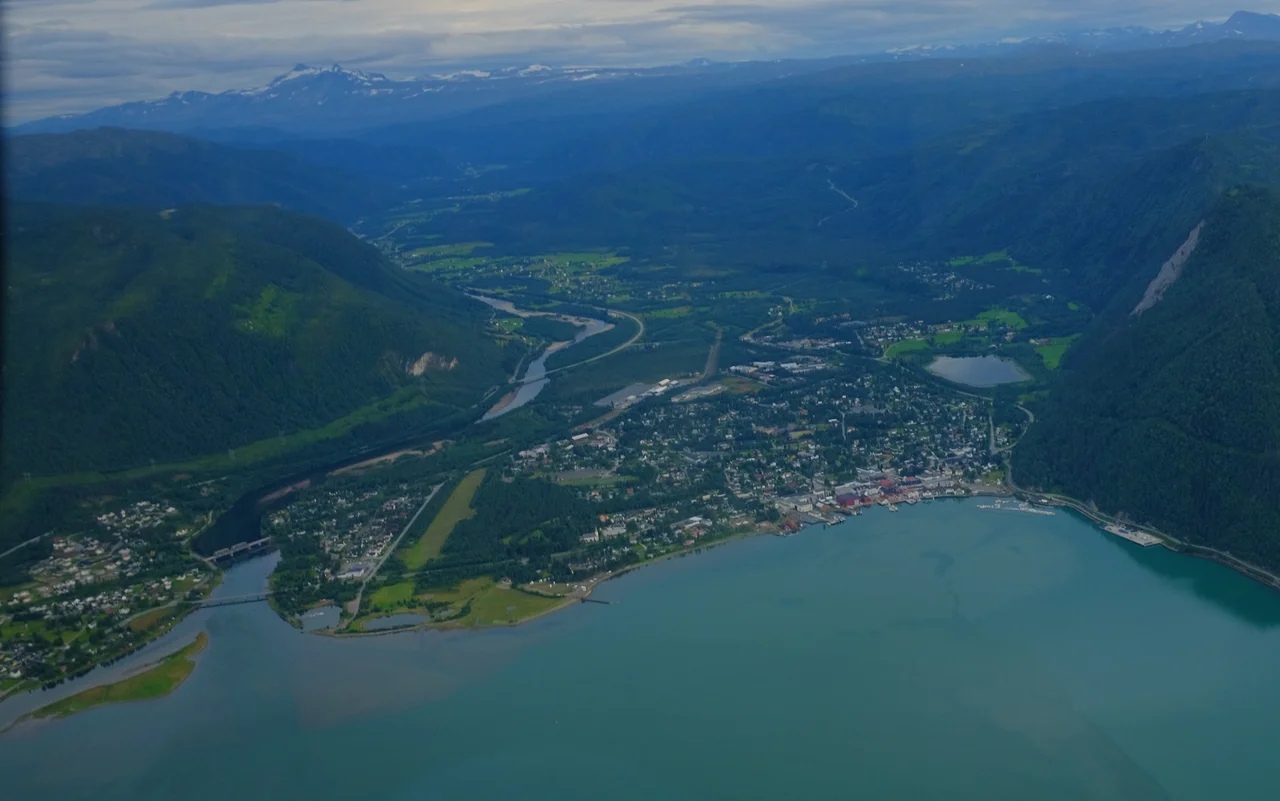
Saltdal Municipality is centred near 66.92N, 15.56E in Nordland county, Norway, entirely north of the Arctic Circle. The dominant feature from the air is the long Saltdalen valley running roughly north-south from the Saltfjellet plateau down to the head of Saltdal Fjord at Rognan, with the E6 and the Nordland Line railway threading it side by side - one of the clearest linear navigation references in northern Norway. Junkerdalen branches east toward Sweden carrying National Road 77. Terrain rises steeply on both flanks to over 1,500 m, peaking at Nordre Saulo (1,755.98 m). Best viewed from 4,000-8,000 feet AGL to keep both the fjord head and the plateau in frame. Bodø (ENBO) is the nearest main airport, about 90 minutes from Rognan by road, with Mo i Rana Røssvoll (ENRA) to the south; Rognan itself has a small general-aviation strip on the valley flats. Expect strong valley winds, frequent low cloud on the Saltfjellet, and complete darkness in midwinter.
Nearby Stories
- Sjønstå 7 km away
- Vuoggatjålme 9.3 km away
- Nasa Silver Mine 20 km away
- Saltstraumen 24 km away
- Dunderland Valley Bus Crash 25 km away
- Sulitjelma Glacier 28 km away
- Operation Musketoon 50 km away
- Laponia 64 km away