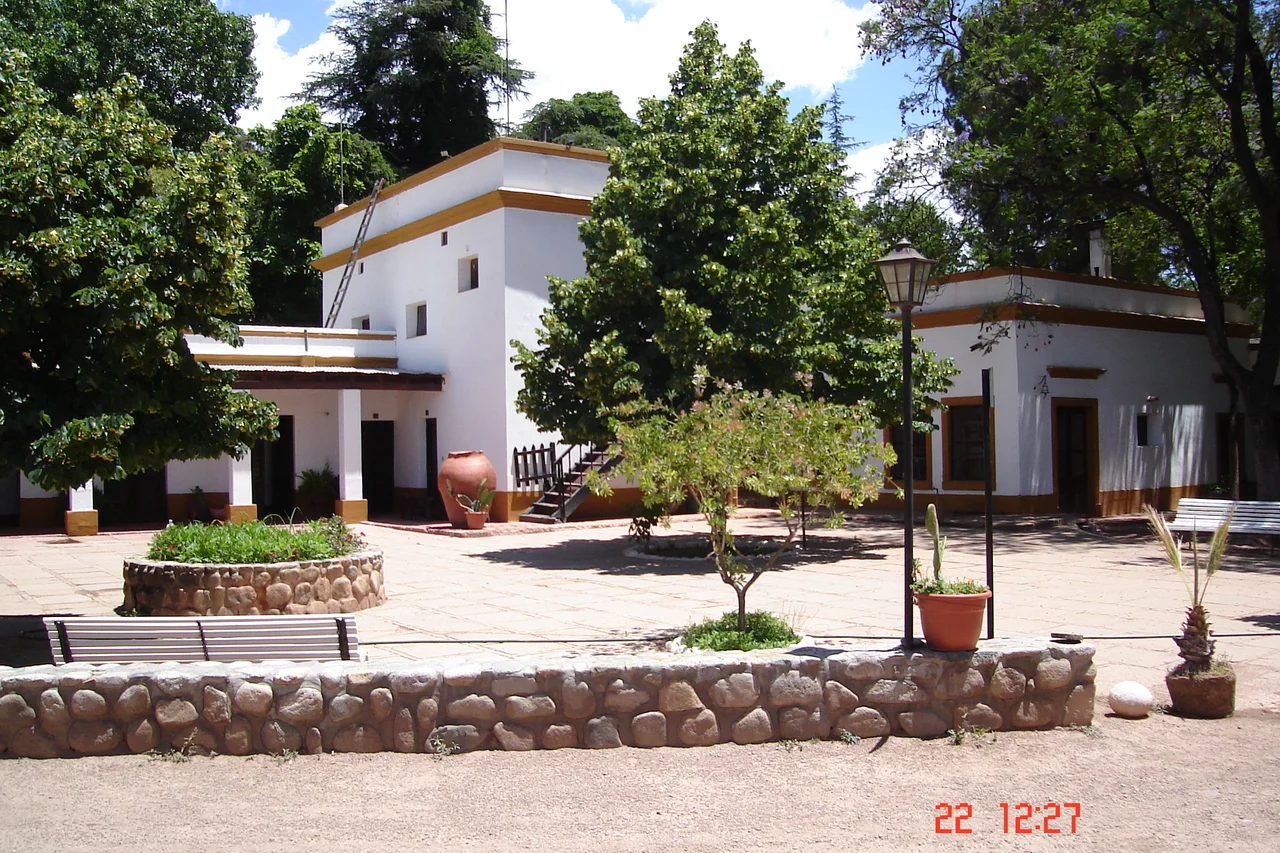

Samay Huasi
Two men met over mining law and ended up trading a house. William Treloar, a British engineer, had come to the dry hills above Chilecito chasing ore and stayed to plant vineyards. Joaquín V. González, born just down the valley in Nonogasta, had grown into one of Argentina's most prolific minds. When Treloar died, he left his friend the finca he called La Carrera. González renamed it in Quechua: Samay Huasi, the rest house. For a man who would write more than a thousand things in his lifetime, rest was the rarest thing he owned.
The House That Quechua Named
The name is a small act of belonging. Samay Wasi means "rest house" in Quechua, the language of the Andes that the Spanish never fully erased from these provinces. González, who inherited the seventeen-hectare property in 1913, did not simply move in. He kept Treloar's vineyards and orchards, expanded the living quarters, and turned the horse stables into ten bedrooms, one for each of his sons. A man arranges a house around what he loves. González loved his family, his books, and the brown mountains rising behind the courtyard. Set high in the Sierras Pampeanas of La Rioja Province, the finca looks out on exactly the kind of landscape that had shaped him as a boy and would outlive him as a museum.
A Thousand Things Written
González was the kind of polymath that an ambitious young nation seems to produce and then half-forget. Born in 1863, he earned a law degree, served as Governor of La Rioja, became a celebrated authority on mining law, and in 1905 founded the University of La Plata, one of Argentina's great institutions. He left behind a staggering bibliography: more than fifty books and over a thousand shorter works. Yet the volume he loved most was not legal or political. In 1903 he published Mis Montañas, My Mountains, an ode to the Talampaya canyons and Andean horizons of his childhood. When the property's museum opened decades later, it took that book's title for its own.
From Retreat to Refuge
González willed Samay Huasi to the University of La Plata and died in 1923, sixty years old, in Buenos Aires. The university formally took possession in 1941 and gave the house a new purpose that suited its old name. It became the Casa de Descanso para Artistas y Escritores, a retreat where artists and writers could do what González so rarely managed: stop. In 1960 part of the house became a museum named Mis Montañas, displaying the founder's anthropological and geological collections alongside his manuscripts. The stones he gathered, the words he wrote, the mountains he loved, all gathered under one roof at last.
The Painter and the Portrait
Walk through Samay Huasi today and you also walk into a gallery. The Antonio Alice Pinacotheca takes its name from the Argentine portraitist and history painter who, among many works, painted González in 1917. The gallery hangs canvases from a range of Argentine artists, so that the writer's retreat doubles as a small national collection. There is a quiet logic to it. González spent his life trying to give his country institutions worthy of its ambition, universities and laws and books. It feels right that his rest house ended up holding art, the work of others, kept safe in the place he built to think. The setting completes the effect. The house sits among parras, the trained grapevines Treloar planted and González kept, their leaves filtering the harsh sierra light into something gentler. Stand in the patio and the whole arrangement makes sense: a working vineyard, a museum of stones and manuscripts, a wall of paintings, and the dry mountains beyond. A man spent a lifetime collecting the world, and then arranged for the world to keep coming here to rest.
From the Air
Samay Huasi sits at roughly 29.17 degrees south, 67.48 degrees west, tucked into the foothills of the Sierras Pampeanas just outside Chilecito in La Rioja Province, at an elevation near 1,000 meters. From the air, look for the green seam of irrigated vineyards and orchards against the parched ochre of the surrounding sierra, with the great Famatina range walling off the western horizon. The nearest major field is Capitán Vicente Almandos Almonacid Airport at La Rioja (ICAO SANL), about 150 km southeast. A viewing altitude of 8,000 to 10,000 feet shows the contrast between the cultivated valley floor and the bare peaks above. Afternoon thermals and mountain turbulence are common in this high desert; clearest light comes early.
Nearby Stories
- 2015 Villa Castelli Mid-Air Collision 37 km away
- Talampaya National Park 68 km away
- Ischigualasto Provincial Park 85 km away
- San Fernando del Valle de Catamarca 107 km away
- Londres, Catamarca 125 km away
- Laguna Negra, Catamarca 148 km away
- Battle of San Cala 262 km away
- Battle of Famaillá 266 km away