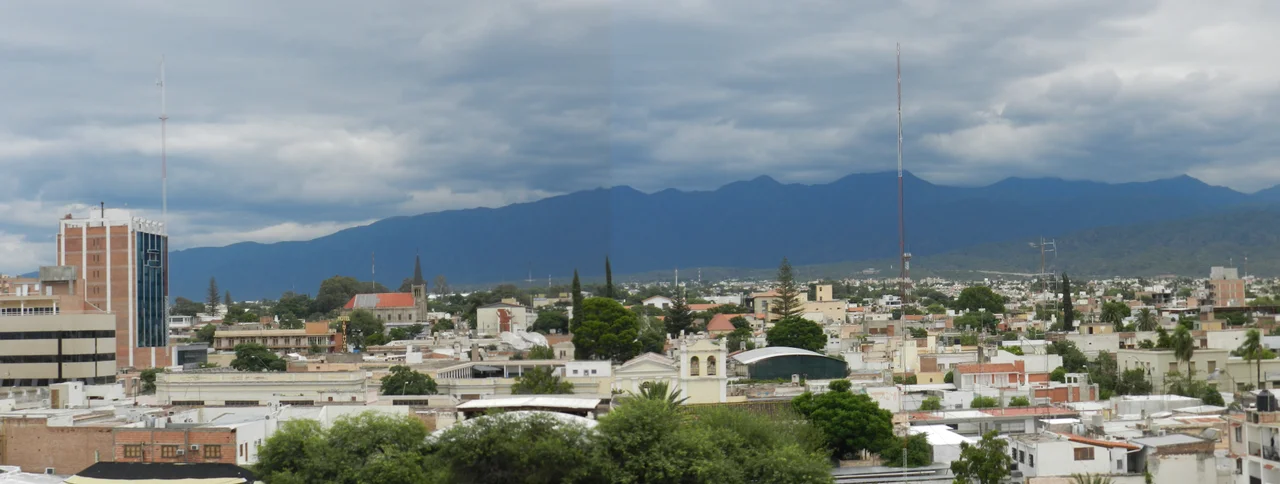

San Fernando del Valle de Catamarca
Sometime around 1620, in a cave near Choya, a small statue of the Virgin Mary was found, her face and hands a soft brown. Four centuries later, pilgrims still come for her. They fill the streets of San Fernando del Valle de Catamarca, climb toward the cathedral, and pray before Nuestra Señora del Valle, Our Lady of the Valley. The city that grew up around that devotion sits in a hot, dry basin in northwestern Argentina, cradled at the feet of Cerro Ambato, on the banks of the Río Valle. To understand Catamarca, start with who keeps arriving, and why.
Our Lady of the Valley
The pilgrimage is the heartbeat of the city. The image of the Virgin, discovered in a cave in the early 1600s, became the spiritual anchor of a remote province, and the records of organized pilgrimage reach back to 1640. Devotion only deepened with time. In 1891 the statue was solemnly crowned by decree of Pope Leo XIII, and in 1907 Pope Pius X proclaimed her the patroness of Catamarca. The cathedral that holds her, raised in a confident neoclassical style between 1859 and 1875, was elevated to a basilica in 1941. Twice a year the devout pour in by the thousands, and the small brown-faced Virgin remains, for them, the truest thing in the valley.
A City Founded More Than Once
Catamarca's name comes from Quechua and means, roughly, "fortress on the slope", and the history here was nothing if not a struggle to hold ground. The first Spanish attempt came in 1558, when Juan Pérez de Zurita founded a settlement he called Londres, London, honoring King Philip II's marriage to Mary Tudor of England. That settlement and others were repeatedly founded, destroyed, and relocated as indigenous communities resisted and the harsh land pushed back. Not until July 5, 1683 did Fernando de Mendoza y Mate de Luna establish a permanent city at this site. Growth came slowly. In 1882 the place still held only 8,000 people; the railway reached it in 1888, and the region stayed poor well into the twentieth century.
Water, Stone, and the Things People Make
This is high-desert country, and everything depends on water. Catamarca sits about 500 meters above sea level under a warm semi-arid sky, where summer days routinely climb past 43 degrees Celsius while winter snow falls only on the peaks ringing the valley. Farming is the chief livelihood, but it survives only by irrigation, coaxing fruit and grapes from oasis pockets near the city and turning some of that harvest into wine. The mountains give up gold, silver, copper, and tin at mines like Bajo de la Alumbrera. And there is older work too: the handwoven ponchos of Catamarca are famous across Argentina, patient labor measured in months at the loom.
Between the Capitals
Catamarca is a hub more than a destination for many travelers, the touristic center of its province and a base for excursions into the surrounding sierra, for hiking and horse riding and wine tasting among colonial streets. The San Francisco Convent anchors the old center, and the broad sweep of Güemes Avenue carries the daily life of the city. It sits a long way from the center of Argentine life, 1,130 kilometers from Buenos Aires, closer in spirit to its neighboring capitals: La Rioja just 154 kilometers away, Santiago del Estero and Tucumán a little farther. For a quiet provincial city, it has hosted its moments on the national stage, including matches of the 1982 men's volleyball world championship at the Polideportivo Fray Mamerto Esquiú. But it is the pilgrims, year after year, who give the valley its rhythm and its name. Long after the railway and the mines and the politics, the small brown-faced Virgin is still the reason the roads fill, and still the reason most travelers first hear of Catamarca at all.
From the Air
San Fernando del Valle de Catamarca lies at about 28.47 degrees south, 65.78 degrees west, roughly 500 meters above sea level in a valley of the Argentine Northwest. From the air, the city reads as a grid of irrigated green on the dun valley floor, with the Río Valle threading through and the bulk of Cerro Ambato rising to the north and west. The city is served directly by Coronel Felipe Varela International Airport (ICAO SANC), which handles flights to Buenos Aires-Aeroparque. A viewing altitude of 7,000 to 9,000 feet frames the city against its mountain backdrop. Expect strong afternoon heat and thermals in summer; visibility is generally excellent in the dry air, with the surrounding peaks sharply defined.
Nearby Stories
- Londres, Catamarca 80 km away
- Samay Huasi 116 km away
- Santiago del Estero 117 km away
- Battle of Famaillá 131 km away
- Chilecito 134 km away
- Battle of Tucuman 173 km away
- Talampaya National Park 223 km away
- San José Charterhouse 227 km away