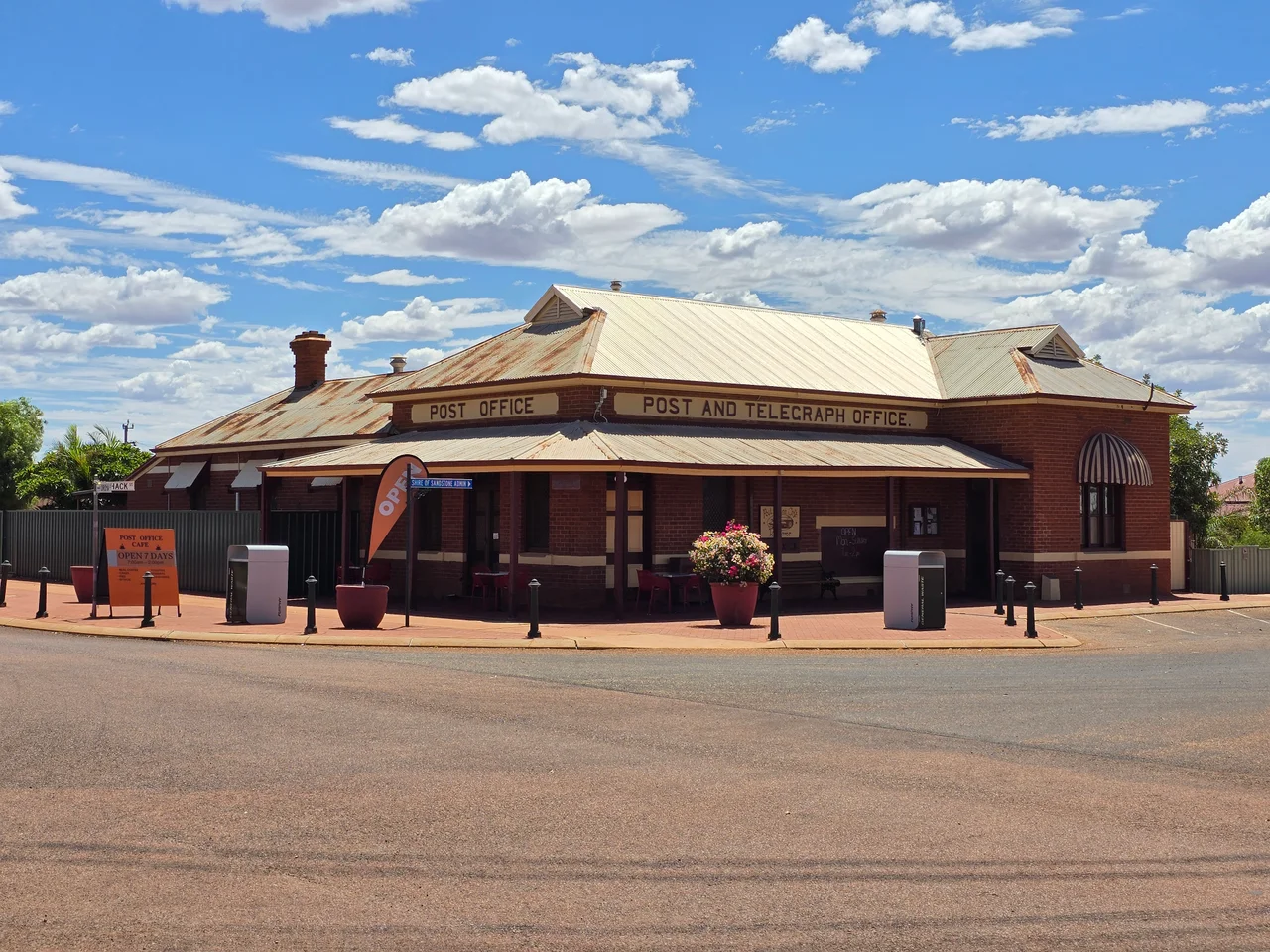

Sandstone, Western Australia
To keep the beer cold in a place where summer afternoons climb past forty degrees, an Irishman named I.V. Kearney did the only sensible thing: he dug the brewery into a cliff. In 1907 he built his works atop a breakaway thirty-five feet high, pumped water to the upper level for brewing, then let the finished beer rest in cellars hollowed out of the rock below, where the stone held the chill that the air would not. Sandstone, then a roaring gold town of several thousand thirsty miners, needed the supply. The miners are long gone - fewer than ninety people live in the whole shire today - but the breakaway and its cool stone cellars endure, one of the strange and human relics of a town the desert nearly erased.
A Reef on New Year's Day
Three South Australians made Sandstone. George Dent and the brothers Wilton and Theodore Hack had spent eight hard years prospecting the area before they struck a gold-bearing reef on New Year's Day, 1903, at a mine they called The Adelaide. News spread by word of mouth, and within a month sixty acres around their lease had been pegged. The men dug by hand until they could dig no deeper, then sold to Hans Irvine in November 1903 and walked away rich. The town swelled around the strike; by 1907 it had four hotels, four butchers, two banks and a population estimated between six and eight thousand. The Hack brothers got the main street named after them - and, less flatteringly, lent their name to a miner's affliction known as "Hack's Cough."
London Bridge
Three kilometres south of town, a span of weathered basalt arches over the ground like the work of a long-vanished engineer. Locals call it London Bridge. The formation runs some eight hundred metres and rises between three and ten metres high, its dark rock laid down around 350 million years ago and slowly sculpted by wind and water into a natural arch. It has drawn visitors for more than a century and anchors the Sandstone Heritage Trail. Time is patient and merciless here: the bridge grows thinner with each passing decade, a reminder that even stone is only borrowing its shape. For now it still stands, a dark ribbon against the pale spinifex, best seen when low sun rakes across its weathered flank.
The Machinery of a Boom
A gold town runs on more than luck. In 1910 the branch railway reached Sandstone from Mount Magnet, and the Jundoo Dam was completed to water the steam locomotives - a reservoir holding three and a half million gallons, built for five thousand pounds, its works still traceable today. A state-run battery crushed ore from 1904 until 1982, treating more than 135,000 tons and yielding nearly 116,000 ounces of gold across those decades. By 1912 the population peaked near eight thousand, with two schools and the surrounding pastoral leases just being carved out. Between 1903 and 1916 the district produced some 930,000 ounces of gold. Then the war came, the reef thinned, and the great machine slowly wound down.
What the Desert Kept
Most of Sandstone has returned to the earth. Of the four hotels that once served the boom, only the National survives - the smallest of them, built in 1909 from locally made bricks, still standing while its grander rivals are gone. The town left a stranger mark on Australian literature: it inspired the fictional mining settlement in Randolph Stow's 1963 novel Tourmaline, a haunting study of a dying outback town and the strangers who pass through it. That feels right. Sandstone today is administrative centre and only town of its shire, a handful of families keeping the lights on amid the ruins, the brewery cliff, and the slowly thinning bridge of stone.
From the Air
Sandstone lies at 27.99°S, 119.30°E, deep in arid Western Australia between the Murchison and the northern Goldfields, about 661 km north of Perth. From the air it is a tiny grid of streets and a few roofs in an immense expanse of red earth and spinifex; the dark basalt of London Bridge is faintly visible three kilometres south. Sandstone Airport (YSAN) serves the town directly. For longer legs, Mount Magnet Airport (YMOG) sits roughly 140 km west and Leinster Airport (YLST) about 140 km east. The inland air is usually crystalline, offering huge visibility, though summer brings heat haze and occasional dust that can blur the flat horizon.
Nearby Stories
- Lawlers, Western Australia 42 km away
- Yeelirrie uranium project 60 km away
- Yarrabubba 72 km away
- Mount Magnet, Western Australia 96 km away
- Sir Samuel, Western Australia 119 km away
- The Great Emu War: When Australia Lost a War to Birds 356 km away
- 7 Naval Ammunition Depot 434 km away
- Neale Junction 581 km away