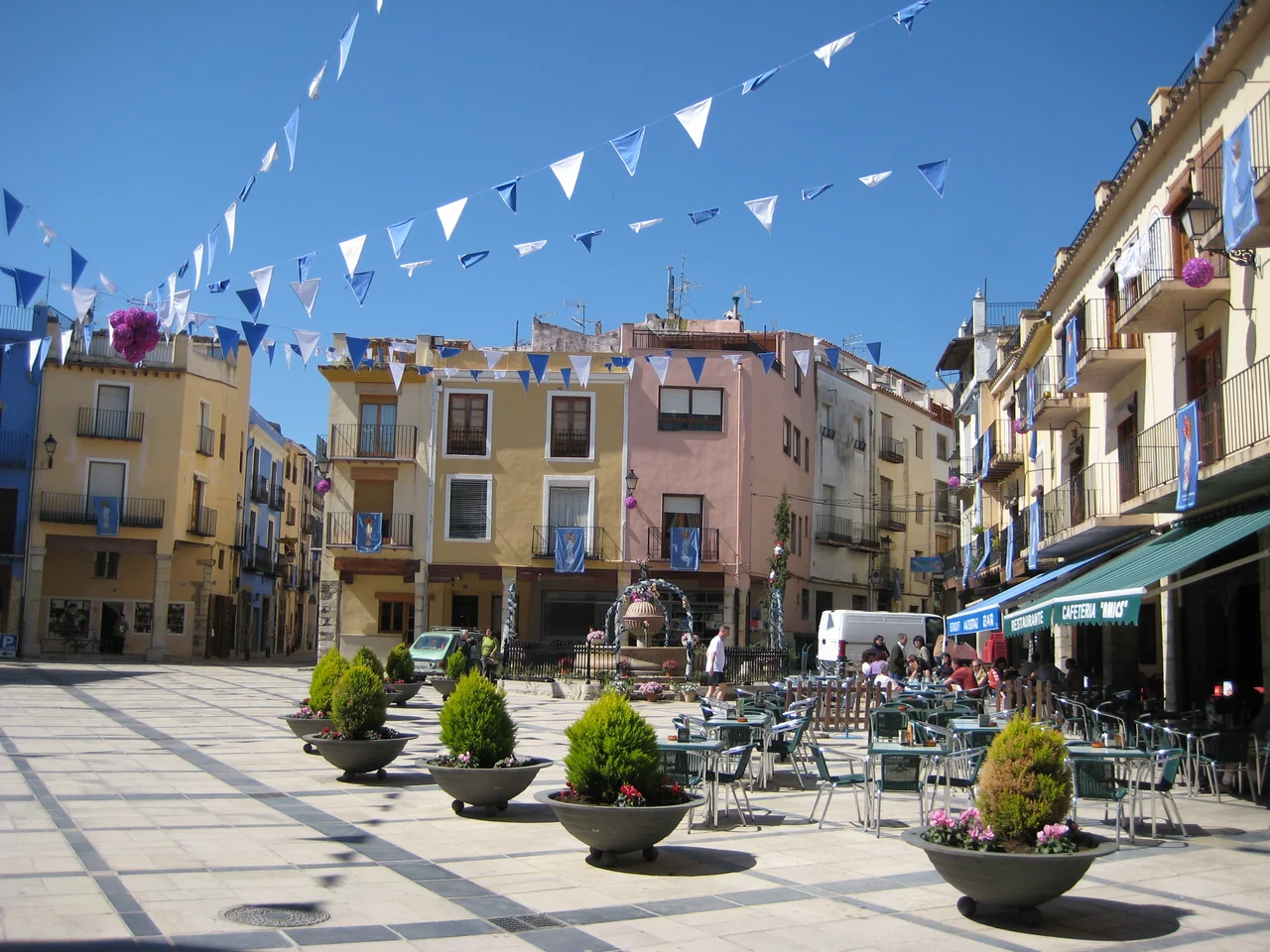

Sant Mateu
Some of the funniest drawings in twentieth-century America began in a small stone town in the mountains of eastern Spain. Sergio Aragonés, the cartoonist who filled the margins of MAD magazine with thousands of wordless gags and conjured the barbarian Groo the Wanderer, was born in Sant Mateu on 6 September 1937. He would grow up in Mexico after his family left a Spain torn by civil war, but the town he came from was no accident of an unremarkable map. Sant Mateu was once one of the richest places in this whole region.
The Master's Land
Sant Mateu lies in the Maestrat, and the name is worth pausing on. It means the land of the Master, the territory once governed by the grand master of a medieval military order, and this town stood among its leading settlements. That history left a physical mark you can still walk through. The heart of the old town is a porticoed square, the Plaça Major, where heavy stone arcades shelter the pavement and merchants once traded beneath them out of the rain and sun. Grand houses line the surrounding lanes, more solid and ambitious than a town of this size would seem to warrant, evidence of a prosperity that has since drained away but never quite disappeared. The arcades still shelter a weekly market and the unhurried business of a country town, but their grandeur belongs to an older age, when Sant Mateu sat near the center of the district's affairs rather than at its quiet edge.
Wool and Stone
That old wealth came largely from wool. In the late Middle Ages the Maestrat's flocks and the merchants who traded their fleece made towns like Sant Mateu unexpectedly cosmopolitan, tied into commercial networks that reached across the Mediterranean. The money went into building. Its centerpiece is the Església Arxiprestal, the archpriest's church, a title that signals the town's standing as a religious center for the surrounding district rather than just another parish. Its scale and stonework speak of a community that could afford ambition. Walking the compact grid today, you sense a town that dressed for a larger role than it now plays, and wears the costume with dignity.
The Chapel on the Ridge
East of the town, up in the Serra de la Vall d'Àngel, stands the Ermita de la Mare de Déu dels Àngels, a hermitage set apart from daily life in the way these mountain shrines so often are. Reaching it means climbing out of the valley into thinner, cleaner air, and the reward is not only the small sanctuary itself but the long view back over Sant Mateu and the folded ridges of the Maestrat. Hermitages like this one anchored the spiritual geography of inland Valencia, places of pilgrimage and festival where a scattered rural population gathered on the saint's day and then returned to the fields.
The Fastest Pen in the Margins
Sant Mateu keeps its most famous export lightly, but it is a good one. Sergio Aragonés became one of the most beloved cartoonists in the world, celebrated for a speed and looseness of line that made drawing look effortless. For decades his tiny marginal doodles crowded the edges of MAD, sly commentaries squeezed into the white space around everyone else's articles, and generations of readers hunted for them. His Groo the Wanderer, a good-hearted, catastrophically clumsy swordsman, ran for years as a comic all its own. It is a fitting legacy for a town built at the meeting of mountains and history: a native son who spent his life finding the joke in the corners nobody else was looking at. He never entirely shed the country he came from. The boy born in a small Castellón hill town grew into an artist who made the whole world laugh from the margins, and Sant Mateu keeps his memory the way it keeps everything else, quietly and for good.
From the Air
Sant Mateu lies inland at 40.47°N, 0.18°E, roughly 25 km from the Mediterranean in the hills of the Baix Maestrat. View it at 3,000–5,000 ft, with the Serra de la Vall d'Àngel rising to the east and the compact grid of the medieval town below. Castellón–Costa Azahar (LECN) is to the south, Reus (LERS) to the north, and Valencia (LEVC) further down the coast. Look for the dense stone core of the old town set among cultivated valley floor and dark ridgelines; the arcaded main square and the tower of the archpriest's church make useful visual anchors in clear inland light.
Nearby Stories
- Sack of Torreblanca 4.1 km away
- Els Ports Natural Park 14 km away
- Delta de l'Ebre Natural Park 20 km away
- Vandellòs I nuclear incident 23 km away
- Vía Verde de Ojos Negros 40 km away
- Teruel 64 km away
- Battle of Belchite (1937) 67 km away
- Cala d'Albarca 144 km away