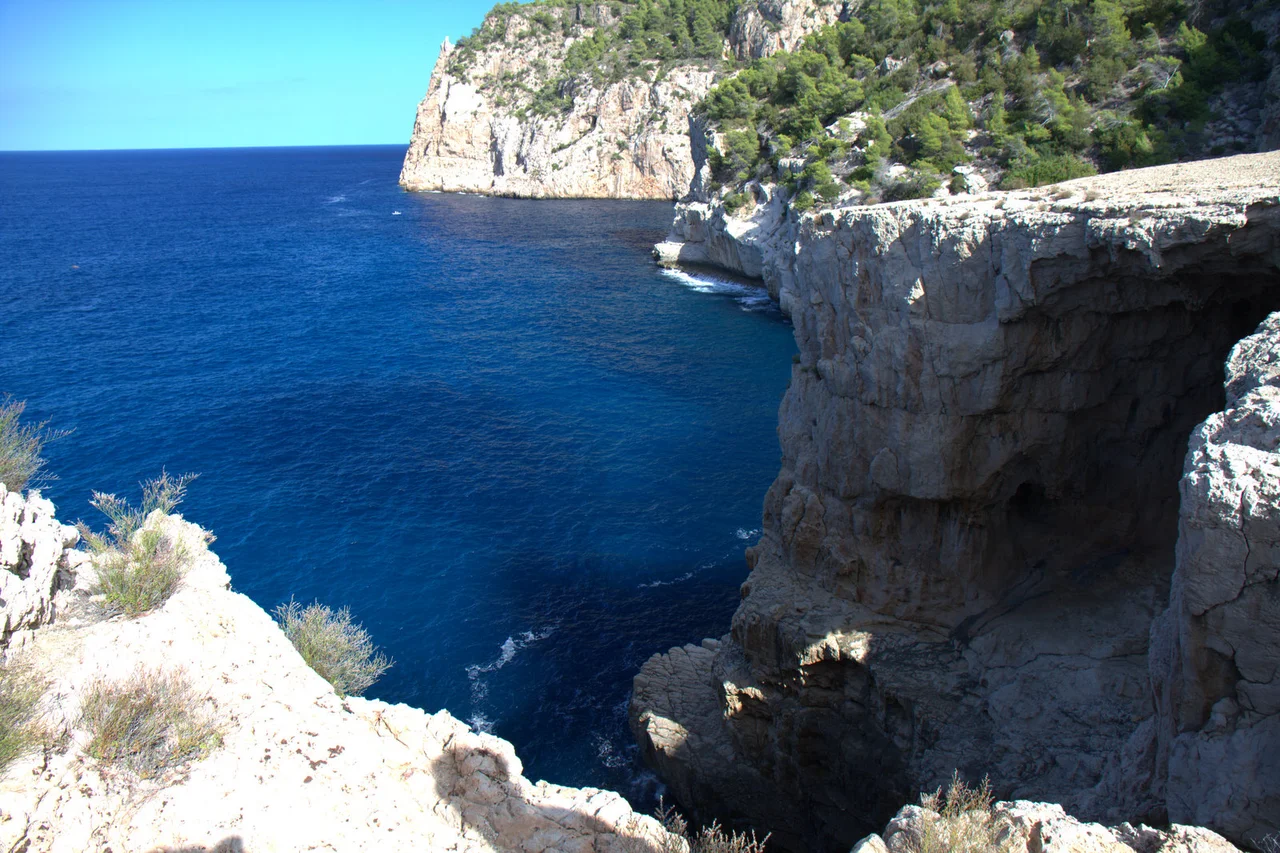

Cala d'Albarca
There is no easy way down to Cala d'Albarca, and that is the first thing to understand about it. On an island famous for pleasure delivered straight to the sunlounger, this cove on Ibiza's wild north coast asks for effort - a scramble down rock, a willingness to be somewhere with no bar, no promenade, and quite possibly no other soul. What waits at the bottom is a vast horseshoe of stone and clear turquoise water that most visitors to Ibiza will never lay eyes on, precisely because reaching it is hard.
The Hard Way Down
Cala d'Albarca opens onto the northern seaboard of Ibiza, within the municipality of Sant Antoni de Portmany but a world away from its nightlife - roughly four miles northeast of the tiny village of Santa Agnes de Corona and fourteen miles north of Ibiza Town. Only the most determined explorer gets down to the bay itself. The cove forms a broad horseshoe framed by two rocky headlands: Cap des Rubio at the eastern end and Cap d'Albarca at the western, each rising more than 200 metres straight from the sea. Behind them the land climbs higher still, to the hills of Puig d'en Cires at 295 metres and Puig de sa Cova at 340. The effect is of standing inside a great stone amphitheatre, walls of cliff on three sides and the open Mediterranean on the fourth.
A Beach of Boulders
Do not come here expecting soft sand between your toes. The shore of Cala d'Albarca is a rocky one, its beach scattered with huge boulders that have tumbled from the heights above and settled at the water's edge in a jumble of pale stone. It is raw, geological scenery - the bones of the island laid bare, unsoftened by the resorts that smooth over so much of Ibiza's coast. Along the shoreline lie flat rocks and broad ledges close to the water, warmed by the sun and perfectly shaped for stretching out on. There is no snack kiosk, no rented umbrella, no soundtrack but the sea working at the stone. The boulders throw shifting shade as the afternoon wears on, and the only company is likely to be a passing gull or the occasional boat anchored offshore, its crew having arrived by the one route that spares the climb. What the cove lacks in comfort it repays in a kind of scale and silence that is genuinely rare on this crowded island.
The Cracked Arch
The cove has one feature that stops people in their tracks: a cracked natural arch, sculpted from the rock by the patient collaboration of wind and water over an unhurried stretch of time. Sea arches form where waves exploit a weakness in a headland, hollowing it out until the stone spans open air like a bridge with nothing beneath it. Here the arch has split, its fracture a visible sign that the sea is still at work and that this shape, like every shape on a coast, is only temporary. It is the kind of landmark that makes the long descent feel earned - a piece of natural architecture standing alone against the bright water, shaped by forces that were busy here long before Ibiza had a name.
Turquoise and Silence
Then there is the water. In the shelter of the cove the sea runs crystal clear, deepening to a rich turquoise wherever the sun reaches through it, so transparent that the rocky bottom seems close enough to touch even where it is not. This is water made for slipping into with a mask - ideal, the visitors who make it down agree, for snorkelling and diving along the boulder-strewn shallows and the walls of the headlands. Cala d'Albarca is the answer to anyone who thinks Ibiza is only clubs and crowds. Here the island keeps a different self entirely: quiet, difficult, dramatic, and all the more rewarding for asking something of you before it gives anything back.
From the Air
At 39.0631 N, 1.3764 E, Cala d'Albarca notches into Ibiza's rugged north coast, about 25 km northwest of Ibiza Airport (LEIB). From 2,000-4,000 ft it reads as a deep horseshoe bite in a wall of cliffs, framed by the headlands of Cap des Rubio and Cap d'Albarca (both over 200 m) and backed by the higher hills of Puig de sa Cova (340 m) - a striking contrast to the low, built-up south of the island. The cracked sea arch and pale boulder shore mark the waterline. This is remote, cliff-bound terrain with few landing options; keep safe clearance from the high ground and watch for wind rotor off the ridges. Alicante-Elche (LEAL) lies roughly 150 km east across open water. Late-afternoon sun lights the cliffs and turns the shallows their signature turquoise.
Nearby Stories
- Capture of the galleon Lion Couronné 15 km away
- Cap de la Nau 44 km away
- Cape Sant Antoni, Spain 56 km away
- Illa Grossa 58 km away
- Andratx 61 km away
- Puig de sa Morisca Archaeological Park 77 km away
- Santa Ponsa 109 km away
- Battle of Cape Cherchell 219 km away