
Santuari de Lluc
Since 1531, a choir of boys in blue cassocks has sung beneath the mountains at Lluc. They are called Els Blauets — 'the blue ones,' after their robes — and their voices have carried the sanctuary's fame far beyond Mallorca. For nearly five centuries they have been woven into the daily life of the island's holiest place, a monastery tucked into a high mountain basin at the very heart of the Serra de Tramuntana. It is a place shaped as much by geography as by devotion. Pilgrims have been climbing to Lluc for some seven hundred years, drawn by a small statue and a shepherd's tale.
A Shepherd's Discovery
The story that founded Lluc is a humble one. In the thirteenth century, according to tradition, a Moorish shepherd came upon a statue of the Virgin Mary on this mountainside, and on the spot of that discovery a sanctuary was raised. From those beginnings, Lluc grew into the most important pilgrimage site on Majorca — the destination that, more than any church in Palma, draws the island's faithful. It sits in a natural basin 525 meters above the sea, cupped by high peaks including the great Puig de Massanella, so that arriving here has always meant a climb, whichever direction you come from. The setting does half the work: remote, sheltered, and quiet, it feels set apart from the ordinary world.
The Boys in Blue
The choir that made Lluc famous was founded in 1531, and it has been singing ever since. Els Blauets take their name from the blue cassocks the boys wear, and their concerts, given regularly at the sanctuary, have earned an international reputation over the centuries. The choir is bound up with a boarding school on the site, so that music and education have grown together at Lluc, one generation of boys handing the tradition to the next. To hear their voices rise in the mountain church is to catch a thread of continuity nearly five hundred years long — the same songs, in the same place, sung by children who look much as their predecessors did.
Walking Through the Night
For many Mallorcans, the way to Lluc is on foot, and the most famous journey happens in the dark. On the first weekend of August each year, a night walk sets out from Palma — leaving the capital's Plaça Güell at eleven o'clock at night — and climbs through the small hours toward the sanctuary in the mountains. It is a demanding pilgrimage, undertaken by thousands, and its arrival at Lluc in the dawn light is a moment of quiet triumph. Those who want to linger can: the cells that once housed the monks are now leased to visitors, so the monastery doubles as a place to stay, and it serves as a natural base for walkers exploring the surrounding range.
Mountains, Gardens, and Green Faith
Lluc sits at the crossroads of the Serra de Tramuntana, which makes it a favorite launching point for walking tours into Mallorca's high country. Behind the monastery buildings runs a botanical garden trail, planted with the flora of the Majorcan mountains and paired with a small exhibition on protecting that fragile environment — an old faith in stewardship carried into the language of conservation. Today buses and cars bring most visitors up the winding roads, but the sense of arrival — of having reached somewhere deliberately hard to get to — has never quite faded. Between the singing, the pilgrims, the peaks, and the gardens, Lluc manages to be a shrine, a school, a hostel, and a trailhead all at once.
The Sanctuary Itself
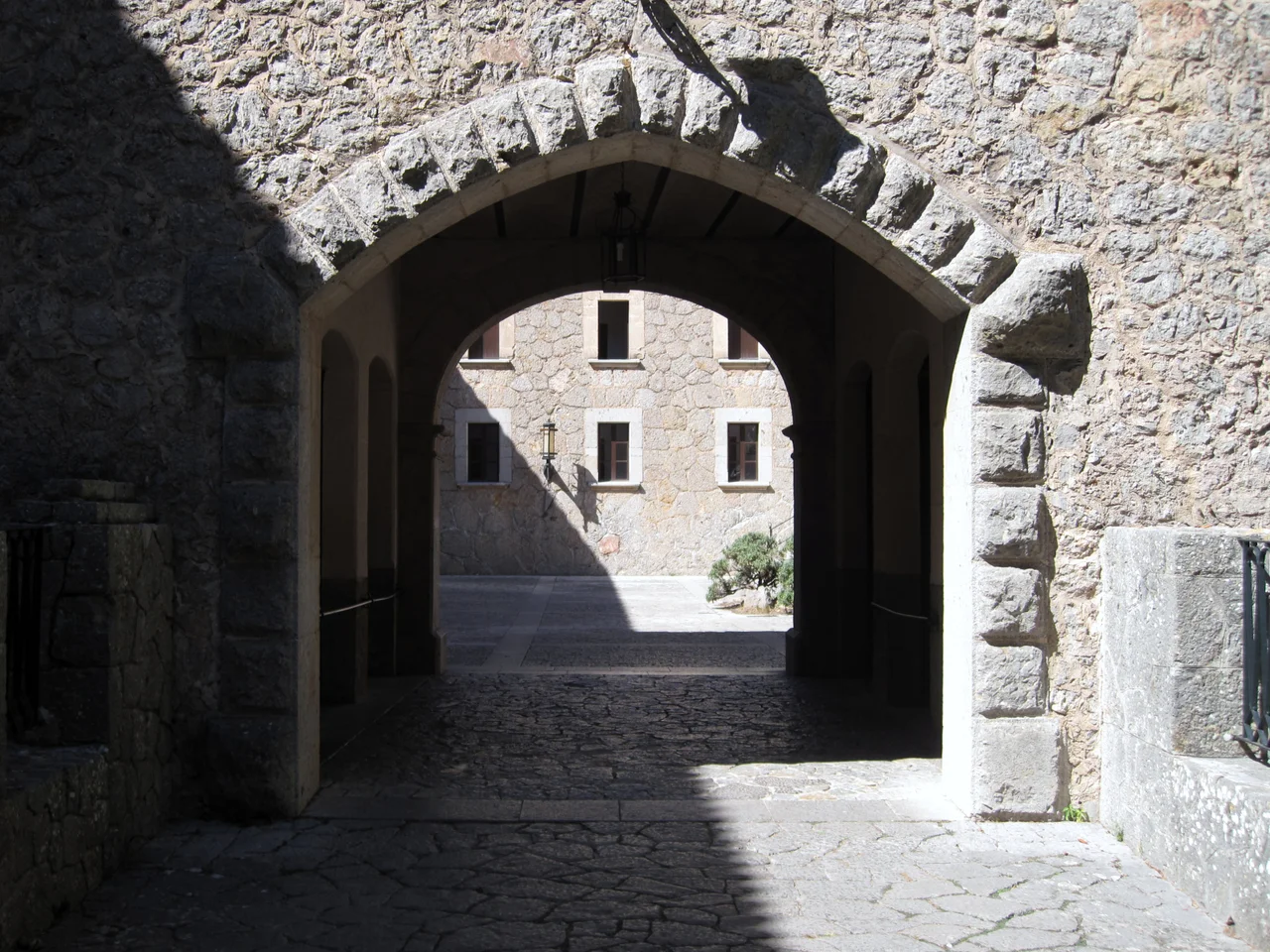
For all its fame as a choir and a pilgrimage, Lluc is also simply a place to arrive at. At its center stands the basilica, its stern stone facade opening onto an interior rich with the offerings of centuries of visitors. Around it spread the monastery's courtyards, lodgings, and shops, busy with day-trippers and walkers. Behind the buildings, a botanical garden trail winds among the plants of the Majorcan mountains, paired with a small exhibition on protecting that environment — a reminder that reverence here extends to the landscape as well as the shrine. Held in its high green basin, ringed by peaks, Lluc feels less like a building than a small world tucked into the mountains.
From the Air
The Santuari de Lluc sits at 39.8229°N, 2.8844°E, in a mountain basin 525 m above the sea in the municipality of Escorca, at the center of Mallorca's Serra de Tramuntana. From the air the large monastery and basilica complex shows as a cluster of pale buildings ringed by high peaks; Puig de Massanella rises just to the southeast, and the Gorg Blau and Cúber reservoirs lie a short distance to the west. Keep a safe height over this rugged terrain, 6,000 ft or more, and watch for mountain turbulence and cloud that can fill the basin quickly. Palma's airport (LEPA) is roughly 30 km to the south; Menorca (LEMH) lies to the east.
Nearby Stories
- Balearic Islands 5.7 km away
- Andratx 27 km away
- Hypogeum of Torre del Ram 33 km away
- Illa de Tagomago 90 km away
- Llobregat Delta 139 km away
- Montjuic Cemetery 158 km away
- Shipwreck of Dellys 295 km away
- Cosquer Cave 383 km away