
Sappho, Washington
Martin Van Buren Lamoreux had read law in his youth, admired the lyric poetry of Sappho of Lesbos, and by 1889 had decided that St. John, Kansas held nothing more for him. He gathered eight of his ten children, his second wife, and her three children from an earlier marriage, and went west until the continent ran out. A steamer from Seattle put the party ashore at Pysht, an Indigenous settlement on the Strait of Juan de Fuca. From there they walked twenty miles inland through rainforest to a claim none of them had ever laid eyes on. When the clearing finally needed a name, Lamoreux gave it the poet's.
The Judge of an Unbuilt District
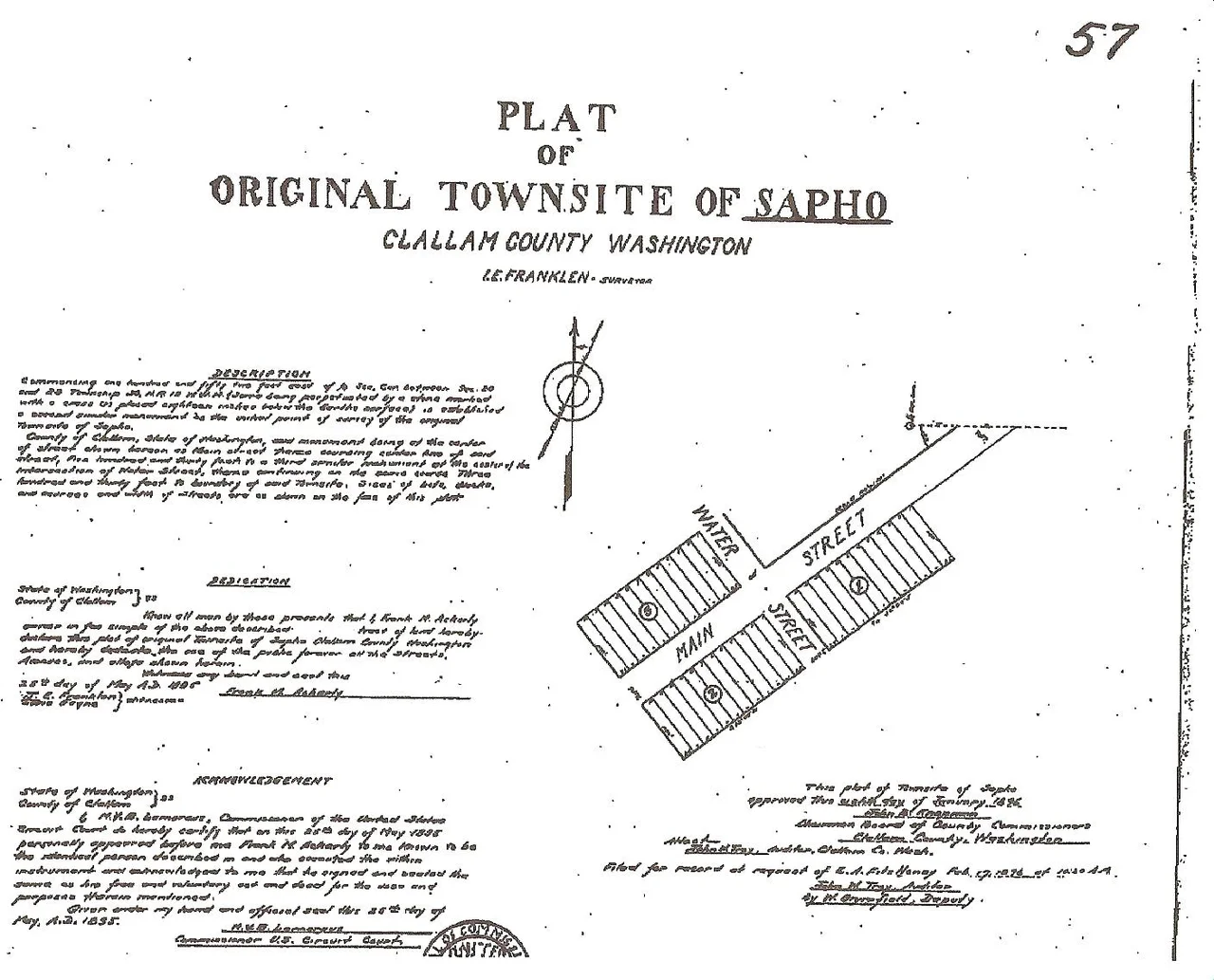
Some of Lamoreux's traveling party had stopped at Lake Union, in Seattle, and settled there. Lamoreux looked at that land, judged it worthless, and kept going -- a decision that would look different a century later, and one that says a great deal about how confidently people misread this coast. Inland, he organized the homestead the way a man organizes a small government: every family member drew a duty. He took the postmastership himself. Neighbors called him Judge, because he had read law as a young man, and eventually the title became official when he was appointed Justice of the Peace for the district. The 1895 homestead was spelled Sapho, one p short of the poet, and it sat about six-tenths of a mile off what is now U.S. Route 101, on a Main Street that survives today as State Route 113.
Bunkhouses on a Railroad Grade
What turned a homestead into a place on the map was timber. Sappho became a logging camp for Bloedel-Donovan, linked by rail to the company's operations at Clallam Bay on the strait. The camp was the standard architecture of Pacific Northwest logging: railroad facilities, bunkhouses for the crews, a company store, a post office, houses for families who stayed. Everything here arrived by grade and left by grade. Whole hillsides of spruce, hemlock, and fir moved out through this valley on flatcars, and the men who cut them lived within earshot of the saws. It was not a town in the civic sense so much as an industrial address that happened to have a school and a poet's name.
What the Fire Spared
The original town burned. When the smoke cleared, the schoolhouse was the only building left standing -- a detail that has a way of outliving the names of everyone it sheltered. Sappho was rebuilt in the loose way logging settlements were rebuilt, and it kept working as long as the timber and the railroad justified it. Then the population fell away. In May 1972, the post office closed, and with it went the last piece of official machinery Lamoreux had established eight decades earlier. That same month, The Seattle Times ran a story on the neighboring settlement under the headline "Yes, Virginia, there IS a Pysht," which captures something about how the outside world regards this stretch of the peninsula: half disbelief, half affection.
Four Times the Rain
Sappho sits in a very wet oceanic climate, the Koppen Cfb regime that runs up the coast from Aberdeen northward. Forks, farther south and tucked closer against the Olympic Mountains, takes slightly more rainfall. But Sappho is still wetter than anywhere in the contiguous United States east of the Cascades, and roughly four times wetter than the eastern half of its own county. That statistic is the peninsula in miniature. Drive an hour east toward Sequim and you enter a rain shadow dry enough for lavender farms. Here, moss loads the alder limbs, the roadside ditches run clear year-round, and clearcuts green over with a speed that startles visitors from drier country. The forest is not a backdrop in this valley. It is the economy, the weather, and the horizon at once.
The Junction
Today Sappho is the point where U.S. 101 meets State Route 113, the shortcut north to Clallam Bay and the strait. There is no town center to speak of -- forest, a highway junction, parks and recreation ground, and the long green corridor that carries traffic between Port Angeles and Forks. Drivers pass it in seconds. What stays with anyone who slows down is the improbability of the name: a Greek poet from the island of Lesbos, whose surviving work amounts to fragments, attached by a Kansas lawyer-turned-homesteader to a rainforest clearing on the far northwestern edge of the United States. Most of Sappho's poems were lost. Most of Sappho, Washington was lost too. The name held on anyway.
From the Air
Located at 48.07 N, 124.28 W in the Sol Duc valley of the western Olympic Peninsula, roughly 1,000 ft MSL. From the air, the site is identified by the sharp Y where State Route 113 branches north from U.S. Route 101 toward Clallam Bay -- one of very few road junctions in an otherwise unbroken canopy. The patchwork of clearcuts and second-growth blocks on the surrounding ridges is the clearest visual signature. Best viewed at 2,500-4,000 ft AGL. Quillayute Airport (KUIL) lies about 20 nm southwest near Forks; William R. Fairchild International Airport (KCLM) at Port Angeles is roughly 35 nm east. Expect low ceilings, marine stratus, and frequent rain: this is one of the wettest corridors in the Lower 48, and VFR windows here can close quickly.
Nearby Stories
- Sooke Harbour House 2.5 km away
- Duncan Cedar 11 km away
- MV Diamond Knot 11 km away
- Olympic: Where Rainforest Meets the Wild Pacific 11 km away
- Juan de Fuca Marine Trail 15 km away
- SS Pacific (1850) 15 km away
- Quinault Canyon 57 km away
- Juan de Fuca Channel 58 km away