.jpg)
Sooke Harbour House
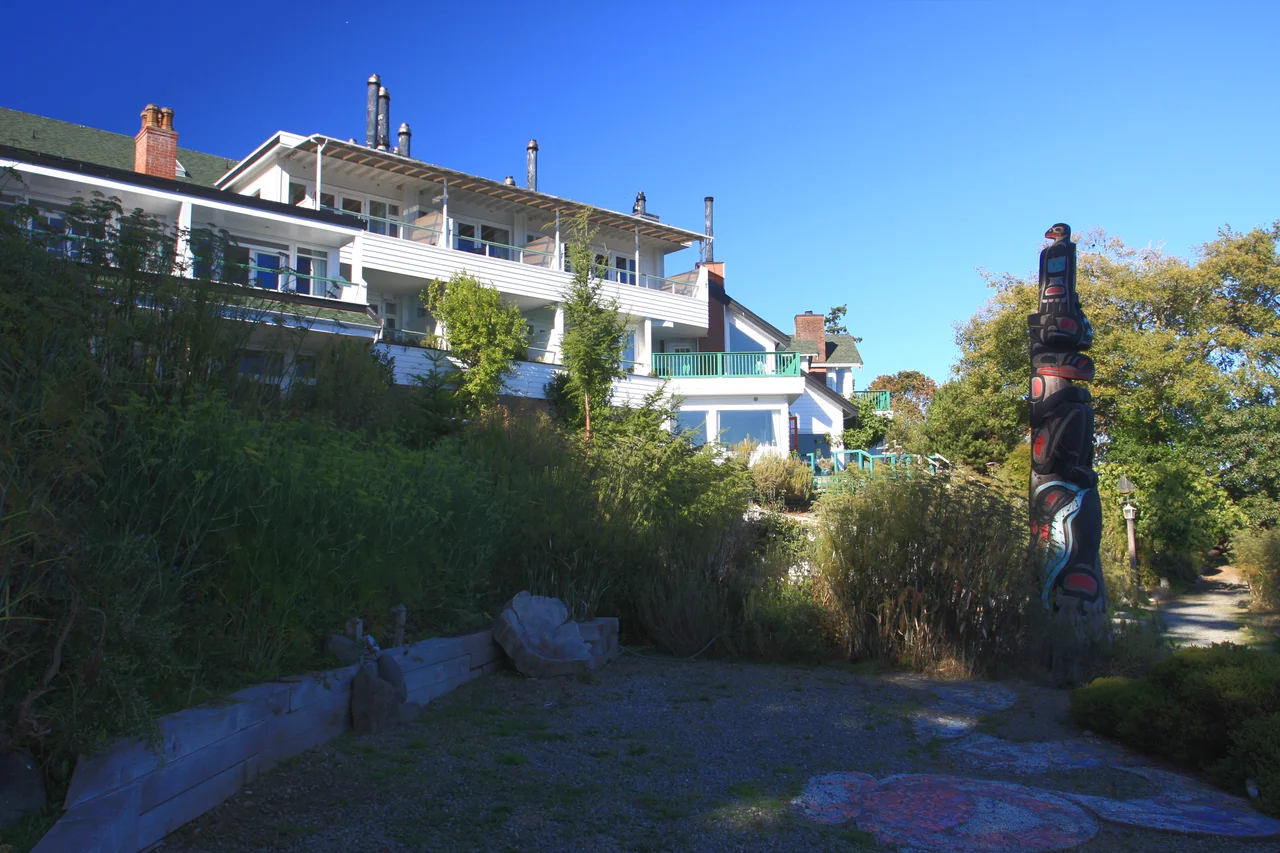
The man who spent four decades running what The New York Times would call one of Canada's half-dozen best restaurants did not come up through kitchens. Sinclair Philip holds a doctorate in political economics from the University of Grenoble. In 1979 he and Frederique Philip took over an inn at the end of Whiffin Spit Road in Sooke - a logging and fishing town thirty-eight kilometres west of Victoria, well past the point where Vancouver Island stops being suburban - and proceeded to build an argument about food out of it. Not a menu. An argument: that what grew and swam within sight of the dining room windows was better than anything that could be flown in, and that a restaurant at the edge of the Pacific had no business pretending to be in Europe.
Thirty-Eight Kilometres Past the Capital
Sooke sits on the southwestern shoulder of Vancouver Island, in the traditional territories of the T'Sou-ke and Scia'new First Nations, on a stretch of coast whose climate is genuinely Mediterranean in the technical sense - warm dry summers, mild wet winters, the classification the Koppen system files as Csb. That climate is the whole foundation of what happens here. It is why oysters and spot prawns and half a hundred wild greens are available within a short walk, and why a kitchen garden on the Pacific coast of Canada can produce through most of the year. The town itself was slow to formalise; the District of Sooke was not incorporated as a municipality until 7 December 1999, and by the 2021 census it held 15,086 people. Whiffin Spit, the low gravel finger that gives the inn's road its name, remains the town's favourite walk.
Slow Food at the Edge of the Pacific
Sinclair Philip became the Canadian representative for Slow Food, the Italian movement founded around local, seasonal, unhurried eating and the defence of regional food traditions against standardisation, and for a period he led the Slow Food Vancouver Island Convivium. That affiliation was not decorative. It is the intellectual frame that explains why an inn on this particular shore built its reputation on what the surrounding kilometres actually produced, and why the kitchen's ambitions ran toward things most Canadian fine dining of the 1980s would have dismissed as weeds and bycatch. The movement's logic and the location's logic pointed the same direction, and the Philips followed both for forty years.
One of Canada's Half-Dozen Best
The recognition arrived from a long way off. In 2000 a writer for The New York Times ranked Sooke Harbour House among "one of Canada's half-dozen best restaurants" - an extraordinary sentence to attach to an address in a town of a few thousand people, reachable only by driving past the last traffic light in Greater Victoria and continuing west. Destination dining of that kind creates its own strange economy. People flew to Victoria, rented a car and drove forty minutes for dinner. The inn's guest rooms existed in large part because nobody who had eaten a long tasting menu that far from a hotel wanted to drive back.
What a Destination Restaurant Costs
The economics of the thing were always precarious, and eventually they caught up. A restaurant like this carries the cost structure of a city institution - the staffing, the cellar, the gardens, the produce sourcing that will not scale - while depending entirely on visitors willing to make a special trip. When tourism softened, there was no local market deep enough to absorb the shortfall. The Philips cited that decline, and the accumulated strain of it, when they decided to step back. The property carried debt that the business could not service. It was sold in 2020 for $5.6 million, changing hands for the first time in forty-one years.
Open Again
The buyers renovated. The inn was dark through the pandemic years while the work went on, which in the restaurant business is usually the end of a story rather than an intermission. It reopened. Today Sooke Harbour House operates at 1528 Whiffin Spit Road under Catalog Hospitality, oceanfront, still an inn and still a restaurant, with the same water outside the windows and the same beaches and gardens producing the same things they always did. What survives of a place like this is rarely the ownership or even the menu. It is the idea - that the best food available in Sooke was always going to be Sooke's food - and that idea outlasted its authors, which is the most any of them could reasonably have hoped for.
From the Air
Sooke Harbour House sits at 48.3565 N, 123.7275 W, on the north shore of the entrance to Sooke Harbour on the Strait of Juan de Fuca coast of southern Vancouver Island, about 38 km by road west of Victoria. Recommended viewing altitude is 1,500-3,000 ft AGL. The defining visual is Whiffin Spit itself - a long, narrow, curving gravel hook reaching out across the harbour mouth, unmistakable from the air and one of the cleanest natural navigation marks on this coast. Behind it, Sooke Harbour opens into the much larger Sooke Basin, with the town spread along Highway 14 to the north. South across the strait, the Olympic Mountains of Washington State dominate the horizon; east, the coast runs toward Victoria past East Sooke Park and Race Rocks. Nearest airports: CYYJ (Victoria International) about 40 km east, CYWH (Victoria Harbour water aerodrome) about 33 km east, and KCLM (William R. Fairchild International, Port Angeles) directly across the strait. Marine fog builds in the strait on summer mornings and can fill the harbour entrance while the hills behind stay clear.
Nearby Stories
- Arbutus Ridge, Cowichan Valley 2.5 km away
- San Juan Island National Historical Park 4.5 km away
- Eastsound 11 km away
- Juan de Fuca Marine Trail 11 km away
- Mesachie Lake 13 km away
- Sappho, Washington 17 km away
- Spruce Railroad Trail 19 km away
- Port Townsend 22 km away