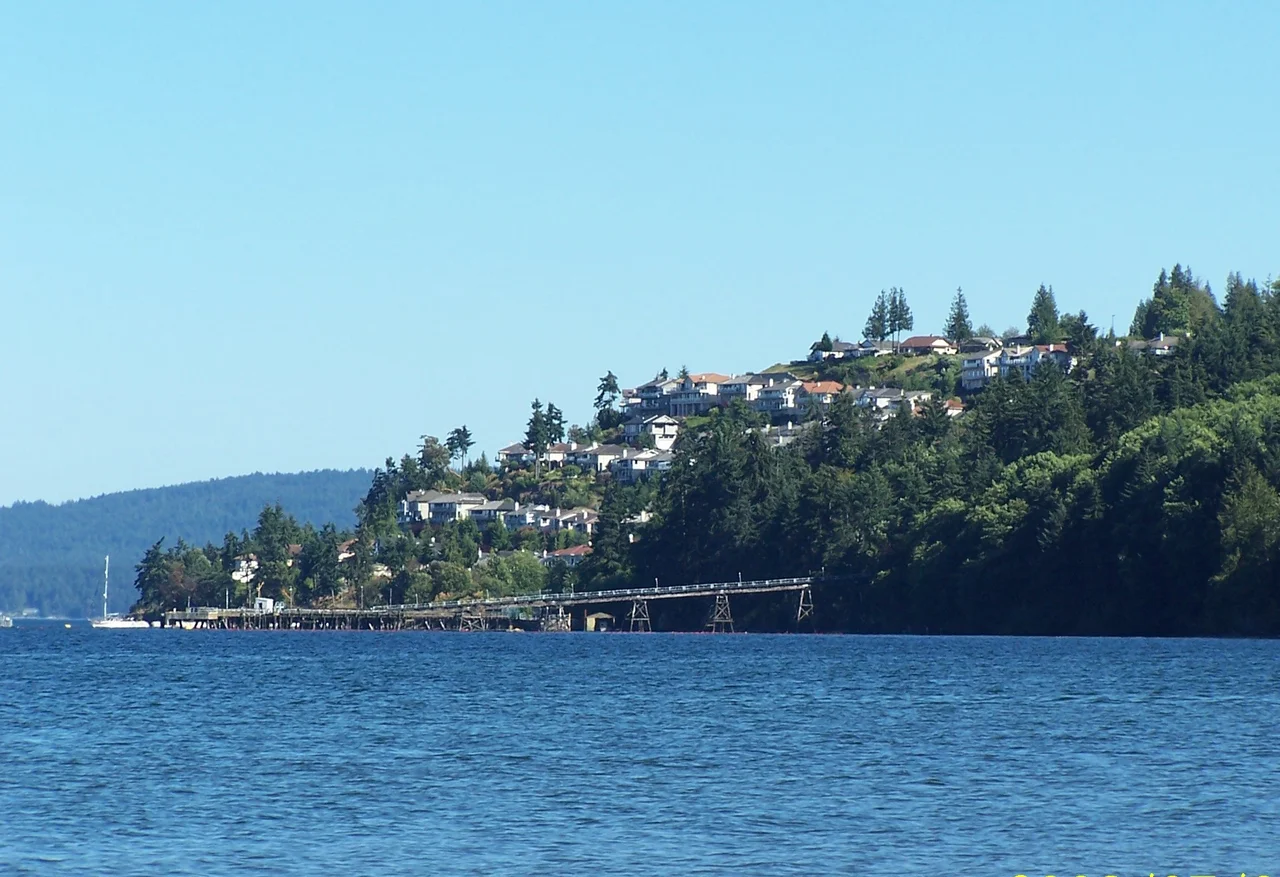

Arbutus Ridge, Cowichan Valley
The community was thirty-one years old before the province agreed that it had a name. Arbutus Ridge was incorporated in 1987, built out over the following two decades, and issued its own newsletter and elected its own council the whole time - but British Columbia did not formally adopt "Arbutus Ridge" as the official place name until 2018. That gap says something about what this place is. It is not a town and never applied to be one. It is a 60-hectare bare-land strata on a ridge a hundred metres above Satellite Channel, and it was built to answer a question somebody asked in 1983: what would happen if you took the American retirement community and set it down on a cool, green, rainy island off the Pacific coast of Canada?
Sun City, With Rain
The founder, James Patrick, spent the mid-1980s studying how the United States had reorganized old age. The model was the Sun Belt - Sun City in Arizona above all - where developers had discovered that retirees would buy into places designed around them: single-level houses, golf, no children, and a set of rules to keep it that way. Nothing comparable existed in Canada.
CRC Canadian Retirement Corporation was incorporated in March 1986 to build one. The Cowichan Valley Regional District issued the development permit in April 1987, and on 14 May 1988 the developer recorded the names of the first sixty owners - the pioneers, on a certificate still hanging in the Activity Centre. Arbutus Ridge has been described as the first comprehensive retirement community built in Canada, and as the template that made age-specific housing ordinary here. In 1989, half finished, it won the Urban Development Institute's Pacific Region Award of Excellence.
Almost a Village
The legal form is the interesting part. Arbutus Ridge is a bare-land strata, registered as Strata Plan 1601 at the Victoria Land Title Office in November 1987 - meaning the land is held collectively, each house is owned individually, and the shared buildings belong to everyone. From that document flows everything else.
A seven-member volunteer Strata Council, elected annually, runs the place through committees with names that would not look out of place in a municipal hall: Finance, Civil Works, Grounds, Security, Community Planning. A separate ratepayers association, incorporated in 1990, handles the things a strata cannot - transportation, health services, utilities, development beyond the gates. A monthly newsletter, Ridge Talk, goes to every household. In 2009 residents voted to hand the water, sewer, and drainage systems over to the regional district after twenty years of running them privately. A local paper summed the whole arrangement up as a large luxury subdivision, almost a village. Almost is doing a lot of work in that sentence.
Who Gets to Live Here
The rules were plain from the start: two people to a home, at least one of them over fifty. By the 2021 census the community held 1,085 residents in 646 units, and the age profile was exactly what the design intended - 41 per cent aged 71 to 80, another 34 per cent between 51 and 70, nearly a quarter over eighty, and one per cent fifty or under.
Then the ground shifted. In 2023, facing a housing shortage that was pushing families out of the market, the provincial government banned strata corporations from imposing minimum age requirements - with an exception preserved for genuine seniors housing at 55 and over. Arbutus Ridge responded by voting to raise its own threshold from fifty to fifty-five, which brought it inside the exception and kept the community as it was. Both sides of that exchange are easy to understand. A province needs homes for young families; several hundred people who bought into a particular kind of quiet had every reason to defend it.
The Ridge Itself
Whatever you make of the social experiment, the site is superb. The ground rises more than a hundred metres above the water, looking east across Satellite Channel toward Salt Spring Island and the Gulf Islands beyond. The community takes its name from the arbutus, the red-barked broadleaf evergreen that peels in summer and grows on exactly this kind of dry, rocky, sun-facing slope.
A provincial forestry brochure once described this small corner of British Columbia as having perhaps the finest climate in Canada - sheltered by the rainshadow of both the Vancouver Island and the Olympic Mountains, warmed by Pacific air, with long dry summers and mild wet winters. The seawater below is within the boundaries proposed in 2011 for the Southern Strait of Georgia National Marine Conservation Area. An eighteen-hole golf course threads between the neighbourhoods, houses have grown from the original thousand-square-foot ranchers to the twenty-four-hundred-square-foot homes of the final phases, and the build-out is complete. Victoria is fifty kilometres south, Nanaimo seventy north, and nothing more is going to be added.
From the Air
Arbutus Ridge sits at 48.693N, 123.540W on the southeastern coast of Vancouver Island, about 27 nm north-northwest of Victoria and 38 nm south of Nanaimo. From 2,500 to 4,000 feet it reads as a distinctive curved street pattern cut into forest on a bluff above Satellite Channel, with the fairways of its eighteen-hole golf course woven through the housing - the golf course is the easiest identifier from the air. Salt Spring Island lies directly east across the channel; Saanich Peninsula and Victoria International (CYYJ) are south, Mill Bay and the Malahat ridge to the southwest. Nearest fields are Duncan (CAM3) a few miles northwest, Victoria International (CYYJ), and Ganges Harbour water aerodrome (CAX6) on Salt Spring. This is the driest, sunniest corner of the coast, so expect good VFR more often than the region's reputation suggests, with morning valley fog in autumn and channel-aligned afternoon breezes.
Nearby Stories
- Mesachie Lake 3.6 km away
- Island Rail Corridor 3.9 km away
- Canadian Forces Station Ladner 4.5 km away
- Patos Island Light 5.6 km away
- San Juan Island National Historical Park 6 km away
- Valdes Island 6.4 km away
- Juan de Fuca Marine Trail 11 km away
- Mount Arrowsmith Biosphere Region 19 km away