.jpg)
Scioto Trail State Park
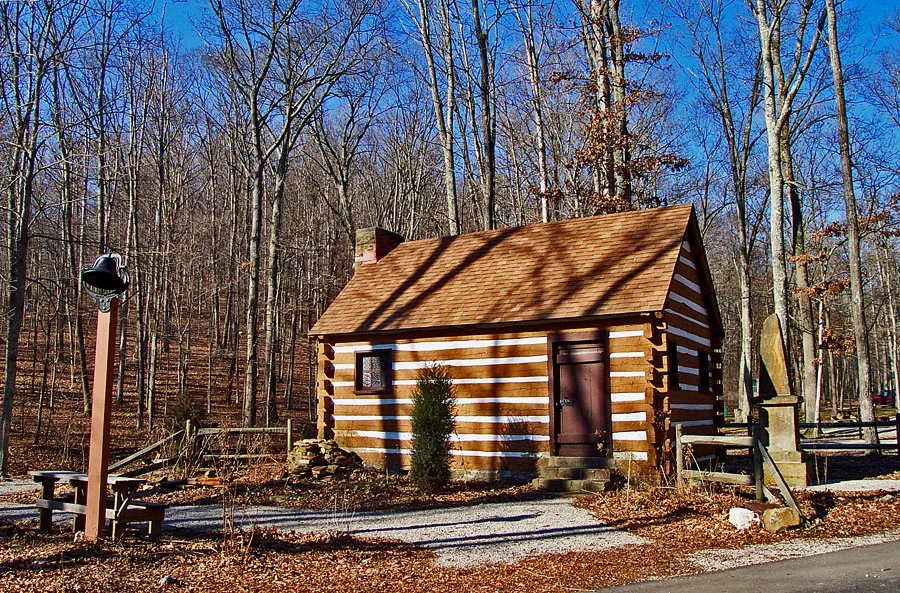
William Hewitt lived in a cave near here until his death in 1838. The hermit is something of a local legend - a man who chose a hole in the sandstone over neighbors and town life, surviving in the woods south of Chillicothe in the early decades after Ohio statehood. The replica log church that now stands in the park honors the more conventional version of Ross County frontier life: the First Presbyterian congregation of Chillicothe, founded in 1797, whose original log structure stood on a similar site. Two monuments in a 218-acre park to two ways of being alone in Ohio woods - one in church on Sunday, one in a cave year-round.
Park Inside a Forest
Scioto Trail State Park is a small enclave - 218 acres - inside the much larger Scioto Trail State Forest, which sprawls across thousands of acres of the Scioto River valley south of Chillicothe. The park provides the developed recreational core: Caldwell Lake for boating, fishing, and swimming, plus campsites, trails, and a quiet beach. The surrounding state forest offers the backcountry, multi-use trails for horseback riders and mountain bikers, and forest roads winding through ridge after ridge of dense hardwood. The state forest predates the park, with the protected land dating back to early Ohio Department of Natural Resources holdings in the 1920s.
Oaks and Hemlocks
The forest mix here is unusual for southern Ohio. Oak dominates as expected, but eastern hemlock - a conifer normally associated with cooler northern forests - clings to the shaded ravines and stream valleys where the microclimate stays cool enough for it to thrive. Dogwood blossoms light up the understory in April. Eastern redbud follows soon after, dusting the slopes in pink. The wildlife reads like an inventory of Eastern Woodland fauna: gray squirrels in the oak crowns, white-tailed deer browsing the meadows, wild turkey gobbling in spring, ruffed grouse drumming on hidden logs, opossum and raccoon at night, the occasional red fox crossing a forest road at dawn.
The Church and the Hermit
The replica of Chillicothe's First Presbyterian log church anchors the cultural side of the park. The original congregation was founded in 1797, the year before Ohio's first territorial capital was established at Chillicothe, and the log building was its first permanent home. The replica gives visitors a tangible sense of what frontier worship looked like - rough timber, hand-hewn benches, no decoration. Nearby a monument honors William Hewitt, the hermit who lived in a cave in these hills until his death in 1838. Hewitt apparently chose solitude deliberately, and the local memory of him persisted through generations as the kind of folk figure who reminds a settling community that not everyone wanted to be settled.
The Quiet Kind of Ohio
Scioto Trail does not deliver dramatic landmarks the way the nearby Hocking Hills do. There are no famous overhanging cliffs or waterfalls, no caves with chandeliers of ice in winter. What it offers instead is the underdrawn version of Ohio backcountry - wooded hills, a small lake, a forest road, a few thousand acres where the deer outnumber the people on most days. The park makes a good base for fishing weekends and family camping trips. The state forest beyond it absorbs the more serious hikers. The hermit's cave is still up there somewhere in the ridges, no longer marked, but the monument in the developed park keeps his memory available for anyone who pauses to read the plaque.
From the Air
Located at 39.23 N, 82.95 W in Ross County, southern Ohio, about 10 miles south of Chillicothe along the Scioto River valley. The park is surrounded by the larger Scioto Trail State Forest. John Glenn Columbus International (KCMH) is about 60 miles north. Best viewed at 3,500-5,000 feet on clear days, with Caldwell Lake glinting amid the forested ridges.
Nearby Stories
- Athens Lunatic Asylum 14 km away
- Gavin Power Plant 16 km away
- Hardin Village Site 33 km away
- The Y-Bridge of Zanesville 49 km away
- Columbus: The Test Market Where America Tries Things First 49 km away
- Ripley and the Underground Railroad 55 km away
- Wright-Patterson Air Force Base 69 km away