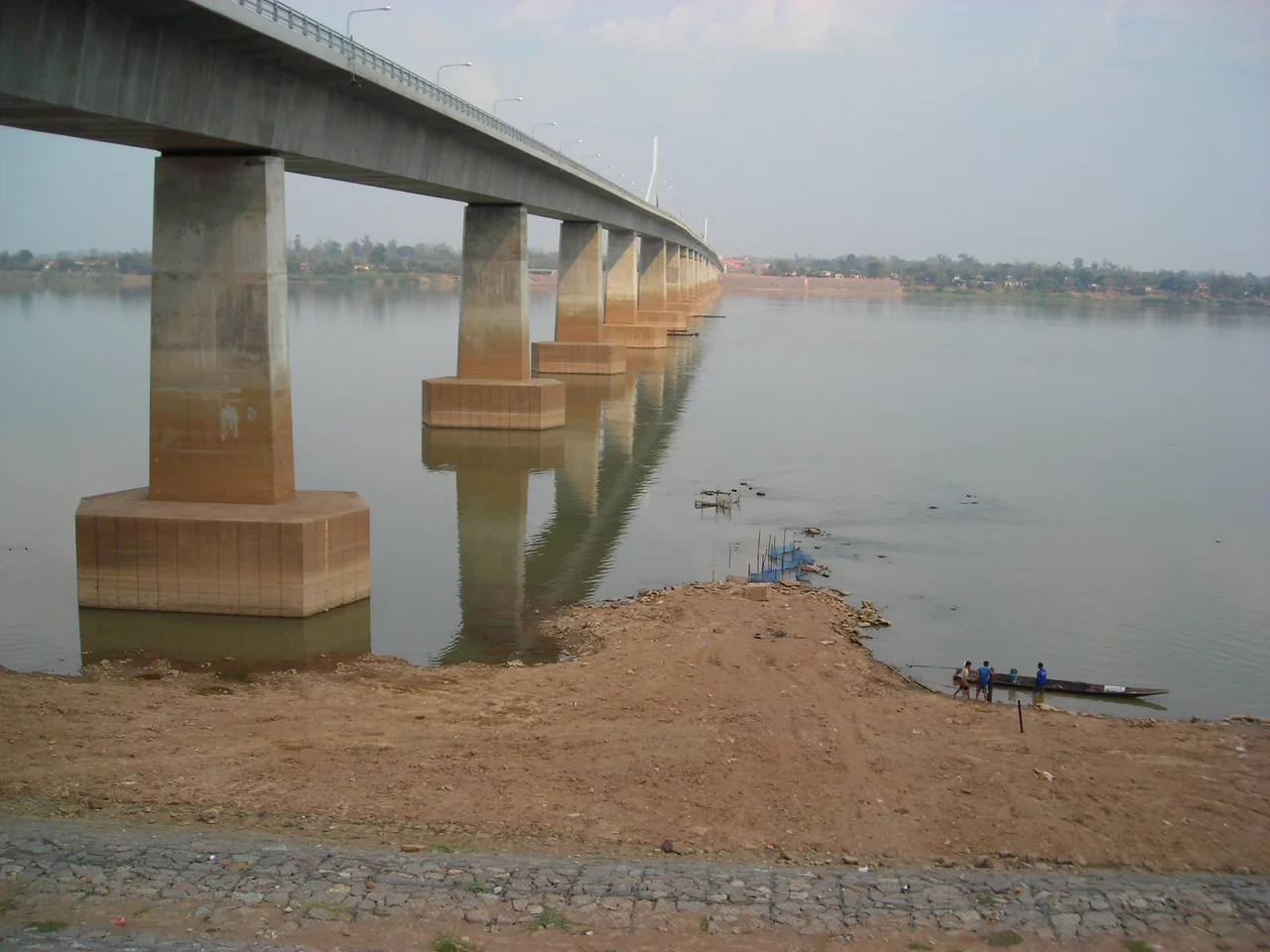

Second Thai–Lao Friendship Bridge
Somewhere on the Thai side of the Second Thai–Lao Friendship Bridge, the road switches from left-hand to right-hand traffic. Thailand drives on the left; Laos drives on the right. The 1,600-meter bridge over the Mekong has to accommodate both, and so it does — a lane-change baked into the crossing, a small but concrete reminder that this structure connects two countries with different rules, different histories, and a shared river that neither one has ever fully belonged to.
Building Across the Mekong
Construction began on 21 March 2004. The engineering approach was pragmatic: supports and span sections were built on shore, then moved out over the water by crane and lowered onto pylons already driven into the riverbed. The Mekong here at Mukdahan is wide and subject to dramatic seasonal variation — a river that swells to a brown flood in the wet season and drops to reveal sandbars and rocky shallows in the dry months. Building a permanent crossing across it required careful planning at every stage. The project cost approximately 2.5 billion baht — roughly US$70 million at the time — funded largely through a Japanese loan. An opening ceremony was held on 19 December 2006, and the bridge opened to ordinary traffic on 9 January 2007.
The Friendship Bridge Series
This crossing is the second of what has become a family of Thai–Lao bridges spanning the Mekong at different points along the border. The First Thai–Lao Friendship Bridge, completed in 1994, links Nong Khai in Thailand to Vientiane, the Lao capital — it remains the most famous of the series. The second connects Mukdahan to the Lao city of Savannakhet, a significant commercial center on the Lao side. Subsequent bridges have been built or proposed at other crossing points, each extending the regional road network that links Thailand, Laos, Vietnam, and southern China. The Friendship Bridges are part of the larger Asian Highway network, and the route through Mukdahan and Savannakhet continues east to Vietnam's coast. When a truck crosses this bridge, it may be heading all the way to Da Nang.
Mukdahan and Savannakhet
The bridge sits between two provincial capitals that have grown toward each other since the crossing opened. Mukdahan, on the Thai side, is a trading town with a large Vietnamese-Thai community and a market economy long oriented toward commerce across the river. Savannakhet, on the Lao side, is the second-largest city in Laos and a manufacturing hub that has attracted significant investment since the bridge gave it direct road access to Thailand. The Special Economic Zone near Savannakhet grew partly in anticipation of and response to the bridge's opening. What the Mekong once divided — two provincial cities facing each other across the water — the bridge has connected into an emerging cross-border economic zone.
The Name and What It Carries
The series of bridges is called Friendship Bridges — Saphan Mittraphap in Thai — a name that carries diplomatic weight. Thailand and Laos share a long border, a common linguistic heritage (the Isan dialect spoken in northeastern Thailand is closely related to Lao), and a complex history that includes the displacement of Lao-speaking populations and periods of tension. The bridges are infrastructure, but the name registers an aspiration: that crossing the river should be an act of connection rather than separation. Whether that aspiration is met depends on the day, the paperwork, and the politics — but the river gets crossed, goods move, families visit, and the road changes sides on the Thai approach, a quiet mechanical acknowledgment that two different systems are meeting here.
From the Air
The Second Thai–Lao Friendship Bridge is one of the most visually distinctive landmarks along this stretch of the Mekong, located at approximately 16.60°N, 104.74°E. From the air the bridge is immediately identifiable as the pale ribbon crossing the broad brown river between Mukdahan (Thailand) and Savannakhet (Laos). Recommended viewing altitude is 1,500–4,000 feet for a clear view of the span and the urban areas at each end. The nearest airport is Mukdahan Airport (MDH), located within a few kilometers on the Thai side.
Nearby Stories
- Wat Phra That Phanom 16 km away
- Phu Sa Dok Bua National Park 28 km away
- National Route 9 (Vietnam) 59 km away
- Sam Phan Bok 69 km away
- Khammouane Province 73 km away
- Ban Chiang 106 km away
- 2022 Nong Bua Lamphu Massacre 214 km away
- Cambodian Landmine Museum 313 km away