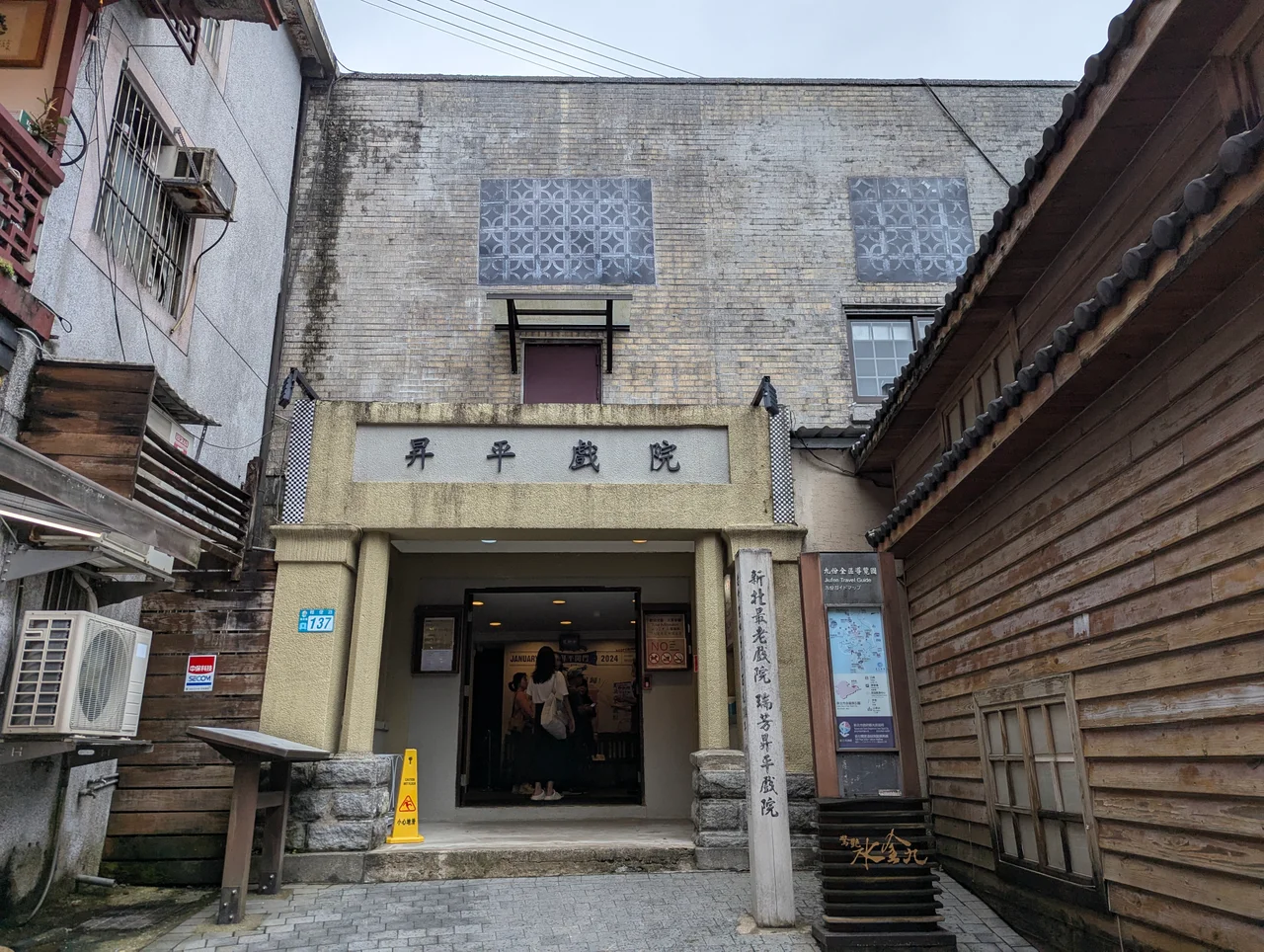

Shengping Theater
Jiufen in the 1930s was a boom town on a hillside, running on gold. The mines above the town produced ore that funded restaurants, hotels, opium dens, and at least one theater — a proper one, not just a stage in the back of a teahouse. The Shengping Theater opened in its current form in 1934, rebuilt after the original structure collapsed in 1927, on land donated in 1916 by Yan Yun-nian. When the gold faded and Jiufen quieted, the theater stayed. It outlasted the colonial administration that built it, the typhoons that shook it, and the decades of closure that followed. It is still there, on the steep streets above the sea.
Gold, Government, and a Stage
The land was donated in 1916 by Yan Yun-nian, and the Taihoku Prefecture government — the Japanese colonial administration based in what is now Taipei — raised funds and built a simple theater that could seat 400 people. Jiufen was then at the height of its gold-mining prosperity, a hillside town crowded with workers and merchants and the infrastructure that a profitable extraction economy attracts. The original building did not last: it collapsed in 1927. What replaced it was more substantial. In 1934, the structure was rebuilt as the Shengping Stage — a two-story building of hollow bricks with a roof trimmed in Chinese cypress, seating arranged in six-seat rows on the ground floor and a U-shaped grandstand of wooden chairs on the upper level. For a mining town theater in the mid-1930s, it was well-appointed.
Names Across the Handover
In 1945, Taiwan passed from Japanese to Republic of China administration. The transition carried different meanings for different institutions, and for the Shengping Stage the immediate consequence was a name change: it became the Shengping Theater. The renaming acknowledged the new political reality while keeping the operation largely continuous. The theater ran through the postwar decades, showing films and hosting Taiwanese opera performances in a community that had entered its long post-mining decline. The gold extraction that built Jiufen had run thin, and the hillside town was contracting. The theater contracted with it, rebuilt once more in 1961, and then faced a series of structural challenges — the final blow arriving with the 1986 Pacific typhoon season, which damaged the building so severely that it closed.
Typhoons, Closure, and Return
The 1986 closure marked the beginning of a long institutional limbo. A typhoon damaged the roof again in 1994, compounding the structural problems. The building sat, unoccupied and deteriorating, while Jiufen itself was experiencing a revival of a different kind: the 1989 film A City of Sadness, directed by Hou Hsiao-hsien, was partly filmed in the town, and the attention it brought sparked a tourism economy that transformed Jiufen's narrow alleys into one of Taiwan's most visited destinations. In 2009, the theater building was donated to the Taipei County Government, which by 2010 had become the New Taipei City Government. The government designated it a historical monument on 28 June 2010. Renovation followed: work began in October 2010 and was completed in 2011, after which the theater reopened to the public.
Architecture of an Era
The building covers 660 square meters across two floors. The hollow brick walls and Chinese cypress roof elements represent the construction techniques and material choices of 1930s Taiwan under Japanese colonial rule — a hybrid of imported engineering and local materials. The interior arrangement reflects the theatrical conventions of the period: ground floor seating in fixed rows, upper gallery in a U-shaped grandstand configuration that gave upper-level patrons an angled view of the stage. The building is compact by the standards of contemporary venues but generous by the standards of a hillside mining town. Restored rather than rebuilt, the theater retains the proportions and material character of its 1934 construction. Walking in, the scale is immediately intimate — 660 square meters does not leave room for grandeur, only presence.
What Plays Here Now
The Shengping Theater today regularly hosts films, Taiwanese opera performances, and other cultural events — continuing the mixed programming that characterized its original operation. Taiwanese opera, known as gezaixi, is a form of musical theater performed in Taiwanese Hokkien; seeing it in a restored 1930s venue in Jiufen is an experience with particular resonance, the form matching the setting in both age and regional character. The theater serves Jiufen's visitor economy while remaining a functioning cultural space rather than a static museum piece. Its position on the steep lanes above Jiufen's famous teahouses and staircase alleys makes it a natural stop on routes through the old town — a building that explains something about what kind of place Jiufen once was, and why people still come to find its traces.
From the Air
The Shengping Theater sits at approximately 25.109°N, 121.843°E in Jiufen, a hillside town in Ruifang District on Taiwan's northeast coast. Flying southeast from Taipei Songshan Airport (RCSS) at 2,000–3,000 feet, Jiufen is visible as a dense cluster of buildings clinging to the steep hillside above the coast, south of Keelung harbor. The theater itself is within the upper portion of the old town; the layered rooftops and staircase alleys are characteristic from the air. The coastline turns sharply here as the Ruifang headland meets the sea. Nearest major airport: Taipei Songshan (RCSS), approximately 27 kilometers to the west-northwest. Keelung is approximately 10 kilometers to the northwest.
Nearby Stories
- Taoyuan Air Base 4.7 km away
- Min Ping Yu No. 5540 Incident 6.9 km away
- Neiwan 14 km away
- North Jiangsu Main Irrigation Canal 982 km away
- Sinking of MV Sewol 1049 km away
- General Cliff Rock Paintings 1058 km away
- Yellow Sea 1108 km away
- Sibuyan Island 1376 km away