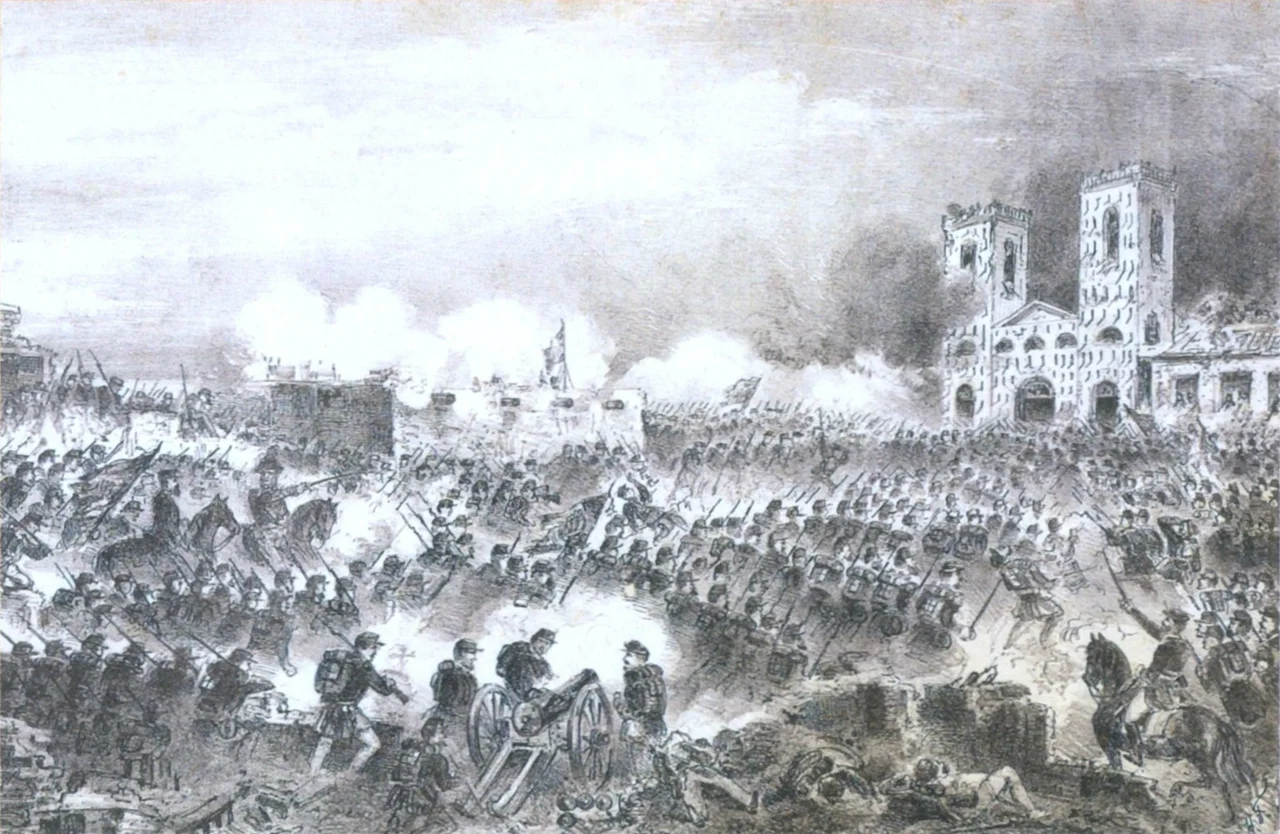

Siege of Paysandú
When the order to surrender reached him, Leandro Gómez did not hesitate. Asked when he would give up the city, the colonel answered in two words: "¡Cuando sucumba!" - When I fall. He had perhaps twelve hundred men and fifteen cannons. Arrayed against him on the far bank and in the surrounding fields were Brazilian warships, Colorado infantry, and an allied army that would swell to many times his strength. For thirty-one days at the turn of the new year in 1865, the people of Paysandú made that defiance their own. The city has been called La Heroica ever since.
The Blockade Tightens
It began on 3 December 1864. The Brazilian navy, commanded by the Marquis of Tamandaré, sealed the river with a corvette and four gunboats while Colorado forces under Venancio Flores closed in by land. Inside the defensive perimeter, just six blocks by two near the city center, Gómez and his second, Lucas Píriz, had a garrison of around 1,250 men. The attackers fielded thousands and brought thirty cannons, several of them modern rifled guns that could shatter masonry from a distance. From 6 to 8 December the besiegers pushed into the streets and were thrown back. They settled in to wait for reinforcements, and the bombardment ground on, day after day, against a town with no way out.
Thirty-One Days
The defenders held through weeks of shelling, hunger, and exhaustion, hoping for relief that never came. By late December the allied army had grown enormously, joined by Brazil's Army of the South with fresh brigades and the artillery of Lieutenant Colonel Émile Mallet. The fighting turned merciless on both sides. On 31 December the final assault began, and the last battle raged for some fifty-six hours through the rubble of the city. On 2 January 1865 the defenses were overrun. By then much of Paysandú lay in ruins, and the basilica that had sheltered civilians was gutted. The townspeople who survived had endured a month most could scarcely have imagined.
The Price of Defiance
What happened to Leandro Gómez turned a defeat into a martyrdom. Captured after the city fell, he was offered guarantees for his life. They were not honored. On the orders of the Colorado colonel Gregorio "Goyo" Suárez, Gómez and several of his officers were shot in the street. Suárez had personal scores to settle, and the killings were as much vengeance as war. The brutality only deepened the legend. In the decades that followed, Uruguayan historians, poets, and balladeers told and retold the defense of Paysandú until it became a shared inheritance, a story that stood above the country's bitter party divisions. The men who died here were not statistics. They were defenders who chose to stay, and a city that paid for their choice.
From the Air
The siege unfolded around the center of modern Paysandú, at roughly 32.32°S, 58.08°W on the east bank of the Uruguay River. The river itself was the highway for the Brazilian fleet that enforced the blockade; from the air its broad channel and the General Artigas Bridge to the south orient the scene. Paysandú's Tydeo Larre Borges Airport (ICAO: SUPU) serves general aviation nearby, with Salto's Nueva Hespérides (ICAO: SUSO) about 120 km north and Concordia's Comodoro Pierrestegui (ICAO: SAAC) across the river in Argentina. A slow pass at 3,000 to 5,000 feet over the city center and waterfront lets you trace the cramped six-by-two-block perimeter the defenders held. Clear, calm subtropical air prevails most of the year.
Nearby Stories
- San Javier, Uruguay 19 km away
- El Palmar National Park 20 km away
- Abadía del Niño Dios 138 km away
- Tacuarembó 162 km away
- Cayastá 164 km away
- Cisplatina 164 km away
- Battle of Pavón 179 km away
- Battle of Sarandí 191 km away