
Sierra Minera de Cartagena-La Unión
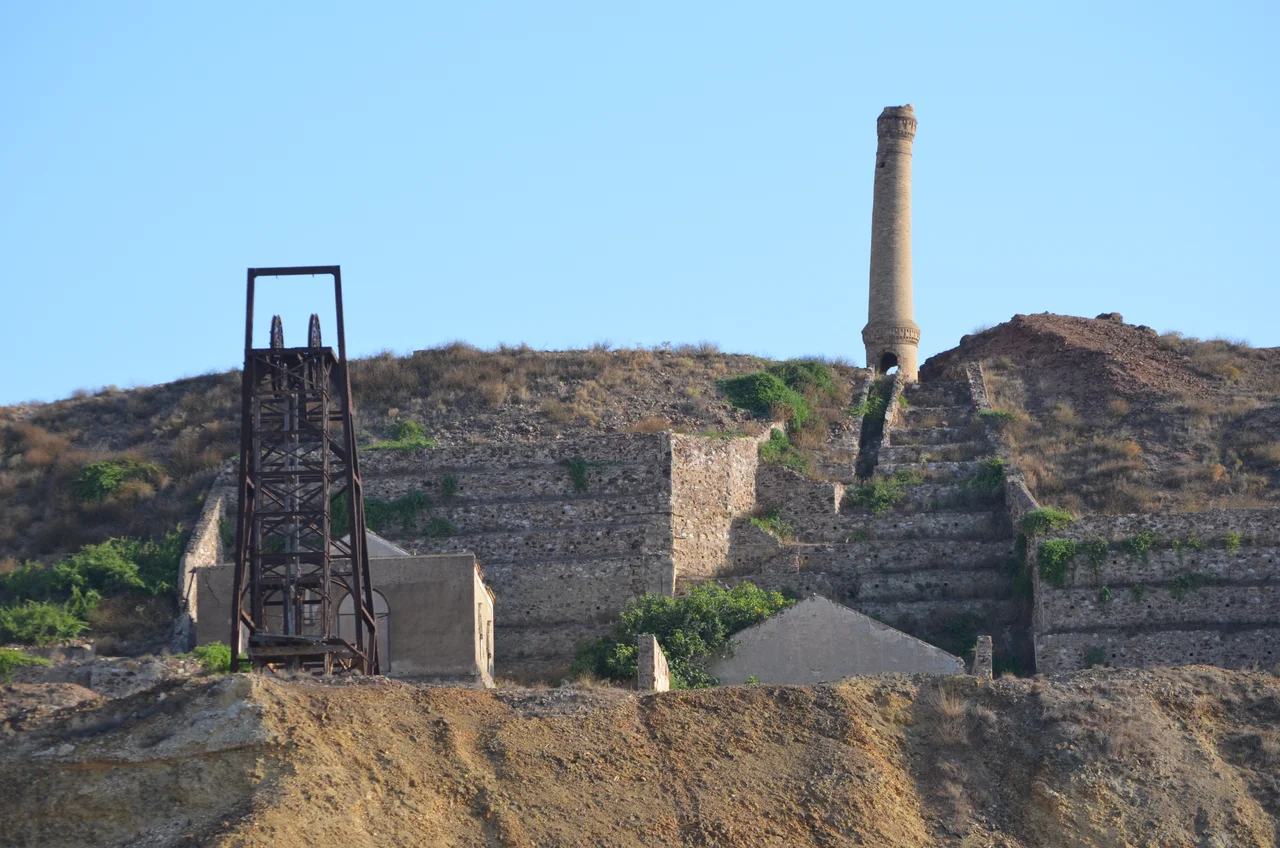
A range of low, sun-scorched hills runs for 26 kilometers along the coast east of Cartagena, out to Cape Palos. It is not much to look at, and that is the point: everything valuable here was underground. For nearly three thousand years, the silver and lead locked in these slopes made this modest sierra one of the most fought-over pieces of ground in the western Mediterranean. Empires were built and broken over the right to dig here. Whoever held these hills held a fortune, and they knew it.
Metal from a Vanished Volcano
The wealth had a violent origin. Around seven million years ago, the land around Cartagena convulsed in one of the Iberian Peninsula's most recent bouts of volcanism, and the small islands scattered across the nearby Mar Menor lagoon are the worn remnants of those eruptions. As the fires cooled, superheated water charged with dissolved metals forced its way through the cracks in the rock and deposited its cargo there, threading the mountains with rich veins of silver-bearing galena, lead, zinc, and iron. Geology handed this coast an almost unfair concentration of ore. The rest of the story is what people did to get it out.
The Silver That Decided a War
Phoenician traders were working this coast by the 7th century BC, and one of their ships, wrecked near the island of Grosa, still held ingots of tin and copper and elephant tusks scratched with Phoenician letters when divers found it. When the Carthaginian general Hasdrubal founded Qart Hadasht here in 227 BC, the silver was his chief object; with it, Carthage paid the mercenary armies that fought Rome. The Greek historian Polybius, who saw the mines in person, reported that in Roman times forty thousand people labored in them and that they poured 25,000 drachmas a day into the Roman treasury. That is why the loss of the city to the young Scipio in 209 BC was so devastating. Cut off from this silver, Hannibal could no longer pay his war, and the fall of these mines helped decide the fall of Carthage.
Death Preferable to Life
The fortune came at a horrifying human price, and the ancients did not hide it. Under Rome, tens of thousands of enslaved people were driven into the galleries beneath these hills to claw the ore loose in the dark. The historian Diodorus of Sicily, describing mines like these, wrote that the workers wore out their bodies day and night underground, lashed on by overseers, and that for many of them death came as a release from suffering they could no longer bear. It is easy, gazing at ruined headframes and scenic sea views, to forget what the wealth cost. These were not statistics. They were people, most of them held against their will, whose lives were spent to fill someone else's treasury, and any honest telling of these mountains has to hold their memory alongside the silver.
The Miners' Song
The Romans exhausted the best veins and left, and the mines fell silent for over a thousand years. A liberalizing mining law in 1825 and a silver strike in the 1830s reopened everything, and by 1850 Cartagena had dozens of smelting works turning slag and ore back into metal. The boom drew a flood of poor migrants, especially Andalusians from Almeria, who carried their music with them. Out of their fandangos and the hardship of the pits grew a distinct school of flamenco, the cantes mineros, the miner's songs, deep and difficult laments like the taranta and the minera. La Union has honored them since 1961 with an international festival of mine-singing, and in 2010 UNESCO recognized flamenco itself as a treasure of humanity. Open-pit mining ended in 1990 and left the range scarred and poisoned, yet the hills are now protected as a cultural and natural heritage site, home to rare Cartagena cypress and a music born of everything that happened here.
From the Air
The Sierra Minera runs roughly 26 km along the coast at about 37.611 degrees N, 0.861 degrees W, between Cartagena and Cape Palos, with its high point on the Sancti Spiritus hill (about 431 m) near Portmán. From the air it is a striking, legible landscape: bare, quarried, reddish-brown hills pocked with open pits and dotted with the skeletal iron headframes of old mines, giving way eastward to the greener protected ridges of the Calblanque Regional Park and the filled, pale bay of Portmán. A viewing altitude of 3,000 to 5,500 feet best captures the sweep of the range against the sea. Nearest airports are Region de Murcia International (LEMI), about 30 km northwest, and Alicante-Elche (LEAL), roughly 65 km northeast. Coastal visibility is usually excellent, clearest under the dry southwesterly wind.
Nearby Stories
- San Javier (Spain) 4.1 km away
- 2011 Lorca Earthquake 23 km away
- German submarine U-573 31 km away
- German submarine U-602 57 km away
- Villajoyosa 80 km away
- Cabo de Gata-Nijar Natural Park 82 km away
- SM U-39 107 km away
- Battle of Las Navas de Tolosa 197 km away