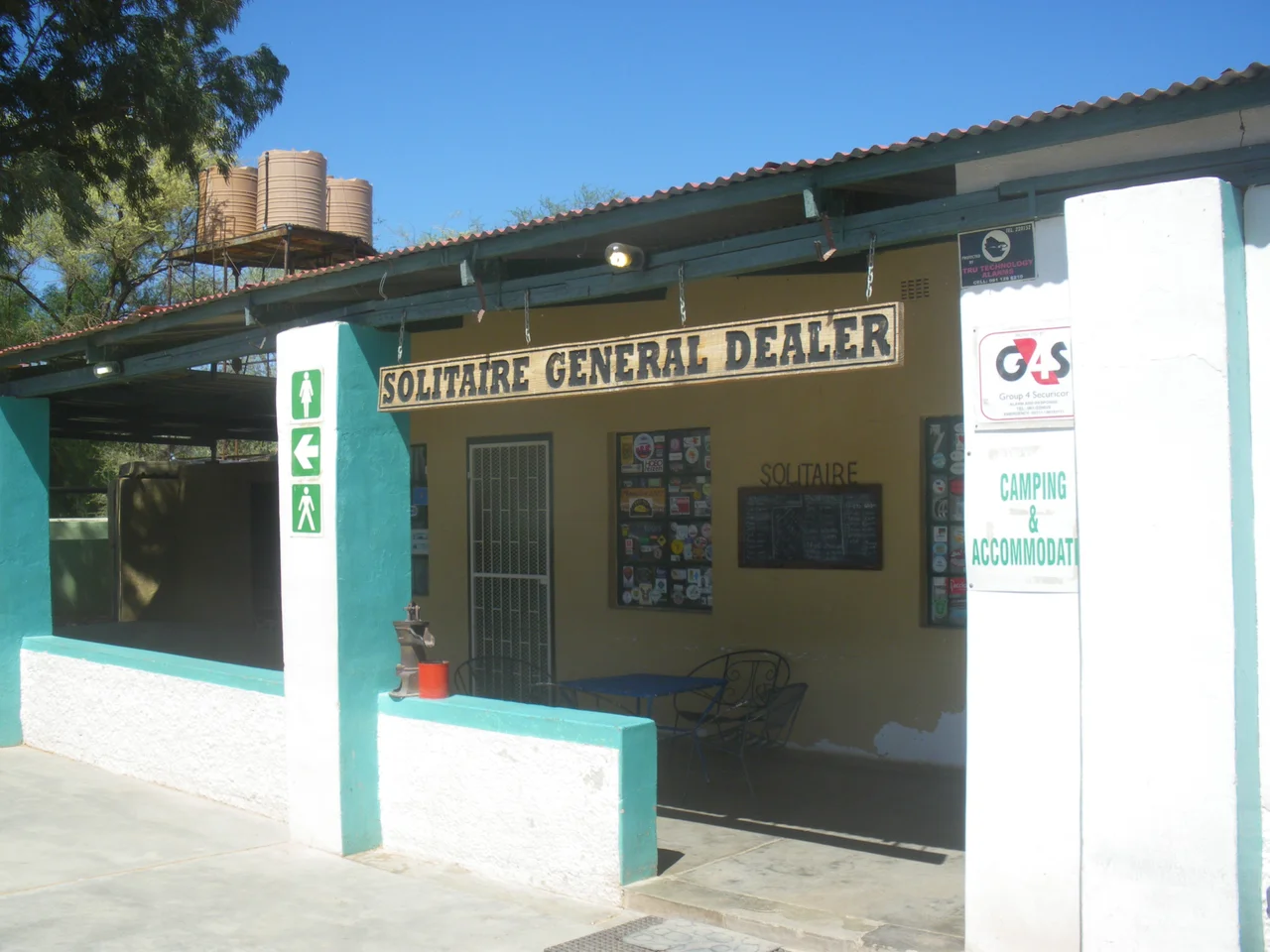

Solitaire, Namibia
The name means exactly what it looks like. Solitaire, a single petrol pump and a handful of buildings dropped into the Namibian desert, takes its name from a word that points two ways at once: a solitaire is a single set diamond, precious and alone, and solitaire is also plain solitude. The woman who named the place in 1948 chose it for both meanings, and both still hold. For travellers crossing the empty country between the great dunes of Sossusvlei and the coast at Walvis Bay, Solitaire is the only fuel, the only food, and very nearly the only company for a hundred kilometres in any direction.
One Family, Thirty-Three Thousand Hectares
Solitaire began as a sheep farm. In 1948 Willem Christoffel van Coller bought thirty-three thousand hectares of this semi-arid land from the territorial administration to raise Karakul sheep, whose lambs' pelts were prized in Europe. The first building was a humble two-room cottage; a farmhouse, a stone kraal, and a dam wall in the riverbed followed. It was van Coller's wife, Elsie Sophia, who gave the farm its name. Then came the shop and the first petrol pump, and the little store doubled as the regional post office, taking in weekly mailbags for a scattered population. A small Dutch Reformed chapel, begun in 1948 and finished in 1951, still serves the congregation and stands in as the community's meeting hall, polling station, and clinic. Out here a single building has to be many things at once.
The Best Apple Pie in the Desert
Somewhere along the way, Solitaire became famous for pie. The credit belongs to Percy Cross McGregor, a Scottish baker universally known as Moose, who settled here and began turning out an apple pie from an old family recipe at his desert bakery. Word travelled the way few things do in a place this remote, by mouth, from one dusty traveller to the next, until the pie reached something close to legend across Namibia. People drove hours out of their way for a slice and Moose's easy welcome. He died in January 2014, only fifty-seven, but the bakery kept going much as he left it, and the pie still draws the faithful. It remains one of the stranger pleasures of African travel: a warm, sugar-dusted apple pie eaten in the silence of the oldest desert on Earth.
A Crossroads in the Emptiness
Geography made Solitaire matter. It sits at the junction of two gravel highways, the C14 running from Walvis Bay and the C19 linking Sesriem and Sossusvlei, both arteries for the steady stream of visitors heading to the famous dunes. There is a tyre-repair workshop, a motel, public restrooms, a restaurant, and a hard-packed airstrip where charter pilots and self-fly tourists put down, fuel available by prior arrangement. None of it amounts to a town. It amounts to a lifeline. In a region this sparsely settled, the difference between a working petrol pump and a closed one is the difference between a smooth crossing and a very long, very dry wait.
Wrecks and Wildlife
Part of Solitaire's charm is the way it wears its decay. Rusting carcasses of old cars and trucks lie scattered around the buildings, bleached and oxidising in the dry air, more sculpture than scrap, so evocative of a vanished era that visitors keep comparing the scene to a 1950s film set. The land around it has found a second purpose, too. The farms that once raised sheep are now part of a land trust devoted to habitat preservation, and this drought-prone country supports healthy wildlife, including the endemic Hartmann's mountain zebra. Solitaire stands where the Great Escarpment gives way to grasslands, gravel plains, and dry riverbeds, right at the edge of the Namib. One pump, one bakery, one chapel, and all around it the oldest desert in the world.
From the Air
Solitaire sits at 23.883°S, 16.0°E in central Namibia, where the inland plains meet the eastern edge of the Namib at the junction of the C14 and C19 gravel roads. From the air it is a tiny cluster of buildings and a fuel stop isolated in vast open country; the well-maintained hard-sand airstrip is frequented by charter and self-fly traffic, with AVGas available by prior arrangement only, so confirm fuel before relying on it. Best viewed from 1,500 to 3,000 ft AGL. The settlement makes a natural waypoint en route to the Sossusvlei dune fields to the southwest near Sesriem. Conditions are generally clear and hot inland, away from the coastal fog belt; expect strong afternoon thermals, turbulence, and dust over the gravel plains. Nearest sizeable fields are at Walvis Bay (FYWB) on the coast to the northwest and Windhoek's Eros (FYWE) and Hosea Kutako International (FYWH) to the northeast.
Nearby Stories
- Gobabeb Namib Research Institute 51 km away
- Namib-Naukluft National Park 54 km away
- Rehoboth, Namibia 63 km away
- Namib 78 km away
- Fairy Circles 97 km away
- South West Africa 103 km away
- Duwisib Castle 131 km away
- Otjimbingwe 134 km away