Namib
This desert was already old when the dinosaurs died. The Namib has been arid for something like fifty-five million years, long enough to earn the title of the oldest desert on Earth, a place that has been dry continuously since before the modern world took shape. Its name, taken from a Nama word often rendered as vast place, barely covers it. Along Namibia's Atlantic flank the Namib runs roughly a thousand miles north to south, a ribbon of sand, gravel, and bare rock pressed between the cold ocean and the inland escarpment, and almost everything that lives here owes its survival to a single, improbable source of water: fog.
Mountains of Sand
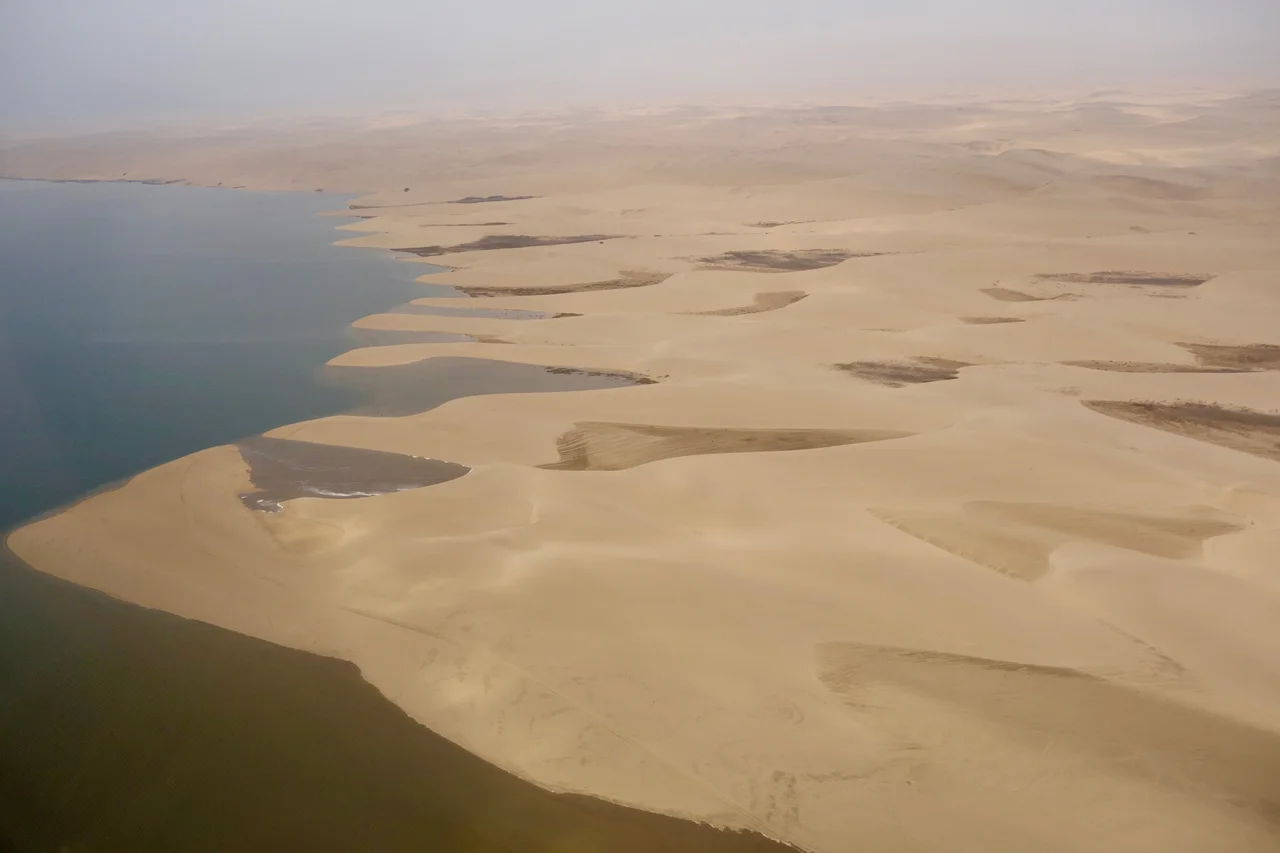
The southern Namib is a sea of dunes, and they are some of the most spectacular on the planet. Built largely from sand carried to the coast by the Orange River and then marched north by the wind, the dunes rise in great sculpted ridges that shift colour through the day, from soft pink at dawn to a deep, burning orange at noon. Several exceed three hundred metres in height, ranking among the tallest dunes anywhere, and the regularity of their patterns has puzzled geologists for decades. The sand sea has been called a wind-displaced delta, a river's worth of sediment rearranged into mountains. Walk the crest of one at sunrise and the desert seems freshly made, every footprint the first.
A Land Watered by Mist
Rain almost never comes. What sustains life here drifts in off the Atlantic each morning as fog, born where the icy Benguela Current chills the air above the sea. The mist rolls inland and beads on stone, plant, and sand, and the desert's residents have learned to harvest it. Darkling beetles, collectively known as fog beetles, perform feats of engineering for a single drink. One species tilts its smooth back into the wind so that condensation gathers and trickles down to its mouth; another builds tiny trenches in the sand to trap the moisture. Black-backed jackals lick dew from rocks. Gemsbok, the great straight-horned oryx that are the desert's largest antelope, can let their body temperature climb to forty degrees Celsius rather than sweat away water they cannot spare.
The Plant That Refuses to Die
Nothing captures the Namib's strangeness like the welwitschia. A single plant grows just two leaves in its entire life, splitting and fraying them over the centuries into a sprawling, tattered heap that can outlast empires. Carbon dating has put some specimens past a thousand years old, and the larger ones may be far older still. Like so much here, it drinks from the fog, drawing moisture the sky never sends. It looks less like a plant than like something washed up from another age, which in a sense it is. The Namib is full of such survivors, organisms that have spent millions of years perfecting the art of needing almost nothing.
The Edge of the World
Humans have always passed through more than settled. Before the twentieth century, San hunter-gatherers crossed the Namib, drinking the juice of the tsamma melon where there was no other water, while Herero and Nama herders moved livestock between scattered waterholes along its margins. Much of the desert is now protected. The vast Namib-Naukluft Park, one of the largest conservation areas in Africa, guards a great swath of it, and to the south the old Sperrgebiet diamond zone kept people out for a different reason entirely. The emptiness has a pull all its own. Filmmakers have chased it here, and somewhere out in the dunes an art installation reportedly plays a single pop song on an endless loop to no audience at all. The Namib needs no soundtrack. Its silence is the point.
From the Air
The Namib stretches along Namibia's entire Atlantic coast; this entry centres near 23.0°S, 15.0°E in the heart of the dune sea inland of Walvis Bay. From altitude the contrast is unmistakable: a band of orange and pink dunes meeting the dark Atlantic to the west and giving way to pale gravel plains and the escarpment to the east. The classic dune fields around Sossusvlei lie to the southeast. Morning fog and low stratus off the cold Benguela Current routinely blanket the coastal strip and can push well inland, so plan dune viewing for late morning onward; light is most dramatic at low sun angles. Most visitors reach the desert by light aircraft from Windhoek's Eros Airport (FYWE) or Hosea Kutako International (FYWH), about 480 km northeast, or from the coastal fields at Walvis Bay (FYWB) and Swakopmund (FYSM). Gravel airstrips serve the park interior; expect heat, turbulence, and blowing sand over the dunes by afternoon.
Nearby Stories
- Husab Mine 10 km away
- Gobabeb Namib Research Institute 42 km away
- Otjimbingwe 77 km away
- Spreetshoogte Pass 89 km away
- Cape Cross 111 km away
- Solitaire, Namibia 118 km away
- Twyfelfontein 261 km away
- Cospatrick 1552 km away