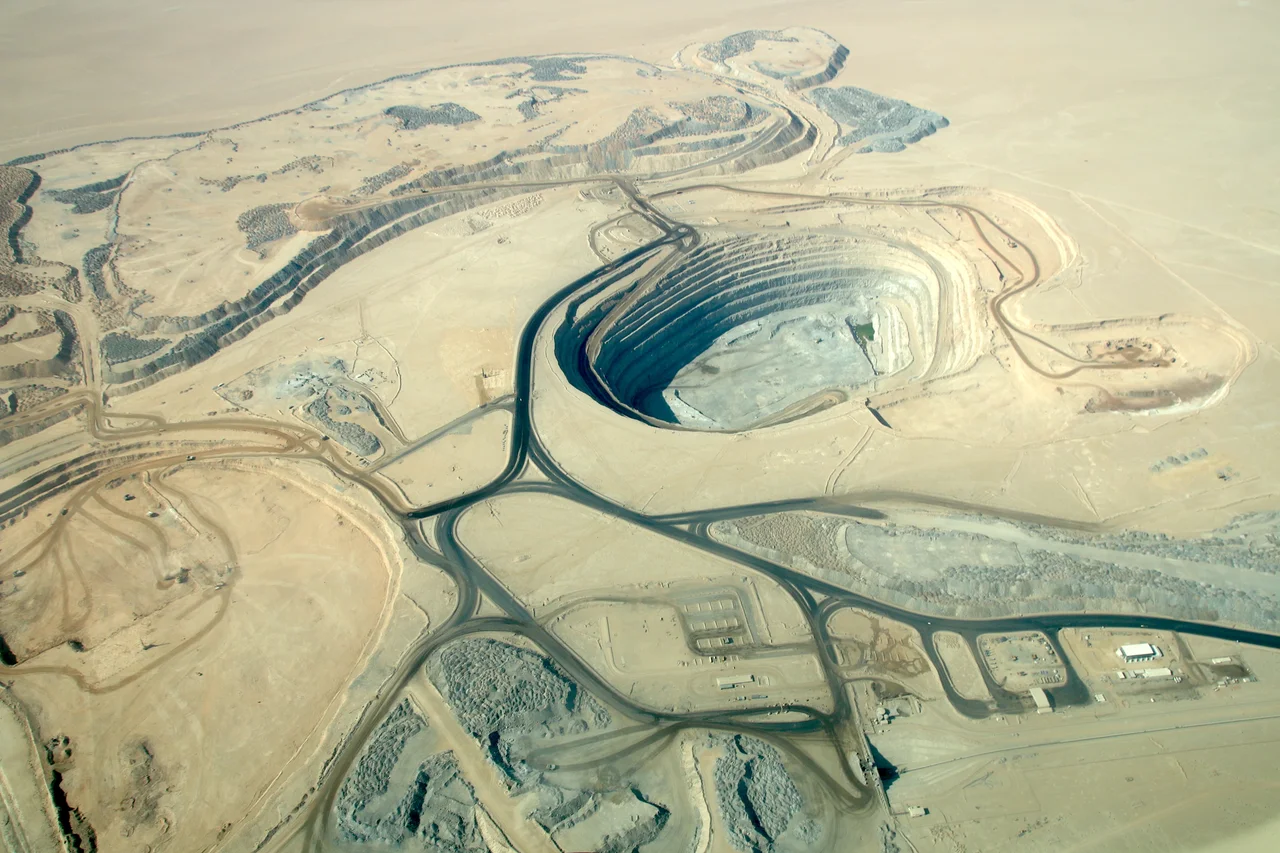

Husab Mine
Somewhere in the gravel plains east of Swakopmund, machines the size of houses are digging fuel for nuclear reactors out of rock that is half a billion years old. The Husab Mine is one of the largest uranium operations on the planet and the biggest open-pit uranium mine on the African continent, three vast terraced craters gouged into the oldest desert on Earth. It began producing in 2016, and at full stride it can ship thousands of tonnes of uranium oxide a year, enough to power cities on the far side of the world. Yet the ground it disturbs is also home to plants that were already ancient when the first shovel arrived.
Ore in the Bones of the Earth
The uranium at Husab is not scattered randomly. It sits locked in pale granite that welled up hundreds of millions of years ago, during the mountain-building convulsion geologists call the Damara Orogeny, when continents collided and the crust folded the rock that would become Namibia. Along a particular geological boundary, chemistry did the rest: iron-rich minerals created the conditions for uranium to settle and crystallise as uraninite, the dense, dark mineral that mining now chases. The deposit holds an estimated 280 million tonnes of ore, a resource expected to keep the pits working for roughly two decades. It is a strange thought, that the energy ambitions of the present should depend on a reaction the Earth ran in deep time.
A Chinese Megaproject in the Desert
Husab is as much a financial landmark as a geological one. The Australian explorer Extract Resources proved the deposit, but the capital to build the mine came from China. Through a Hong Kong holding company, the state-owned China General Nuclear Power Company took control of the operating firm, Swakop Uranium, with Namibia's state mining company holding the rest. The numbers were staggering for a young nation: well over two billion US dollars to bring the mine online, by far the single largest Chinese investment in Africa at the time. For Namibia it meant jobs, infrastructure, and a place near the top of the global uranium trade. For Beijing it meant a long-term, secure supply of nuclear fuel, dug from someone else's desert.
Mining Where the Welwitschia Grows
The Namib is hyper-arid, one of the driest places people have ever tried to work. Swakopmund and the inland station of Gobabeb may see only a few millimetres of rain in a year, and the nearby Rössing records barely thirty to thirty-five. Water is the constraint that shadows everything. The operators monitor groundwater through a ring of boreholes and suppress the choking dust with chemicals that, they say, spare up to ninety percent of the water a wetter method would demand. The deeper tension is harder to engineer away. Scattered across these plains grow welwitschia, the desert's living fossils, individual plants carbon-dated to a thousand years and more. The mine maps and tracks the welwitschia fields, an industrial enterprise keeping watch over organisms that have outlived every human institution around them, and may yet outlive the mine itself.
What the Pits Leave Behind
A uranium mine is a calculation that runs for generations. The ore body will not last forever, and when it is exhausted the pits, the towering waste dumps, and the tailings will remain, along with a radiation management plan submitted to Namibia's regulators and audited to keep the operation within limits. Husab sits in a cluster of uranium prospects threaded through this corner of the Erongo region, names like Ida Dome, Goanikontes, and Valencia marking other granite-bound deposits awaiting their turn. Together they have made Namibia one of the world's leading sources of uranium. The desert that took fifty-five million years to form is being read, in places like this, as a balance sheet, its deep geology converted into kilowatts an ocean away.
From the Air
The Husab Mine lies at 22.612°S, 15.014°E in the Namib gravel plains of the Erongo region, about 45 km inland from Walvis Bay and a similar distance east-southeast of Swakopmund, roughly 5 km south of the older Rössing mine. From the air it is conspicuous: a sprawling industrial complex with large open pits, pale waste-rock dumps, and a processing plant set against otherwise empty desert; the two big mines together form an obvious landmark. Best viewed from 2,000 to 4,000 ft AGL. As active operational airspace with blasting, haul traffic, and dust, this is a place to observe from a respectful distance rather than overfly low. Coastal fog and low stratus off the Benguela Current often blanket the approach from the west in the morning, clearing toward midday. Nearest fields are Walvis Bay International (FYWB) and Swakopmund (FYSM) to the west; expect afternoon turbulence and blowing sand over the plains.
Nearby Stories
- Battle of Trekkopjes 17 km away
- Namib 18 km away
- Otjimbingwe 73 km away
- Cape Cross 78 km away
- Leopard Cave, Namibia 84 km away
- Spreetshoogte Pass 116 km away
- Twyfelfontein 222 km away
- Cospatrick 1590 km away