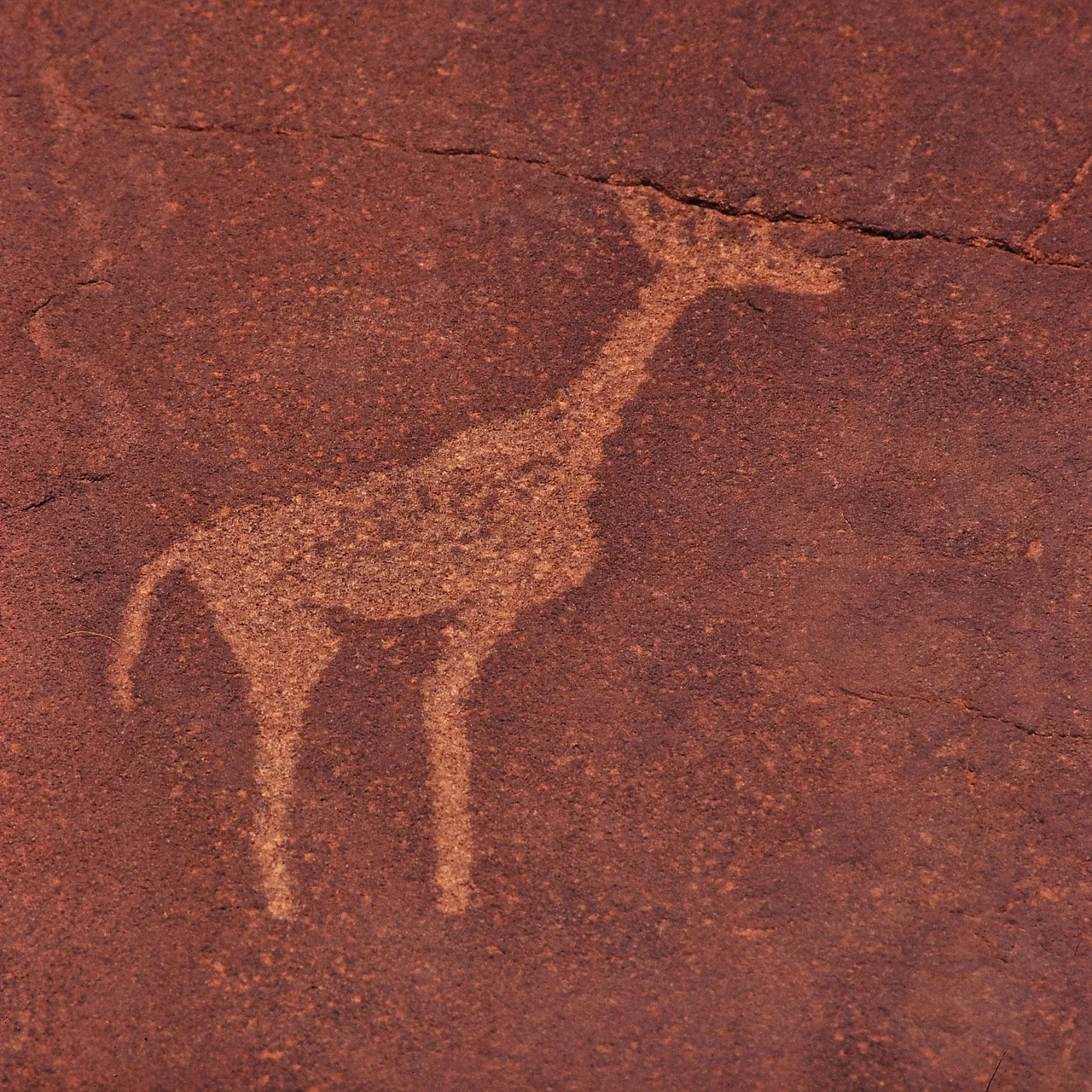

Twyfelfontein
A giraffe stands frozen in the rock, neck arched, legs mid-stride, pecked into red sandstone by a hand that worked here perhaps before the pyramids were built. Around it, on slab after tilted slab, march elephants and rhinos, ostriches and lions, the spoor of a desert that was once wetter and wilder. The artists who made them are gone, their language carried by the click-consonant name the place still bears, but their record endures: at least 2,500 engravings clustered in one valley of the Kunene region, one of the densest concentrations of rock art anywhere in Africa.
Six Thousand Years at the Spring
People have come to this valley for some 6,000 years, drawn by a spring in an otherwise punishing land. First came San hunter-gatherers, and later Khoikhoi herders, and both treated the place as sacred ground where shamans entered trance and the work of ritual was done. The art belongs mostly to the hunter-gatherers, who lived here until Damara pastoralists arrived around 1,000 years ago. The Afrikaans name Twyfelfontein means "doubtful spring," a settler's wary judgment of unreliable water. The site's own name, in the Damara language, is written today as /Ui-//aes, with the slashes that mark the clicks of a tongue most visitors will never have heard spoken.
Carving Through the Skin of the Rock
The technique was a kind of reverse drawing. Over thousands of years, the sandstone here grew a dark patina that geologists call desert varnish, a hard brown-to-grey skin baked onto the stone by sun and time. The artists chiseled through that skin to expose the pale rock beneath, so that each engraving glowed lighter than the surface around it. The work was slow and deliberate, accumulated over millennia rather than carved in any single burst of inspiration. The oldest figures may be as much as 10,000 years old, and the making of new ones seems to have ended around the time the herding peoples arrived. Every line is a decision that has lasted longer than most civilizations.
The Lion That Is a Man
Some of the engravings reward a closer look with a jolt of strangeness. The famous "Lion Man" shows a great cat with an impossibly long, kinked tail that ends in a paw-print, and feet that carry five toes instead of the four a real lion bears. To the people who made it, this was not an error but a meaning: a shaman in trance who has crossed over into the body of a lion. Nearby, the polished figure known as the "Dancing Kudu" stands among the herds. These were never simple pictures of animals. They were a spiritual record, the residue of ritual, the marks left by people reaching for the world behind the visible one.
Walking the Gallery Today
In 2007, Twyfelfontein became Namibia's first UNESCO World Heritage Site, recognized for a coherent and high-quality record of hunter-gatherer ritual stretching across at least two millennia. The art cannot be wandered alone; visitors go out only with a local guide, which the modest entrance fee includes, and the walks run from roughly half an hour to well over an hour across the heated rock. It is worth every step. To stand before a 6,000-year-old elephant in the silence of the Damaraland desert, guided by someone whose own people belong to this ground, is to feel the distance and the nearness of the human past collapse into a single morning.
From the Air
Twyfelfontein lies at 20.60 degrees south, 14.37 degrees east, in the rugged Damaraland country of the Kunene region in northwestern Namibia, reached overland from Khorixas by a string of gravel roads. From the air the landscape is dramatic: red sandstone tablelands, the dark cone of nearby volcanic features, and the dry watercourses that trace the desert. There is no major airport at the site; the nearest substantial fields are on the coast at Swakopmund (FYSM) and Walvis Bay (FYWB), several hours' drive to the southwest, while light aircraft serve regional strips in Damaraland. The desert air is typically clear with excellent visibility; the dry winter months offer the most comfortable conditions on the ground.
Nearby Stories
- Brandberg 35 km away
- The White Lady (Namibia) 49 km away
- Leopard Cave, Namibia 131 km away
- Etosha National Park 238 km away
- Kaokoland 276 km away
- Omugulugwombashe 296 km away
- 1997 Namibia Mid-Air Collision 326 km away
- Cospatrick 1796 km away