
Etosha National Park
Stand at the edge of the Etosha Pan in the dry season and the horizon disappears. The salt flat stretches out flat and blinding white, so large that it shows up clearly from orbit, so empty that mirages of phantom water ripple where there is nothing but cracked mineral crust. The name the local people gave it says everything: Etosha, the 'great white place.' This ghostly expanse is the still centre of one of the most celebrated wildlife parks on the continent, and the secret to why the animals come is hidden in plain sight - the pan is almost always bone dry, and the few places that hold water rule everything that lives here.
The Great White Place
The Etosha Pan dominates the park the way a missing tooth dominates a smile - you cannot stop looking at the absence. Covering roughly 4,760 square kilometres, it is the largest salt pan in Africa, the dried bed of an ancient lake that vanished when the rivers feeding it changed course long ago. For most of the year it is simply a hard, glittering plain. Only after exceptional rains does a shallow film of water gather across part of it, sometimes drawing flamingos to breed in their thousands before the sun erases the lake again. The rest of the time the pan is a barrier and a beacon at once: too saline and waterless to cross casually, yet the gravitational centre around which the entire ecosystem arranges itself.
A Reserve Older Than the Country
Etosha's protection is more than a century old, predating Namibia's independence by generations. The German colonial administration proclaimed the area a game reserve in 1907, designating it Game Reserve No. 2 - and at the time it sprawled across some 100,000 square kilometres, a staggering swath of land. Over the following decades, political shifts and the carving-up of territory whittled it down to its present size of roughly 22,000 square kilometres, still one of the largest reserves in Africa and second in Namibia only to the immense Namib-Naukluft Park. Today its lodges and gates are run by Namibia Wildlife Resorts, a state-owned operation, and the park draws visitors from across the world to a landscape that has been left wild for well over a hundred years.
Why the Animals Gather
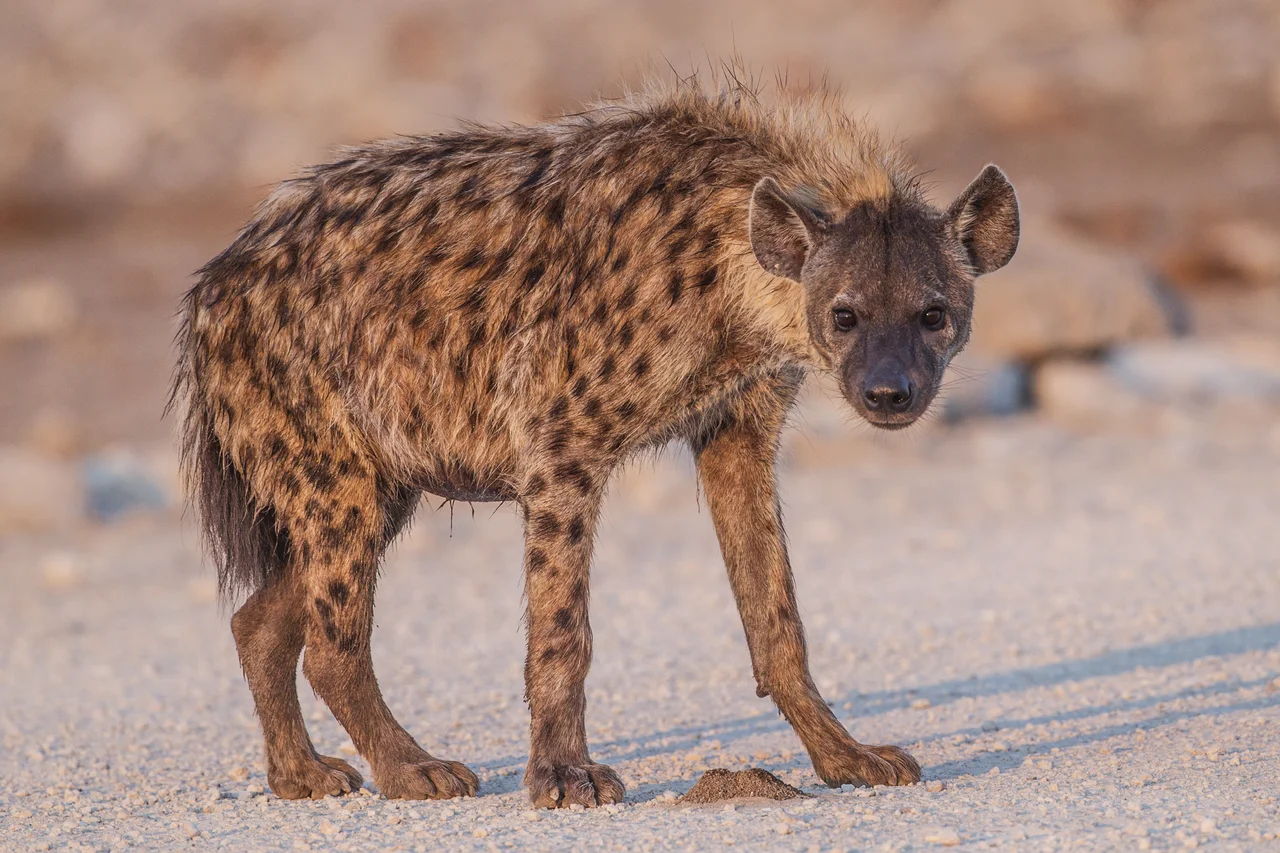
In a land this dry, water is not a convenience - it is the whole story. Ringing the pan are dozens of waterholes and boreholes, and in the parched winter months they become the only reliable drink for miles. The result is a concentration of wildlife that borders on the theatrical. Springbok, zebra, giraffe, wildebeest, warthog and the rare black-faced impala are nearly impossible to miss from the main roads. Elephant and rhino emerge from the bush at the water's edge, and for the patient watcher, cheetah, lion and leopard move through the shadows. Around 114 mammal species live here in all, from jackals and hyenas down to the tiny dik-dik. One animal is conspicuously absent: there are no buffalo in Etosha, kept out by deliberate veterinary policy - buffalo are natural carriers of foot-and-mouth disease, and Namibia excludes them from protected areas to safeguard the country's livestock export status.
Theatre at the Waterhole
The most extraordinary way to experience Etosha asks almost nothing of you. At the rest camps of Okaukuejo, Halali and Namutoni, floodlit waterholes sit just beyond the perimeter fence, and after sunset - when visitors are barred from venturing into the park itself - the animals come to you. You can settle in with a drink and watch in the cool dark as elephants, rhinos and predators arrive in shifting procession to drink, posture, court and occasionally clash, often deep into the night. It is the rarest kind of wildlife viewing: not a chase across the bush, but a vigil. The animals choreograph themselves around the water, and the human audience simply has to be still, and patient, and quiet enough to let the night unfold.
The Rules of a Wild Place
Etosha lets you in, but on the land's terms, not yours. Visitors stay in their vehicles - leaving the car outside the fenced camps and picnic sites is forbidden, because the things that make the park magnificent will also kill you. The roads are well-graded gravel, navigable without four-wheel drive, but the speed limit is held to 60 kilometres an hour to keep down the dust that damages the ecosystem, and crossing the park east to west eats the better part of a day. The gates open at sunrise and close at sunset, locking the rhythm of every visit to the rhythm of the light. Even within the camps the warnings are real: jackals wander between the tents at night, and the fences around the floodlit waterholes are low enough that no one should ever sleep out beside them - a lion does not consider that barrier an obstacle at all.
From the Air
Etosha centres on roughly 18.79 degrees south, 16.26 degrees east in northern Namibia. From the air the park is impossible to mistake: the vast pale Etosha Pan blazes against the surrounding olive-green bushveld, a brilliant white void visible from extreme altitude and from space. Waterholes show as dark pinpricks ringed by animal-trodden earth. The eastern gate at Namutoni and southern gate near Okaukuejo mark the developed edges. The park has its own airstrips serving the camps and lodges; charter access is common. The nearest sizeable towns are Tsumeb to the east and Outjo to the south. Hosea Kutako International (FYWH) and Eros (FYWE) at Windhoek lie well to the south. Clearest viewing is in the dry winter months (May to September), when haze is minimal and the contrast between white pan and green bush is sharpest.
Nearby Stories
- Battle of Namutoni 12 km away
- Ovamboland 73 km away
- Battle of Otavi 88 km away
- Ombalantu Baobab Tree 137 km away
- Tsumeb 147 km away
- Omugulugwombashe 159 km away
- Petrified Forest, Khorixas 206 km away
- 1985 Aeroflot Antonov An-12 Shoot-Down 437 km away