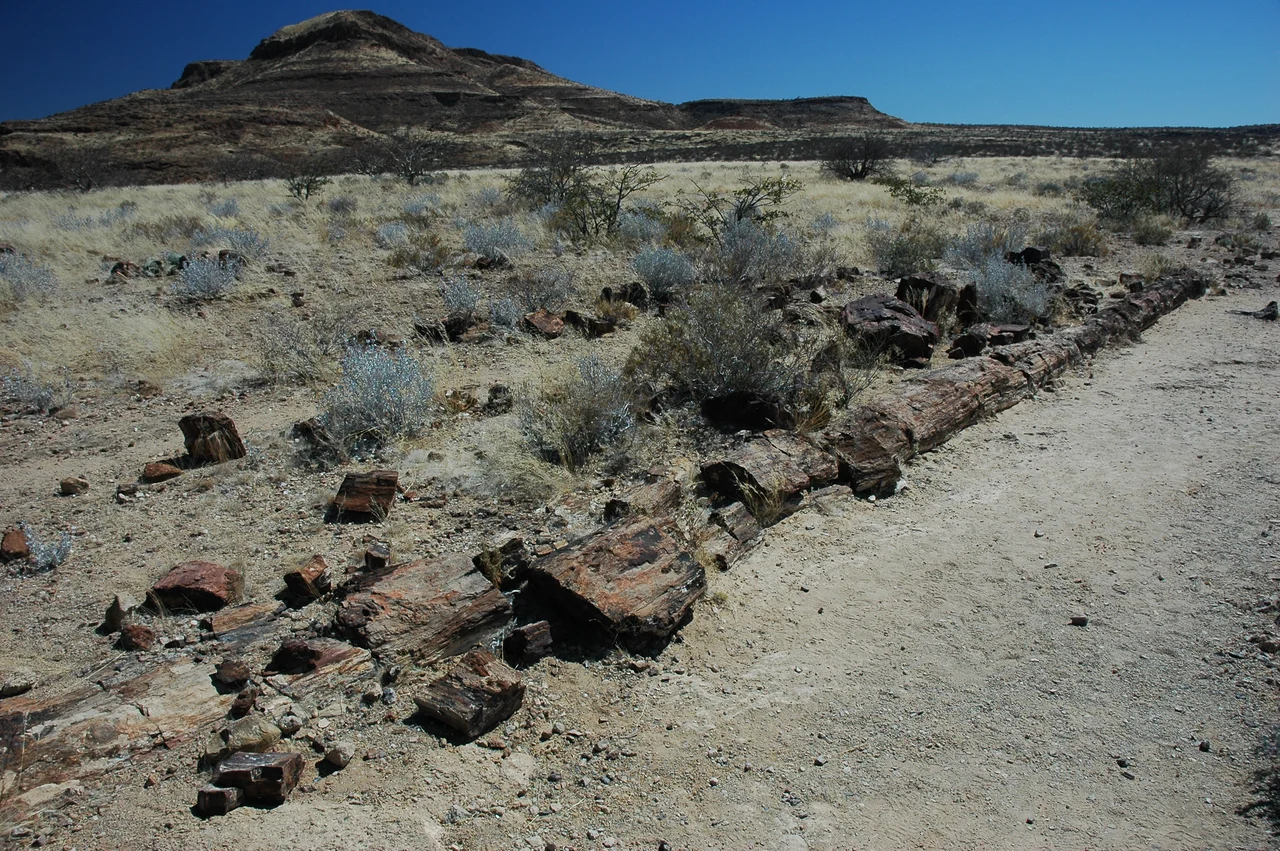

Petrified Forest, Khorixas
Run your hand along the bark and your fingers expect wood. They find stone. The trunk lying half-buried in the red gravel west of Khorixas has every detail a living tree would have - the grain, the rings, the knots where branches once grew - but it weighs as much as rock because that is exactly what it has become. These trees fell roughly 280 million years ago, long before the dinosaurs, when this corner of Namibia was part of the supercontinent Gondwana. They have outlasted the very landmass they grew on.
Trees That Travelled Here
The first surprise is that these trees never grew where they now lie. They were carried here. Geologists believe a massive flood - likely meltwater from a retreating Gondwana ice age - ripped the trunks from forests far upstream and dumped them on a floodplain, where alluvial sand quickly buried them. Stripped of bark, lacking root systems, the logs arrived already dead and stranded. Two of the largest trunks on display stretch about 45 metres, and several hundred more lie scattered through the surrounding terrain. They came from a world we would not recognise, deposited on a riverbank that has since dried into one of the most arid places on Earth.
How Stone Replaced Wood
Burial saved them. Sealed beneath sand, cut off from oxygen, the wood could not rot. Instead, mineral-rich groundwater seeped through the trunks cell by cell over millions of years, and silica precipitated inside each individual plant cell - a process called silicification. The result is uncanny fidelity: the microscopic structure of the wood is preserved in quartz, even if the warm browns of living timber have given way to the muted greys and ochres of stone. The sand that entombed them hardened into sandstone, and that sandstone is now slowly eroding away, surrendering the trunks back to the surface one wind-blown grain at a time. What you see is the forest re-emerging on geology's schedule, not ours.
A Window Into Gondwana
What makes these trunks so valuable is not just their age but the lost world they belong to. Roughly 280 million years ago, in the Permian period, there were no separate continents as we know them. Africa was fused with South America, Antarctica, Australia and India into the single great southern landmass of Gondwana, and ice sheets had only recently retreated from much of it. The forests these logs came from grew in that frozen-then-thawing supercontinent, in a climate and on a map that no human eye has ever seen. When you look at the grain frozen in the quartz, you are reading the anatomy of a tree from a planet arranged entirely differently from our own - the continents not yet torn apart, the dinosaurs not yet evolved, the whole familiar geography of the world still tens of millions of years from forming.
The Living Fossil Alongside the Dead
Scattered among the stone logs grows something that blurs the line between living and ancient: the welwitschia. This bizarre plant produces just two leaves in its entire lifetime, which fray and split as they sprawl across the desert floor over the centuries. Welwitschias are slow beyond comprehension - some individuals are believed to be more than 1,500 years old, and a few may be far older still. The plant is so emblematic of this land that it appears on Namibia's national coat of arms. To stand here is to occupy a strange double exposure of time. At your feet lies a tree that died 280 million years ago, and beside it sprawls a plant that has been quietly alive since before Europe's cathedrals were built, both of them outliving nearly everything around them.
A Monument in the Desert
The site has been protected for generations. Namibian authorities declared the Petrified Forest a National Monument on 1 March 1950, recognising that fossils this old and this exposed could vanish into private hands or souvenir pockets without safeguards. Local guides now lead visitors along marked paths roughly 42 kilometres west of the town of Khorixas, on the C39 road that threads through Damaraland. There are no fences around the open desert, no grand visitor centre - just the trunks themselves, lying where the flood left them, in a silence broken mostly by wind. It is one of the few places where you can touch something a quarter of a billion years old and feel, briefly, how shallow human time really is.
From the Air
The Petrified Forest sits at roughly 20.44 degrees south, 14.61 degrees east, on the C39 road about 42 km west of Khorixas in Namibia's Damaraland. The terrain reads from the air as a vast tableland of red and ochre gravel plains punctuated by flat-topped mesas and dry watercourses, with the Brandberg massif rising to the southwest. The nearest sealed airstrip is Khorixas Airport (FYKS). Larger options include Eros Airport (FYWE) and Hosea Kutako International (FYWH) at Windhoek to the southeast, and Walvis Bay (FYWB) on the coast. Best viewed in the clear, low-humidity light of the dry winter months (May to September); midday glare off the pale ground can wash out contrast, so morning or late-afternoon light defines the landscape best.
Nearby Stories
- The White Lady (Namibia) 42 km away
- Leopard Cave, Namibia 103 km away
- Cape Cross 115 km away
- Spitzkoppe 150 km away
- Etosha National Park 199 km away
- Kaokoland 270 km away
- Omugulugwombashe 272 km away
- 1997 Namibia Mid-Air Collision 344 km away