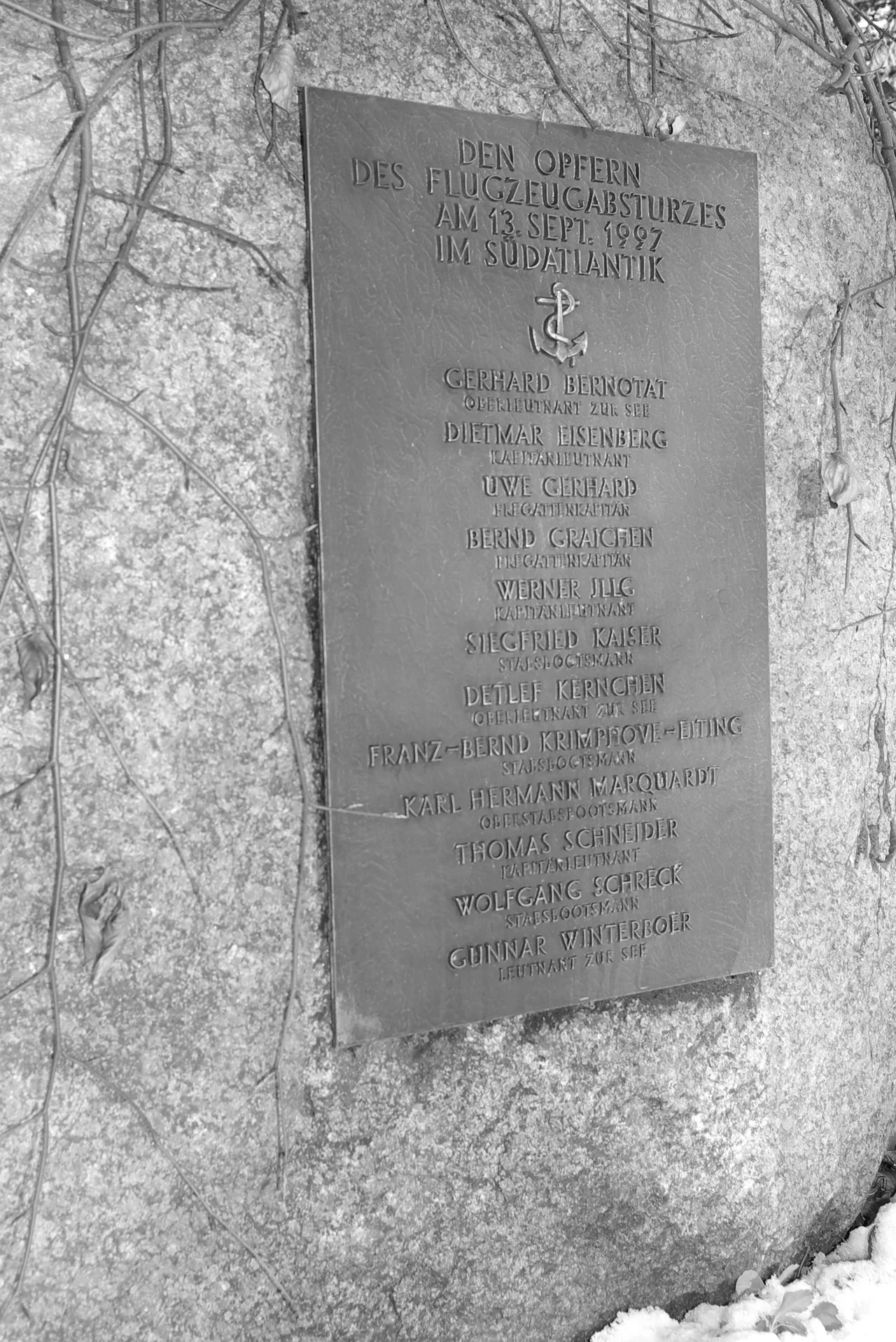

1997 Namibia Mid-Air Collision
The sky above the South Atlantic was clear that afternoon - the kind of high, empty blue where two aircraft might pass for hours without ever seeing one another. On 13 September 1997, about 65 nautical miles off the Skeleton Coast of Namibia, they did not pass. A German Air Force Tupolev Tu-154M flying south toward Cape Town and a United States Air Force C-141B Starlifter flying north toward Ascension Island struck each other at 35,000 feet, in airspace where, by terrible coincidence, no controller knew the German jet was even there. All 33 people aboard the two aircraft were killed.
Two Crews, Two Missions
They had nothing to do with each other, which is part of what makes the collision so haunting. The American Starlifter, callsign REACH 4201, was flying a mission of mercy - it had just delivered a United Nations mine-clearing team to Namibia, a country still healing from decades of war. It was commanded by Captain Peter Vallejo, 34, with Captains Jason Ramsey, 27, and Gregory Cindrich, 31, and six other airmen aboard. The German Tupolev carried 24 people, among them 12 marines and two of their wives, bound for a regatta in Cape Town marking the 75th anniversary of the South African Navy. One of them was Saskia Neumeyer, a 43-year-old flight attendant. None of them knew they were on a collision course.
The Gap in the System
Neither aircraft carried a traffic collision avoidance system - the cockpit technology that warns pilots when another plane is closing. Both crews had filed flight plans, but the German jet's plan never reached the people who needed it. Faulty communications equipment and a sporadic regional teletype network meant Namibian controllers had no idea GAF 074 was in their airspace at all. Worse, the Tupolev was cruising at 35,000 feet - the altitude assigned to traffic heading the opposite way under the semicircular rule that keeps northbound and southbound aircraft vertically separated. The two planes were placed, by a cascade of small failures, at exactly the same height on a converging path. A year earlier, an international pilots' federation had warned that 75 percent of African airspace was 'critically deficient.' That warning now read like a prophecy.
The Final Moments
The Tupolev clipped the Starlifter's lower fuselage, and the explosion was bright enough to register on a US surveillance satellite passing overhead. Cockpit recordings later revealed that someone aboard the Tupolev had spotted the American jet and tried, too late, to turn away. They also revealed something harder to absorb: the American crew survived the impact itself, at least for a few moments. One pilot's voice can be heard urging the others to get their oxygen masks on, to find the flashlights, fighting to save a crippled aircraft as it fell. A French Air Force plane in the area picked up a single mayday call. Then both aircraft went into the sea, and the voices stopped. These were not statistics. They were people who, in their last seconds, reached for one another.
The Long Search
When the Starlifter failed to arrive at Ascension, controllers there tried fifty times to raise Namibia before the alarm finally spread. An international fleet from the United States, France, Britain, Germany and several African nations converged on the empty water. For days, faint signals from emergency beacons raised and then dashed hopes of survivors. The sea gave back almost nothing. Six days after the crash, searchers recovered the body of Saskia Neumeyer - the only one of the 33 ever returned whole. Months later, divers found the remains of Captains Vallejo and Ramsey along with unidentifiable fragments of their crewmates; they were laid to rest at Arlington National Cemetery on 2 April 1998. Most of those lost remain in the Atlantic to this day.
What the Loss Demanded
The investigations that followed - American and German alike - reached the same conclusion: the German aircraft, flying at the wrong altitude and unknown to local control, bore primary fault, with the continent's broken air traffic system a grievous contributing cause. But blame was not the lasting outcome. The report stated plainly that a working collision-avoidance system on either aircraft would almost certainly have prevented the disaster. One day before it was published, the US Secretary of Defense ordered such systems installed across the military fleet, and Germany faced mounting pressure to do the same. It is a bitter pattern in aviation: the technology that protects the living is so often paid for by the dead. Thirty-three people went down off this coast so that the warning would finally be heeded.
From the Air
The collision occurred at approximately 18.8 degrees south, 11.3 degrees east, about 65 nautical miles offshore from Namibia's Skeleton Coast over the South Atlantic. There is nothing to see on the water itself - the wreckage lies on a seabed more than 600 metres deep - but the desolate coastline inland is among the most striking on the continent: a knife-edge between the cold Atlantic and the dunes of the Namib. The nearest coastal field is Walvis Bay (FYWB) to the south; Hosea Kutako International (FYWH) and Eros (FYWE) at Windhoek lie to the southeast. Visual conditions here are frequently excellent at altitude, though a low coastal fog bank often clings to the shore - the same treacherous combination of clear sky and unseen hazard that defined the day.
Nearby Stories
- MV Dunedin Star 39 km away
- Kaokoland 122 km away
- Iona National Park 232 km away
- Twyfelfontein 310 km away
- Petrified Forest, Khorixas 370 km away
- Loango National Park 1817 km away
- Ngounie River 1994 km away
- Roncador Field 4754 km away