.jpg)
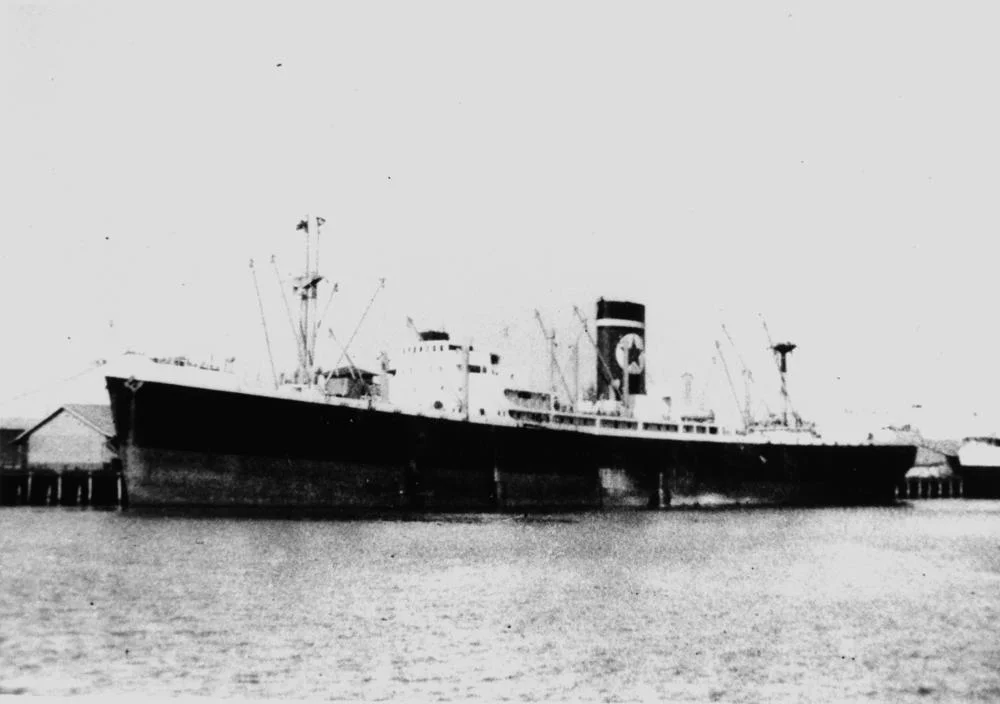
MV Dunedin Star
Sailors gave this shore its name for a reason. The Skeleton Coast is a 500-kilometre wall of fog, surf and shifting dune where the cold Atlantic meets the Namib Desert, and the bleached bones it is named for belong to whales, to ships, and to the people who washed up alive only to find there was nowhere to go. On the night of 29 November 1942, the British refrigerated cargo liner MV Dunedin Star struck an underwater obstruction here and limped toward the beach. Everyone aboard survived the grounding. What followed - to keep them alive on that lethal coast - would cost more lives than the wreck itself.
A Meat Ship Goes to War
The Dunedin Star was never built for drama. Cammell Laird launched her on the Mersey in 1935 as a Blue Star Line motor ship, a refrigerated workhorse designed to haul frozen meat from Australia and New Zealand to British dinner tables. War gave her a harder life. She ran the gauntlet of Convoy GM 2 during Operation Halberd in September 1941, part of the desperate effort to relieve the besieged island of Malta - a run that saw her sister ship Imperial Star torpedoed and scuttled. The Dunedin Star reached Malta and survived. A year later, sailing alone down the African coast with a hold full of munitions and supplies bound for the Eighth Army, she met not an enemy torpedo but the seabed itself.
Aground on a Killing Shore
At half past ten that night she struck what was likely the poorly charted Clan Alpine Shoal, holed below the waterline and taking on water. Her captain ran her toward shore to keep her from sinking, and she grounded with 106 souls aboard - 85 crew and 21 passengers. That should have been the rescue. On any ordinary coast it would have been. But here the surf was murderous and the shore behind it was worse: a waterless desert stretching inland for hundreds of kilometres. Boats ferried some survivors to the beach, where they were marooned without shelter, food or water, while others stayed aboard the listing ship. Both groups were now in mortal danger, and the nearest help was days away by sea, air and land at once.
The Rescue That Devoured Its Rescuers
What unfolded was a three-pronged operation of extraordinary courage and cruel luck. The South African Railways tug Sir Charles Elliott steamed north to take survivors off by sea. A minesweeper, the HMSAS Nerine, carried emergency supplies. A South African Air Force Lockheed Ventura flew up from Cape Town to drop food and water on the beach, piloted by Captain Immins Naudé. And overland from Windhoek a police-led convoy hacked its way through the dunes toward the stranded party ashore. Then the rescue began to consume the rescuers. The Ventura that landed near the beach bogged in the sand and was lost. Returning south, the tug Sir Charles Elliott ran aground near Rocky Point, and two of her crew - First Officer Angus McIntyre and deckhand Mathias Korabseb - drowned. The sea was taking its toll on the people sent to cheat it.
Everyone Home, at a Price
Against every setback, the operation worked. Through some combination of the overland convoy, the supply drops and sheer endurance, every passenger, every crew member and every gunner from the Dunedin Star was eventually brought out alive. But the accounting was grim. The wreck itself killed no one; the rescue killed two and destroyed an aircraft and a tug. It took a full month for the last of the ship's company to reach Cape Town, and more than two months for the last of the rescuers to make it home. The story passed into legend on the South African coast, retold in books and a television documentary featuring survivors and the pilot Immins Naudé. The Dunedin Star never sailed again.
The Coast That Keeps Its Wrecks
Today the Skeleton Coast still hoards its dead ships, and the Dunedin Star is in famous company. A short distance down the same shore lie the rusting remains of the Eduard Bohlen, a German liner wrecked in 1909 and now stranded improbably far inland as the dunes have marched seaward, swallowing the old beach. These hulks are not picturesque ruins on a friendly coast; they are warnings, left where they fell. The very emptiness that nearly killed the Dunedin Star's survivors is what now protects the wrecks - too remote to salvage, too harsh to settle, a coastline that simply keeps what the sea hands it.
From the Air
The Dunedin Star grounded at roughly 18.13 degrees south, 11.55 degrees east, on the northern Skeleton Coast of Namibia near the Angolan border. From the air the coast is unmistakable: a hard line where ochre and white dunes meet a perpetually surf-pounded shore, frequently veiled by the cold Benguela Current fog that drifts inland on most mornings. Scattered shipwrecks dot the sand for hundreds of kilometres. The nearest serviced field is Walvis Bay (FYWB) well to the south; Hosea Kutako International (FYWH) and Eros (FYWE) at Windhoek lie inland to the southeast. Visibility is best in the afternoon once the coastal fog burns off; mornings can drop to near zero at the shoreline - the same fog that helped doom ships here for over a century.
Nearby Stories
- 1997 Namibia Mid-Air Collision 40 km away
- Kaokoland 113 km away
- Iona National Park 146 km away
- São Martinho dos Tigres 151 km away
- Twyfelfontein 348 km away
- Loango National Park 1759 km away
- Ngounie River 1935 km away
- Roncador Field 4767 km away