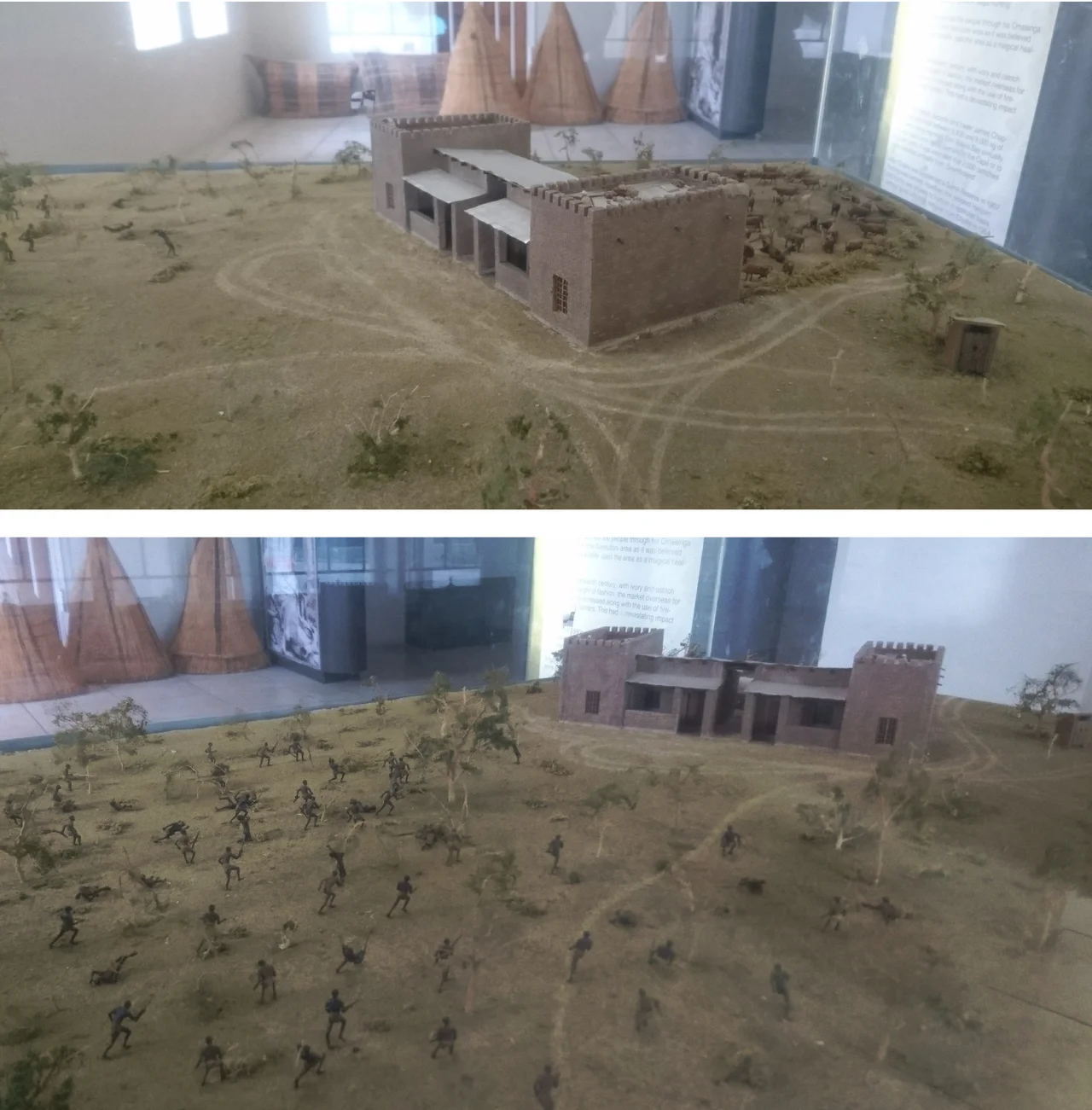

Battle of Namutoni
Seven men held the fort. Four were regular soldiers of the German Schutztruppe, three were colonial reservists, and between them they had fifteen hundred rounds of ammunition and a stone outpost on the dry northern lip of the Etosha Pan. On 28 January 1904, five hundred Ondonga warriors came for them. The names of the defenders survive - Grossman, Basendowski, Lassmann, Lemke, Lier, Becker, Hartmann - which is its own kind of clue to how the colonial record was kept: seven Germans carefully listed, five hundred attackers counted as a number. This was the Battle of Namutoni, a single day's fight at a place that is now one of the most visited rest camps in Namibia, and it was one of the first blows struck against German rule in the territory.
The Man Who Refused the Empire
The attack had a leader with a long memory for resistance. Chief Nehale lyaMpingana of the Ondonga was known for an anti-colonial stance that predated the Germans entirely - nearly two decades earlier, in 1886, he had driven off Boer trekkers of the Dorsland party and ordered the killing of William Jordan, the trader whose land deals had propped up the short-lived Republic of Upingtonia. When the great Herero uprising broke out to the south in early 1904, Nehale saw his moment. The German fort at Namutoni sat at the edge of his world, a small garrison far from help. He did not wait to be conquered. He moved first.
A Day at the Fort
The fighting lasted all day. Five hundred Ondonga warriors pressed the walls in waves, the attacks coming hard through the morning and then thinning as the hours wore on, until by afternoon they slackened and stopped. The seven defenders, firing from cover, had held - but they had spent most of what they had. Of fifteen hundred rounds, only about a hundred and fifty remained. They could not survive a second day like the first. So under the cover of darkness the Germans did the only sensible thing: they mounted up and slipped away south, riding 40 kilometers through the night to the farm Sandhup, leaving the fort behind them. Remarkably, not one of the defenders had been killed.
The Fort Falls
Morning found the outpost empty. The Ondonga took it, sacked it, and burned it, driving off the cattle that had been kept there. It was a clean victory - the garrison routed, the position destroyed, the herds carried off - and a rare one in a colonial war that would soon turn catastrophically against the African peoples of the territory. For a moment at Namutoni, the balance of force had tipped the other way. The empire that prided itself on its modern rifles had been forced to run in the dark from a fort it could no longer hold.
What Rose From the Ashes
The Germans came back, of course. They rebuilt Namutoni and made it bigger and stronger than before - the whitewashed fort that still stands today, now restored, photographed by tourists, and folded into the eastern edge of Etosha National Park. The pan stretches away from its walls, a vast pale ghost of an ancient lake, and the waterholes nearby draw elephant, lion, and rhino where soldiers once watched for an attack. In independent Namibia, Nehale lyaMpingana is remembered not as a rebel against lawful authority but as an early resistance hero, and the battle is commemorated at the fort he once destroyed. The victory was a single day. The memory of it has lasted more than a century.
From the Air
Fort Namutoni stands at 18.81 degrees south, 16.94 degrees east, on the northeastern edge of the Etosha Pan in northern Namibia, inside Etosha National Park. Namutoni Airport (ICAO FYNA) serves the fort and the park's eastern camps directly; Tsumeb Airport (FYTM) is the nearest town airport to the south. The dominant landmark from any altitude is the Etosha Pan itself - an immense, blindingly white salt flat roughly 120 km across that is impossible to mistake for anything else and serves as a navigation anchor across the whole region. The fort sits at the pan's eastern margin where bush gives way to bare saline ground. Visibility is excellent in the dry season; the pan can flood and shimmer in the December-to-April rains.
Nearby Stories
- Etosha National Park 28 km away
- Tsumeb 33 km away
- Battle of Otavi 80 km away
- Ovamboland 85 km away
- Dragon's Breath Cave 86 km away
- Ombalantu Baobab Tree 242 km away
- Petrified Forest, Khorixas 258 km away
- Mavinga National Park 381 km away