
Dragon's Breath Cave
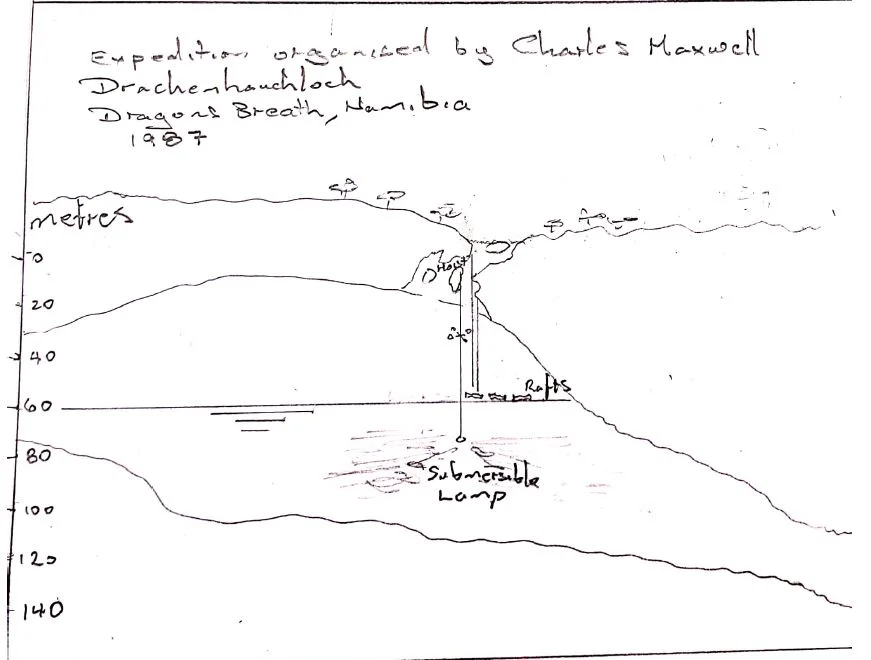
When the barometric pressure drops, the ground breathes. Warm, damp air pushes up out of a narrow crack in a dolomite outcrop, hits the cooler outside world, and condenses into a curl of mist that hangs at the cave mouth like smoke from something alive underground. The cavers who found this place in 1986 knew exactly what to call it: Dragon's Breath. They had no idea, at first, what the breath was rising from. Sixty meters below their feet, in total darkness, lay the largest known underground lake on the planet - a sheet of still black water in a chamber no one had ever seen.
A Door in the Dolomite
There is nothing dramatic on the surface. The entrance is a near-vertical shaft at the foot of a low hill in Namibia's Otjozondjupa Region, roughly 46 kilometers north of Grootfontein, narrow and easy to miss. It opens into nothing you would expect from the dry bush around it. The cave is karst - limestone and dolomite slowly dissolved by water over enormous spans of time - and the only way in is by rope, lowered through the shaft and down to the surface of the water. The land here gives no hint of the void beneath it. That is part of what makes the place feel less like a cave than a secret the desert has been keeping.
The Largest Lake You Will Never See
The superlative is precise: this is the largest known non-subglacial underground lake in the world - the biggest body of water hidden in rock anywhere outside the ice sheets of Antarctica and Greenland. Its surface alone covers nearly two hectares, the better part of three football fields, all of it underground and lit by nothing. The water sits about 60 meters below the land surface at the cave mouth. From there it plunges down: surveys put the deepest point at 264 meters below the entrance datum, with around 205 meters of water column. Divers who descend find the lake widening into a flooded cathedral far larger than the tight shaft that admits them - a chamber whose true edges took decades to find.
Mapping the Dark by Drone
For years the lake's full shape was guesswork; human divers can only go so deep on the gas they can carry. The breakthrough came from a robot. Stone Aerospace, a Texas engineering outfit, brought an autonomous underwater vehicle named Sunfish - a drone that navigates and maps on its own, using sonar to feel out walls no diver could reach. Its survey produced the first real three-dimensional portrait of the cave and pushed the confirmed depth to 264 meters. In June 2024, an expedition went further still, hauling more than 800 kilograms of gear to the site so that six divers could attempt 200 meters - deeper into this system than anyone had gone before. Even now, the cartographers admit, the lake still holds secrets.
The Fish That Isn't There
One famous claim about Dragon's Breath turns out to be wrong. For years, accounts placed a rare blind catfish, Clarias cavernicola - a pale, eyeless fish evolved for life in lightless water - swimming in this lake. The story is complicated. The cavefish is confirmed in nearby Aigamas Cave, a separate flooded system in the same dolomite country about 55 kilometers to the east, and it has also been reported in Dragon's Breath itself. Whether the population here is established or merely occasional remains a question researchers continue to investigate. It is a reminder of how easily a striking fact attaches itself to a striking place. The lake needs no embellishment. The largest hidden body of water on Earth, exhaling mist into the Namibian dawn, is wonder enough on its own.
From the Air
Dragon's Breath Cave lies at 19.47 degrees south, 17.79 degrees east in north-central Namibia, about 46 km north of Grootfontein - though from the air the cave itself is invisible, hidden in a low dolomite hill amid otherwise unremarkable bush. Use the town of Grootfontein and its airport (ICAO FYGF) as the navigation anchor; Tsumeb Airport (FYTM), the closest town to Etosha, lies to the northwest. There are no surface water features to spot, which is the point: the largest underground lake on Earth leaves no trace above ground. Visibility over this part of Namibia is typically excellent, with dry-season dust haze and afternoon storm build-up in the December-to-March wet season.
Nearby Stories
- Battle of Namutoni 49 km away
- Waterberg Plateau Park 81 km away
- Battle of Waterberg 99 km away
- Cheetah Conservation Fund 120 km away
- Etosha National Park 162 km away
- Tsumkwe 234 km away
- Tsodilo 368 km away
- New Xade 508 km away