
Tsodilo
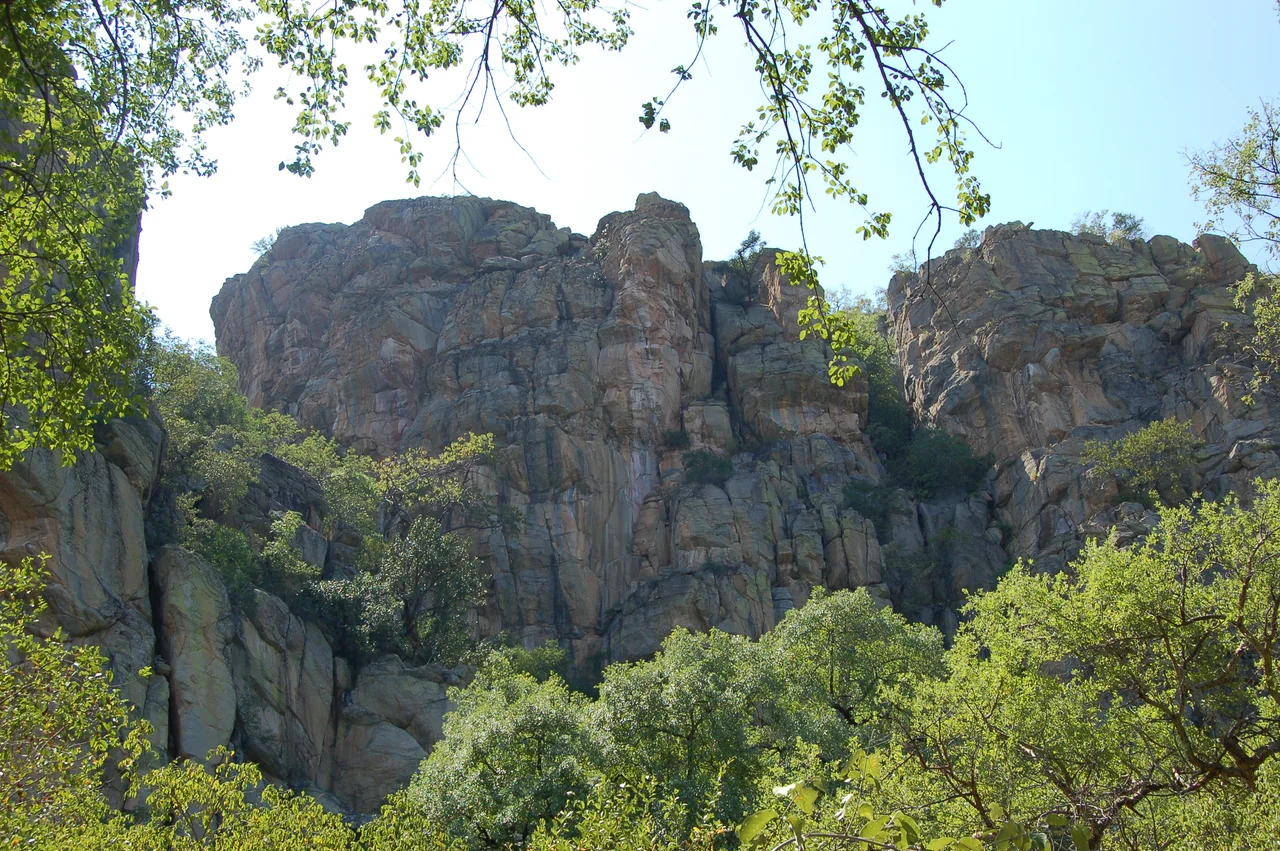
For most of the drive, the Kalahari refuses to give you anything to look at. The sand runs flat to every horizon, the bush low and grey-green, and then four bare slabs of rock heave out of the ground like the back of something half-buried. The San call them the Male, the Female, the Child, and a smaller fourth hill that legend names the Female's first wife. To the people who have lived alongside them for tens of thousands of years, these are not scenery. They are the place where the world began, and they have been answering prayers far longer than any cathedral on Earth.
The Louvre of the Desert
Across roughly ten square kilometres of quartzite, archaeologists have catalogued more than 4,500 rock paintings - one of the densest concentrations anywhere in the world. The nickname that stuck is "the Louvre of the Desert," and it fits. Red figures of eland, giraffe, rhino, and cattle run across the stone, alongside handprints and geometric marks whose meanings are still argued over. The most visited cluster is named for Laurens van der Post, the South African writer who brought the paintings to a wider audience in his 1958 book The Lost World of the Kalahari. UNESCO inscribed Tsodilo as a World Heritage Site in 2001, citing not only the art but the unbroken record of human presence written into the hills.
Where God Released the People
Two peoples hold Tsodilo sacred, and they tell different stories about it. The Hambukushu say their god lowered humans and cattle onto the earth here at the dawn of creation, and you can still be shown the footprints he supposedly left in the rock. The San regard the hills as a resting place for the spirits of their ancestors, a dwelling for the gods who govern the world from within the Female Hill. A freshwater spring near her base is treated as holy - a place to drink, but also to cleanse, to heal, and to ask for protection. People approach these hills carefully. To stand among them is to stand inside someone else's church, and the local guides will tell you so before you climb.
Reading the Stone
The science here is genuinely deep. Charcoal from the floor of Rhino Cave, on the Female Hill's northern end, shows people sheltering there at least 30,000 years ago, and some occupation evidence at the site reaches back far further still. Excavators have pulled out beads, bangles, pendants, and iron and copper tools - chisels, blades, arrowheads - layering an Iron Age industry on top of Stone Age fires. The interpretations have not always agreed. When one team proposed that a serpent-shaped rock in the cave marked the world's oldest known ritual, other archaeologists pushed back hard, arguing the dates did not line up and that older red geometric paintings nearby had been quietly ignored. That argument is part of Tsodilo's character: a place old enough, and rich enough, that even the experts cannot stop debating what it means.
Climbing the Male
The tallest of the hills, the Male, rises about 410 metres above the surrounding sand and is among the higher elevations in northern Botswana. The walk up is hot, exposed, and worth it. From the top, the Okavango's distant green is a rumour to the southeast, and the desert simplifies into pure space. There is a small museum and a campsite tucked between the two largest hills, with showers, toilets, and a graded dirt road running the forty kilometres to Shakawe. An airstrip sits near the camp for those who fly in. Most visitors come for a day; the ones who stay overnight talk about the silence, and about how the rock seems to hold the day's heat long after the sun is gone.
From the Air
Tsodilo lies at 18.77°S, 21.75°E in Botswana's Ngamiland, near the Namibian border northwest of the Okavango Delta. The four quartzite hills are unmistakable from the air - bare grey slabs erupting from otherwise featureless Kalahari sand, with the Male rising about 410 m above the surface (roughly 1,400 m above sea level). A small airstrip serves the site directly; the nearest town airfield is Shakawe Airport (ICAO FBSW), about 40 km north. Maun (ICAO FBMN) is the main regional gateway to the southeast. Best viewed in the clear, dry winter months (May-September); summer haze and dust can soften the hills against the desert floor.
Nearby Stories
- LAM Mozambique Airlines Flight 470 39 km away
- Bwabwata National Park 71 km away
- Okavango Delta 92 km away
- Tsumkwe 92 km away
- Maun, Botswana 193 km away
- Mavinga National Park 270 km away
- Upingtonia 327 km away
- New Xade 359 km away