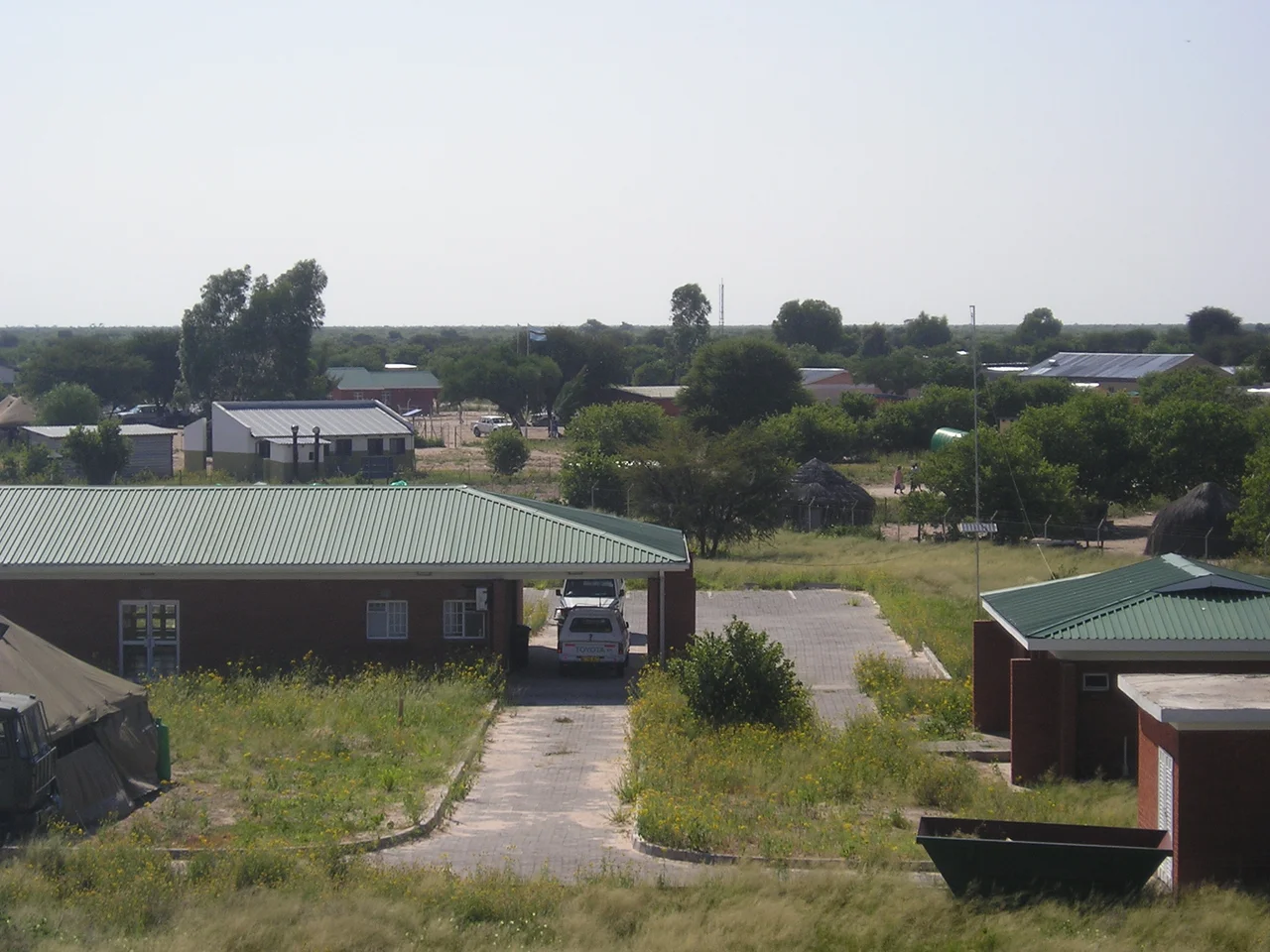

New Xade
The people who built this place chose a name for it: Kg'oesakene, which in their language means "looking for life." The government had its own name ready - New Xade - and that is the one the maps use. The gap between those two names holds the whole story. In 1997, more than 1,700 San and Bakgalagadi were moved out of the Central Kalahari Game Reserve, the desert their families had lived in for generations, and brought to a new settlement on its western edge. They did not choose to leave. The clinic, the school, and the borehole here were meant to be a gift. The land they lost was not theirs to get back.
Kg'oesakene, Looking for Life
Most of the families came from Xade, a settlement some 70 kilometers east, deep inside the reserve. The Botswana government called the move its largest resettlement program ever and justified it three ways: to protect the wildlife, to deliver healthcare and schooling more cheaply, and to bring the San into the country's mainstream. New Xade was the result - a planned village about 100 kilometers from Ghanzi, the district capital. People received plots and compensation for the huts and livestock they left behind. What they did not receive was money for the land itself, or any guarantee they could return. The G/ui and G//ana had named the place for hope. The hope was that life could begin again here, on ground chosen by someone else.
A Quarter of a People in One Village
New Xade is small, but it concentrates something rare. The G/ui (who call themselves Dcuikhoe) and the G//ana (Dxanakhoe) are among the world's least numerous peoples - together perhaps 4,000 in all of Botswana. In the early 2000s, this single settlement held roughly a quarter of them. Their languages, G/ui and G//ana, have no written form; literacy here is measured only in Setswana and English. Identity blurs at the edges, because marriage across the G/ui, G//ana, Kgalagadi, and Naro lines is common and old. Many children in the school hostel speak Naro instead, brought here after being pulled out of child labor on cattle posts and farms around Ghanzi. The village holds several peoples at once, layered and intermarried, the way the Kalahari has always mixed its families.
What the Move Changed
Between 2000 and 2001, the anthropologist Junko Maruyama lived in New Xade to document what resettlement had actually done. Her findings were not simple. Health care and wages became easier to reach. But access to the desert's own resources collapsed, and with it the way people had fed themselves. Hunting and gathering gave way to wage labor and herding. The mobile camps that had organized San life - small groups that produced and shared together, free to move when they wished - dissolved into fixed houses on assigned plots. People could no longer go where they liked, when they liked. The village gained a clinic, a craft shop, an adult-education center, even a mobile internet trailer by 2012. It lost the freedom of movement that had defined the culture for thousands of years.
The Case That Reached the High Court
Some refused to accept the move as final. Roy Sesana, a traditional healer who lives in New Xade, co-founded First People of the Kalahari and took the government to court alongside the London-based group Survival International. On 13 December 2006, Botswana's High Court ruled in the San's favor: the evictions, it found, had been unlawful and unconstitutional, and the applicants had been deprived of land they lawfully occupied. It was one of the most expensive cases in the country's history. Yet the victory has been partial at best. Critics say the government has blocked the return it was ordered to allow, withholding hunting licenses and access to boreholes inside the reserve. In 2005, Sesana received the Right Livelihood Award in recognition of the struggle — a year before the court delivered its verdict. The legal question was answered. Whether the people can truly go home is, decades on, still unsettled.
Living With Two Names
Today New Xade has the shape of an ordinary Botswanan village - tribal office, police post, primary school, the small economy of a place that exists because a government decided it should. Bakgalagadi families have moved in from Kweneng to be near relatives and to try their hand at the new opportunities. The streets work. The water runs. And still the village carries its two names, the administrative one and the hopeful one, like a person answering to a passport while remembering a childhood nickname. The G/ui and G//ana came here looking for life. What they found was survival, dignity, and an argument with their own country that no court has fully closed.
From the Air
New Xade sits at 22.12 degrees south, 22.42 degrees east, on the western fringe of the Central Kalahari, roughly 100 km east of Ghanzi. From altitude the surrounding terrain reads as endless pale scrub and fossil dunes, with the settlement's cleared grid the only geometry for miles. The nearest sealed airstrip is Ghanzi Airport (ICAO FAGZ) to the west; longer-range traffic routes via Maun (FBMN) to the north. Visibility is typically excellent over the Kalahari, though dust haze builds in the dry winter months. The land is flat enough that the village and its access roads are the primary visual landmarks.
Nearby Stories
- Kalahari Desert 82 km away
- Botswana 89 km away
- Maun, Botswana 210 km away
- Okavango Delta 273 km away
- Tsumkwe 280 km away
- Jwaneng diamond mine 309 km away
- Tsodilo 366 km away
- ǀXam and ǂKhomani Heartland 401 km away