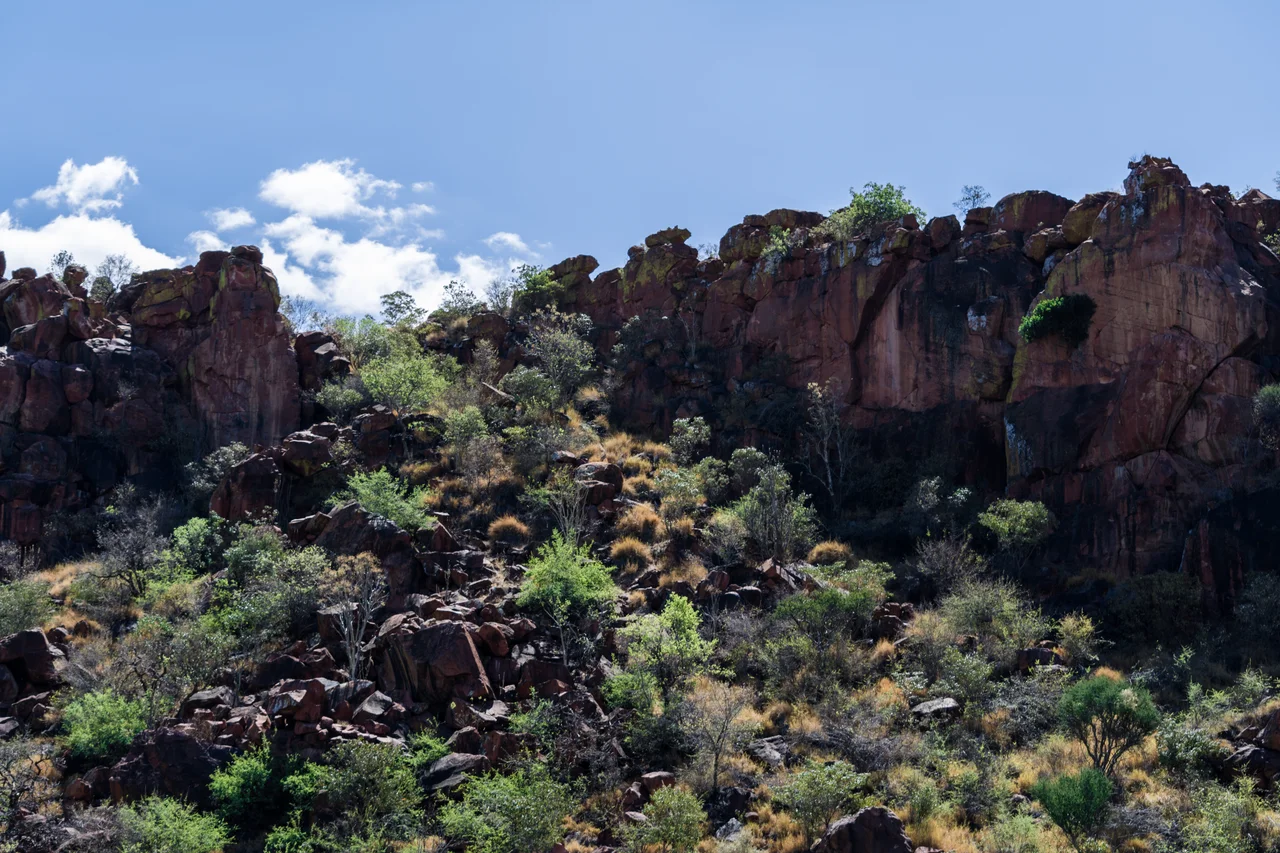

Waterberg Plateau Park
The mountain holds water the way a sponge holds it, slowly and from within. Rain that falls on the Waterberg's porous sandstone cap sinks deep, then seeps out as springs along the southeastern foot - which is exactly how the plateau earned its German name: water mountain. Those springs are why life clusters here in a country defined by thirst, and why, in a far darker chapter, tens of thousands of people once gathered below these cliffs. Today the Waterberg is a sanctuary, its flat red summit floating roughly two hundred meters above the surrounding thornbush like an island lifted out of the plain.
An Island in the Sky
Geologically, the Waterberg is a survivor - a slab of ancient sandstone left standing while the softer rock around it eroded away over millions of years. The result is a near-vertical wall of warm red stone, streaked in places with colorful lichen on its shaded northern faces, capping a plateau of green subtropical woodland that contrasts sharply with the dry acacia scrub below. The summit is its own world, hard to reach and therefore hard to disturb. That isolation is the whole point: what lives up top is largely sealed off from the dangers down below.
A Refuge Built on Purpose
The park covers roughly 40,549 hectares and was set aside deliberately as a haven for rare and endangered animals. Antelope were relocated here from across northern Namibia, and in 1989 black rhinoceros were brought in from Damaraland - a reintroduction that has since become a breeding success of real significance for a species hunted to the edge. The plateau is also a stronghold for sable and roan antelope, buffalo, and other game that struggle to survive in open, unprotected country. Hemmed in by cliffs, these populations have grown secure enough that surplus animals are now moved out to seed other reserves.
Vultures and the Living Air
More than 250 bird species move through the park, but one defines it above the rest. The Waterberg hosts Namibia's only Cape vulture colony - these enormous scavengers once bred on the cliffs of the Okarukuwisa range, and while poisoning and habitat pressure have reduced their numbers severely, the plateau remains their last regional foothold in Namibia. They ride the thermals that rise off the heated cliff faces, scanning the bushveld below for carrion. Watching a Cape vulture wheel against the red rock is to watch one of the continent's most threatened birds at the edge of its range - a quiet reminder that the plateau must protect not just animals on the ground but the ecology of the sky above it.
The Weight of the Ground
Beauty here carries history. At the foot of the Waterberg in August 1904, the Ovaherero people made their last stand against German colonial forces and were driven east into the waterless Omaheke to die of thirst - an event recognized today as one of the twentieth century's first genocides. The battlefield lies within the park's bounds, marked by memorials. Visitors who come for the rhino and the hiking walk the same ground where a nation's catastrophe unfolded. The park does not hide this. To experience the Waterberg fully is to hold both truths at once: a place of refuge, and a place of profound loss.
Walking the Plateau
Most visits begin at the Bernabe de la Bat rest camp, the gateway from which roughly ten trails fan out across the slopes. Open game-viewing vehicles head out in the cool of early morning and late afternoon, the only times the animals - and people - willingly stir, since summer temperatures climb toward 40°C before the night air turns sharply cold. For the committed, a guided four-day Waterberg Wilderness Trail crosses the summit itself, limited to a handful of hikers each week so the plateau stays as undisturbed as the rhino need it to be. Watch your food: the resident baboon troops are bold, clever, and entirely unimpressed by fences.
From the Air
Waterberg Plateau Park centers near 20.42°S, 17.22°E in Namibia's Otjozondjupa Region. From the air the plateau is unmistakable - a long, flat-topped sandstone mesa with sheer red flanks standing several hundred meters above the surrounding bush, running roughly southwest to northeast. The nearest airport is Otjiwarongo (ICAO: FYOW), about 68 km to the west by road; the small Waterberg Wilderness Airstrip serves lodges near the plateau itself. Windhoek's Eros (FYWE) and Hosea Kutako International (FYWH) lie roughly 250 km to the south. Light is best in early morning or late afternoon, when low sun deepens the red of the cliffs and long shadows reveal the plateau's relief. Skies are typically clear and visibility excellent in the dry season (May-October).
Nearby Stories
- Battle of Otavi 69 km away
- Hoba Meteorite 79 km away
- Dragon's Breath Cave 114 km away
- Leopard Cave, Namibia 136 km away
- Okahandja 139 km away
- Etosha National Park 161 km away
- Brandberg 191 km away
- Kalahari Desert 521 km away