
Battle of Waterberg
They came to the springs because the water was there. Tens of thousands of Ovaherero - mothers, grandfathers, children, herders with their cattle - gathered in the broken country below the Waterberg's red sandstone wall, waiting through the heat of June and July for the peace they had been led to expect. They did not know that the man now commanding the German troops had no intention of making peace. Lieutenant General Lothar von Trotha had been sent from Berlin for one purpose: to crush the Ovaherero with a single, annihilating blow. On the morning of 11 August 1904, the trap closed.
The People at the Springs
The Ovaherero were a cattle-keeping people whose wealth and identity were bound to their herds. When German settlers seized their land and cattle, levied debts, and met resistance with violence, the Ovaherero rose in 1904 under their paramount chief, Samuel Maharero. By that August perhaps 60,000 people - an entire society, not an army - had concentrated near the plateau, their cattle grazing the last of the meager grass. They had won early skirmishes. They expected negotiation. The German governor who had favored talks, Theodor Leutwein, had already been pushed aside. In his place stood a commander chosen precisely because he would not negotiate.
The Day the Trap Opened
Von Trotha had spent nearly three months hauling soldiers, artillery, and supplies a hundred kilometers by ox-cart to surround the plateau. His plan was to seal the Ovaherero inside a ring of six columns and destroy them where they stood. Against roughly 1,500 German troops with thirty cannon and fourteen Maxim machine guns, the Ovaherero had rifles and courage but no answer to belt-fed fire. Yet the encirclement failed. The southeastern column never reached its position, and through that unguarded gap the people streamed - eastward, away from the guns, into the one direction that offered no refuge: the waterless Omaheke.
Into the Omaheke
The German victory was, in military terms, incomplete. The Ovaherero had escaped the field. But von Trotha understood that the desert could finish what his columns had not. He ordered his men to pursue the survivors and to hold the rim of the Omaheke, poisoning or guarding the waterholes so that no one could return. Families walked into the sand searching for water that was not there. German patrols later found the dead clustered around pits dug eight to sixteen meters deep - holes scratched into the earth by people dying of thirst. This was not the chaos of battle. It was a method.
The Order to Erase a Nation
On 2 October 1904, von Trotha put the policy into words. His extermination order declared that any Ovaherero found within the colony's borders, armed or unarmed, with cattle or without, would be shot. Those who tried to surrender were killed. Berlin eventually countermanded the order, but by then the harm was done, and the survivors who were captured were sent to the concentration camp at Shark Island, where many more died. Of an estimated population of tens of thousands, the great majority perished - in the desert, in the camps, of thirst and hunger and disease. Historians count the dead of the wider campaign against the Ovaherero and Nama in the range of fifty thousand and more. It is recognized today as one of the first genocides of the twentieth century.
What Is Remembered Here
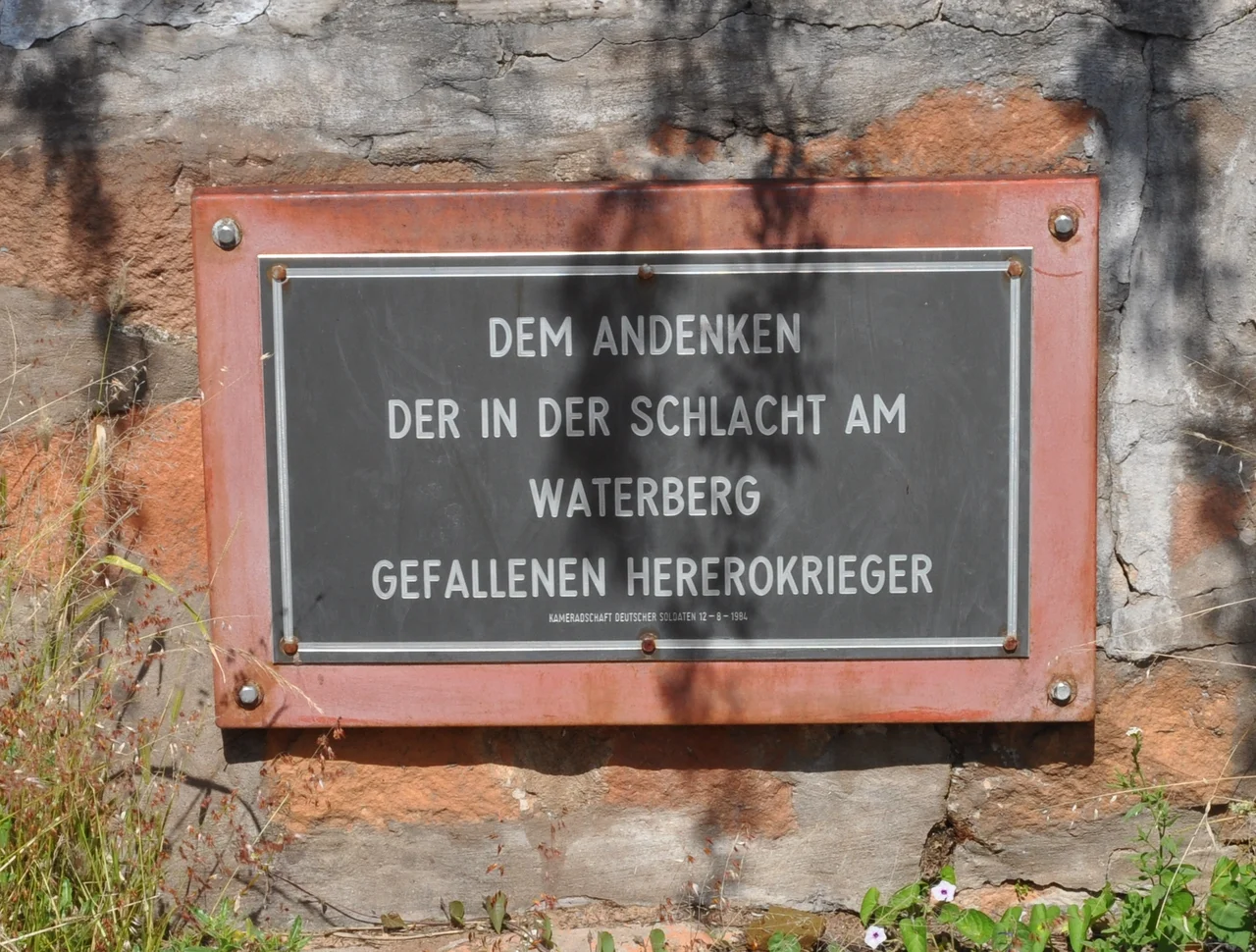
Samuel Maharero and about a thousand followers fought their way across the Kalahari into British-held Bechuanaland (now Botswana) and survived in exile. The battlefield now lies inside Waterberg Plateau Park, a place of antelope and birdsong. Two memorials stand near each other in uneasy company: a graveyard for the German soldiers who fell, and a stone raised to the Ovaherero who died here and in the desert beyond. In 2021 the German government acknowledged the killings as genocide and pledged development aid, while many Ovaherero and Nama descendants rejected the deal for excluding them from the table and avoiding the word reparations. The reckoning, more than a century on, is not finished. The springs still run. The land remembers what was done to the people who came here for water.
From the Air
The Waterberg Plateau rises near 20.48°S, 17.31°E in central Namibia's Otjozondjupa Region - a long, flat-topped sandstone massif standing abruptly above the surrounding thornbush, unmistakable from the air and visible for many kilometers in clear weather. The Omaheke (the sand-veld merging into the Kalahari) stretches away to the east, the direction the Ovaherero were driven. The nearest field is Otjiwarongo Airport (ICAO: FYOW), about 60-70 km to the west; the small Waterberg Wilderness Airstrip lies closer to the plateau itself. Windhoek's Eros Airport (FYWE) and Hosea Kutako International (FYWH) lie roughly 250-280 km to the south. Best light is the low sun of early morning or late afternoon, when the cliff face glows deep red. Approach this airspace with the gravity the ground beneath it deserves.
Nearby Stories
- Battle of Otavi 63 km away
- Hoba Meteorite 69 km away
- Upingtonia 103 km away
- German South West Africa 146 km away
- Gross Barmen 152 km away
- Etosha National Park 171 km away
- Leopard Cave, Namibia 183 km away
- New Xade 489 km away